A plush toy quotation is more than a unit price. This guide walks through each line of a quote—tooling, fabric, size, MOQ, packaging, certification, carton packing, and freight terms—so you can compare two offers fairly and judge the real cost before you commit.
Key takeaways
- A plush quote is not a single number. It has separate lines for unit price, tooling, materials, size, MOQ, packaging, certification, carton packing, and freight terms.
- Two quotes with the same unit price can still differ significantly once tooling, packaging, and freight are included.
- Ask for every line to be itemized and tied to a specification so you can compare like with like.
How much do plushies cost? The short answer
There is no single price for a plush toy. What a supplier quotes depends on the size, fabric, filling, construction, accessories, packaging, order quantity, and compliance requirements you specify. That is why two quotes for the “same” plush can land far apart—they are rarely quoting the same product.
The practical way to answer “how much do plushies cost” is to read a real quotation line by line. When you understand what each line covers, you can see where a cheaper quote has cut something out, and where a higher quote is delivering more. This guide walks through the lines a professional plush quotation should contain, using a typical OEM/ODM custom plush order as the example.
Line 1: Unit price and what it actually includes
The unit price is the number buyers look at first, but it only makes sense when it is tied to a specification. A quote for a custom plush stuffed animal at 20 cm is not comparable to one at 60 cm, even if both are “plush stuffed animals.”
When you read the unit price line, check that it states:
- The exact size (for example, 20–60 cm range or a fixed size within it).
- The fabric type and filling (soft plush fabric with hypoallergenic filling, for example).
- Whether accessories—embroidered eyes, printed details, added garments—are included or priced separately.
- The quantity tier the price applies to. Unit price usually drops as quantity rises, so a price without a quantity is not a price you can use.
If the quote shows only a number and a size, ask for the specification behind it. A supplier who cannot itemize is either working from a template or expects you to accept whatever matches the price.
Line 2: Tooling and setup charges
Custom plush requires patterns, samples, and production setup. These costs are often quoted separately as a one-time tooling or setup charge. The line should say what the charge covers—pattern making, sample production, printing plates for packaging, or embroidery programming—and whether it is refundable against a production order.
Tooling is where quotes often hide differences. One supplier may quote a lower unit price but charge a separate setup fee that another supplier has absorbed. Compare the total first-order cost, not just the unit price.
Line 3: Fabric and filling specification
Plush fabric and filling are the largest material cost drivers. A quote should name the fabric (for example, soft plush), the filling (for example, hypoallergenic filling), and any construction details such as durable stitching. If the line just says “plush fabric,” you cannot tell whether you are comparing the same material.
Ask for the fabric and filling to be stated in the quote itself. If a supplier offers alternatives at different prices, have them quoted as separate lines so you can see the cost of each upgrade.
Line 4: Size and dimensional tolerance
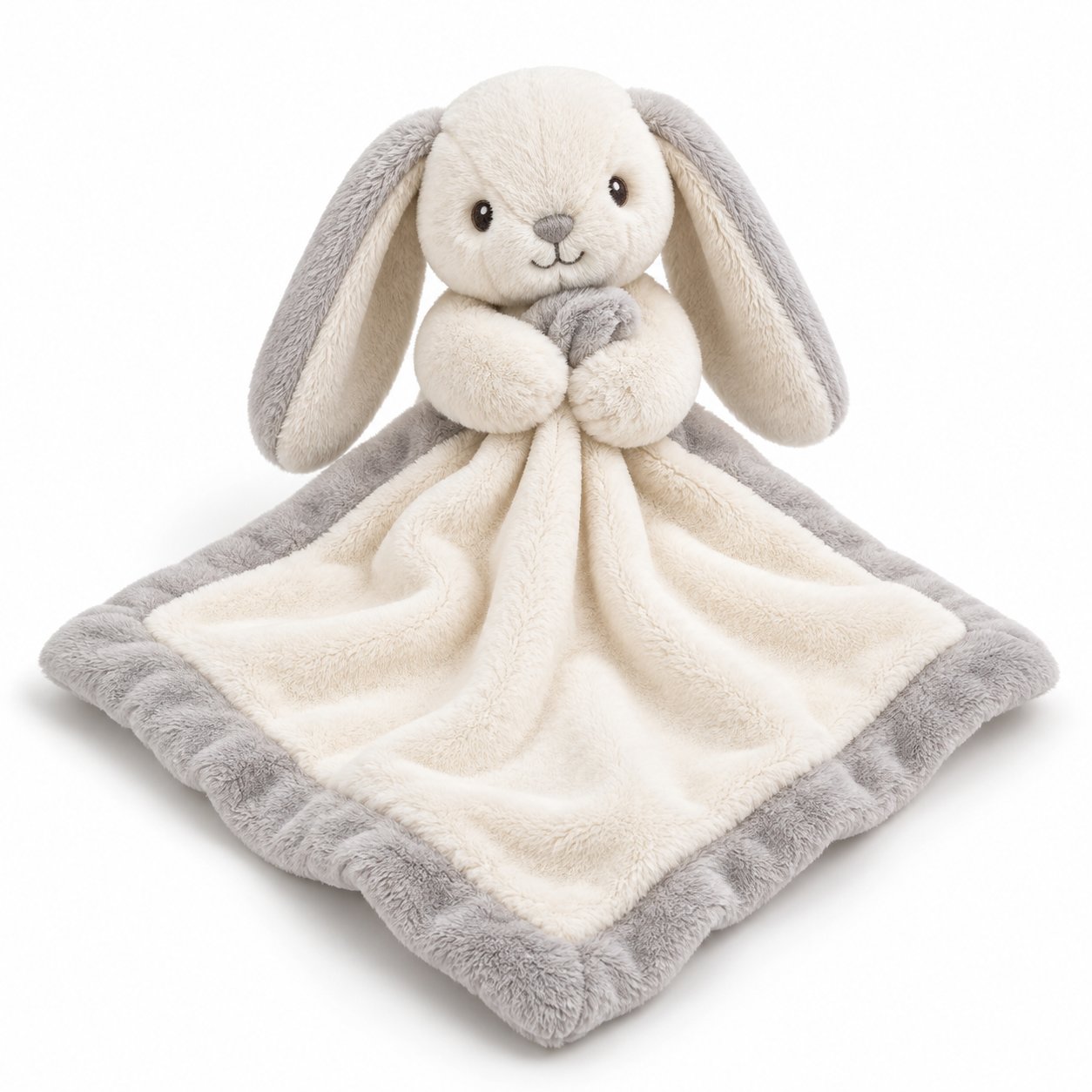
Size affects fabric consumption, filling volume, and packaging. A quote should state the size clearly—either a fixed dimension or the range the supplier can produce, such as 20–60 cm for a custom stuffed animal. For sets that combine a blanket and a toy, both dimensions matter: a plush baby comforter blanket set pairs a 30 x 30 cm blanket with a 15 cm matching toy, and the quote should reflect both components.
If the size line is vague, ask for the measured dimensions the supplier will produce against. Nominal size is a designation; the measured dimensions are what your retail buyer will check.
Line 5: MOQ and price breaks
Minimum order quantity (MOQ) is a commercial term, but it directly affects cost. A quote may offer one price at the MOQ and lower prices at higher tiers. The line should state the MOQ clearly and list any price breaks.
For reference, Lequ Toys quotes a MOQ of 1,000 pieces for custom plush stuffed animals and 1,000 sets for the plush baby comforter blanket set. If a quote shows a much lower MOQ, confirm whether the price still holds at that quantity or whether a small-order surcharge applies.
Line 6: Packaging
Packaging is frequently underestimated. A quote should specify the retail packaging (poly bag, gift box, hang tag, header card) and whether it is included in the unit price or charged separately. For the comforter set, the quote should note the gift box and the export carton, with 48 sets per carton.
If your program requires custom printed packaging, ask for that as a separate line so you can see the cost of the print run, plates, and minimum packaging quantity.
Line 7: Certification and testing
North American and European buyers need compliance documentation. A quote should state which standards the product will be tested to—for example, EN71 for Europe and ASTM F963 for the US—and whether testing costs are included or billed separately.
Ask for the test report to reference the exact product and specification being quoted. A generic certificate for a different product does not cover your order.
Line 8: Carton packing and shipping terms
The carton line covers how many units go into each export carton, the carton dimensions and weight, and whether the price is ex-works, FOB, or another Incoterm. These details determine your landed cost and should appear in the quote, not be left to a later email.
For the comforter set, the quote lists 48 sets per carton. For a custom stuffed animal, ask for the carton quantity at your chosen size, because the same product at 20 cm and 60 cm will pack very differently.
How to compare two plush quotes fairly: a checklist
When two quotes arrive, put them side by side and check each line against the same specification. Use this checklist:
| Quote line | What to confirm on both quotes |
|---|---|
| Unit price | Same size, fabric, filling, accessories, and quantity tier. |
| Tooling / setup | Same scope; refundable or not; included in total cost comparison. |
| Fabric and filling | Same material names and construction details. |
| Size | Same measured dimensions, not just nominal size. |
| MOQ | Same quantity and price breaks. |
| Packaging | Same retail packaging and whether it is included. |
| Certification | Same standards, same product, testing included or not. |
| Carton packing | Same units per carton and carton dimensions. |
| Freight terms | Same Incoterm and port; compare total landed cost. |
If a line is missing from one quote, ask for it before comparing. A quote without a packaging or certification line is not cheaper—it is incomplete.
Next step: request a line-item quote
To get a quote you can actually compare, send the supplier your specification: product type, size, fabric and filling preference, accessories, packaging requirement, target quantity, and destination market. Ask for each line above to be itemized separately.
At Lequ Toys, we quote OEM/ODM plush projects line by line, including tooling, materials, MOQ, packaging, certification, and carton packing. If you are planning a custom plush program for North America or Europe, share your specification and we will return a quote structured for comparison.