A board-puzzle-specific cleaning and maintenance procedure for parents, preschool operators and importers. It covers raised pegs, engraved surfaces and painted finishes, explains the failure modes generic toy-cleaning advice misses, and gives buyers the questions to ask before specifying a wooden puzzle for a classroom or retail program.
Wooden puzzle care and maintenance
Raised number pegs, engraved centres and painted faces each react differently to water, cloth and pressure. That is why the advice for wiping down classroom blocks does not transfer cleanly to a peg puzzle — and why importers evaluating a puzzle line should read the cleaning routine before they read the price.
Key takeaways
- Wooden board puzzles have three distinct surfaces — smooth board, engraved recess, painted face — and each needs different handling.
- Never soak, submerge or leave a board puzzle wet; water enters end grain, peg holes and engraved cuts.
- Use a barely damp cloth, not a running one, and dry every surface fully before storage.
- Cleanability is a selection criterion. Ask a supplier how the finish is applied and how recesses are cut before you commit to a classroom or retail program.
In this article
Why board puzzles need their own cleaning routine
A peg puzzle is not one piece of wood. It is several pieces with different finish conditions, and cleaning advice written for smooth block sets does not account for that.
The board is usually a flat slab. Its face may be painted or printed, its edges may be bare or sealed, and it carries holes or recesses for each piece. Even if you cannot see them, end-grain surfaces inside those cut-outs absorb water quickly, and they do not dry as fast as a flat face.
The pieces vary. A number piece in a counting puzzle may have an engraved numeral or a painted face, and a fixed peg for small hands. Engraving creates fine cuts where moisture and debris collect. Paint sits on top of the wood, so it can be dulled by abrasion, softened by prolonged wetness, or chipped by knocking pieces together.
The pegs take the most handling. A young child grips the peg, so it collects the most oil and residue — and a peg glued into a piece is a joint that will not benefit from being soaked.
Generic wooden-toy advice often says “wipe with a damp cloth.” That is directionally right. The missing parts are exactly the things that separate a well-made peg puzzle from a set that fails after a term of classroom use: what the cloth should touch, how clean is clean enough, and how the piece is dried before it goes back in the box.
A step-by-step cleaning procedure
This is a routine, not a specification. Where a manufacturer supplies its own care instructions, follow those. What follows is practical handling for a painted, engraved, pegged wooden board puzzle.
1. Remove every piece first
Lift out all the pieces before the cloth touches the board. This lets you clean each recess properly and check the board for stains hidden under a piece. Count the pieces back in as you finish — losing a number piece means the puzzle no longer works as a counting tool.
2. Work with a barely damp cloth
Wring the cloth out until it will not release water when pressed. Wipe faces, edges and pegs with light, even pressure. The aim is to lift dust, fingerprints and food residue — not to sanitise by saturation. Too much water is the single most common way a wooden puzzle is ruined: it swells the wood into cut-outs and joints, softens the paint bond and takes far longer to dry than a dry wipe would have taken.
3. Clean engraving and recesses with a soft brush
Fine engraved numerals and shallow recesses collect dust and crumbs that a cloth skates over. Use a soft brush — a clean dry paintbrush works well — to loosen debris out of the cuts. If a recess needs more than loose dust, a lightly dampened cotton swab lets you target it without flooding the surrounding paint.
4. Dry fully before anything goes back
Stand the pieces on edge, or lay them out separately, where air can reach both faces and the peg holes. Do not stack them wet and do not return them to a closed box while any surface feels cool or damp. Wood dries from the outside in, and a puzzle that looks dry can still be holding moisture in a cut-out or around a peg.
5. Clean at the right frequency
Dust and wipe after heavy use, and do a fuller clean when you can see residue — for example, after a child has handled the pieces with sticky hands. Routine daily wiping is more wear on the finish than the puzzle needs. Frequent wetting does more damage to paint than occasional cleaning will prevent.
What goes wrong, and what to do about it
| Symptom | Usual cause | Practical response |
|---|---|---|
| Paint looks dull or chalky on raised areas | Abrasive cloth, scouring pad or repeated wiping | Switch to a soft cloth, reduce wiping pressure, accept light patina on older puzzles |
| Edges feel rough or split after cleaning | Water penetrating cut edges and end grain | Damp-wipe only; dry fully before storage; stop submerging or soaking |
| Engraved numerals clogged with residue | Cloth skipped the recess; debris worked into the cut | Loosen with a soft dry brush first, then target with a lightly dampened swab |
| Pieces feel loose or the peg wobbles | Repeated wetting at a glued joint | Keep moisture off the peg area; retire the piece if it becomes a choking risk |
| Mouldy smell or dark spots in the box | Pieces stored before fully dry | Discard affected pieces; review drying practice for the whole set |
Two of these are worth treating as a stop signal rather than a cleaning problem. A peg that has come loose, and any piece that has cracked or splintered, is a physical hazard for a child under three. Since a damaged piece cannot be cleaned back to safe condition, replacement is the answer.
This is also where the finish quality shows. A well-bonded water-based paint on a properly prepared wood surface holds up to careful wiping; a poor one will lift or flake at the first sign of moisture. No cleaning routine fixes that. It is a manufacturing property, and it is one reason to assess a puzzle supplier on finish as well as appearance.
Building a routine for a classroom or a household
In a nursery or preschool, puzzles pass through many hands in a day, and cleaning becomes a schedule rather than an occasional task. The practical approach is to keep the routine short enough that staff actually follow it:
- End of session: count the pieces back in, wipe obvious residue with a barely damp cloth, air-dry the pieces before closing the box.
- Weekly: brush out engraved recesses and check the board for stains under pieces.
- Periodically: inspect every piece for cracks, loose pegs and lifted paint, and remove any piece that fails.
For a household, the stakes are lower but the same rules apply: wipe, do not soak; brush out the engraving; dry fully before the puzzle goes back on the shelf. The main risk at home is over-cleaning — a well-meant scrub with a wet cloth that shortens the finish's life for no real hygiene gain.
One honest limitation: wooden puzzles are a cleaning problem the moment liquid is involved. If your setting requires frequent wet sanitising of every toy, a painted wooden board puzzle is the wrong material for that job, and no amount of care advice changes it. This is a material property, not a defect.
For importers: cleanability as a product-selection criterion
Buyers evaluating wooden puzzles for a retail line or an institutional customer are not only comparing price per set. They are judging whether the puzzle will still look presentable and be safe to handle after a year of use — and cleaning practice is part of that judgment.
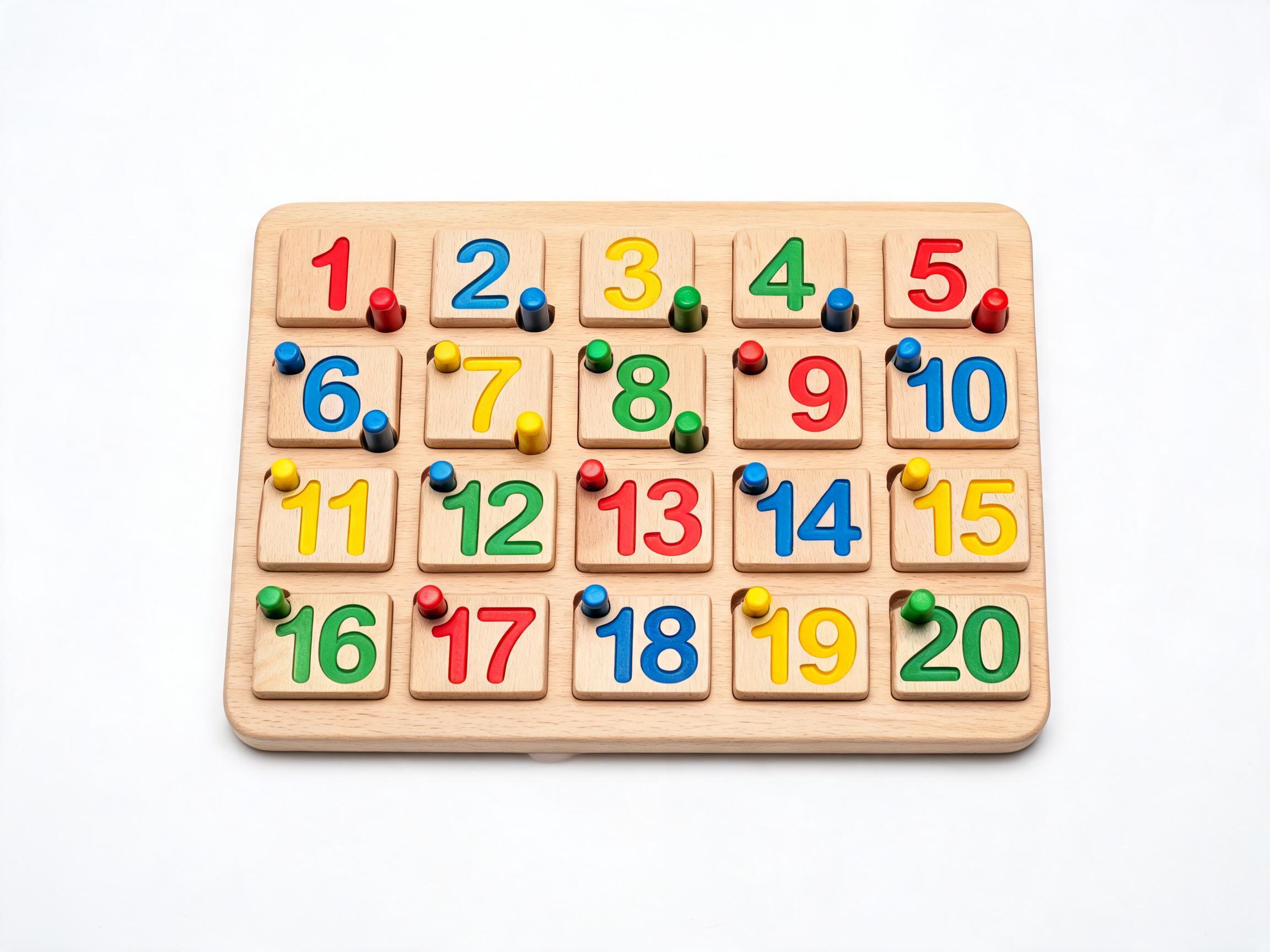
Take the Wooden Number Puzzle Board as a concrete example of how the specification maps onto the advice above. It is a 20-piece board with coloured counting pegs, solid wood construction and non-toxic water-based paint, recommended for age 3+. The minimum order quantity is 500 sets.
Those listed facts tell you what kind of cleaning routine applies. The pegs mean the pieces are handled at a single point, so peg joints and peg surfaces see the most wear. The engraved or painted number faces mean recess cleaning matters. The water-based paint is the finish this article is written to protect. The 20 pieces need counting in and out, and the age 3+ recommendation sets the handling expectations — a peg designed for a three-year-old's grip is also the part most exposed to repeated wiping.
When you compare suppliers on this basis, ask questions the catalog page cannot answer for you:
- How is the paint applied, and is the wood face prepared before painting?
- Are the number recesses engraved into the wood or printed on the surface? Engraved recesses hold debris; printed faces are more exposed to abrasion.
- How are the pegs fixed, and what does the supplier say about the joint's tolerance for moisture?
- What care instructions does the supplier provide with the product, and are they available in the languages your market requires?
- Can you obtain sample pieces for your own handling and cleaning trial before committing to 500 sets?
These are the questions that turn cleanability from an assumption into a checkable property. The answer that matters is not whether a supplier says the puzzle is “easy to clean” — everyone says that — but whether the finish, the recesses and the pegs are built so that the routine above actually works on the product. If you are assessing a puzzle for a classroom program or a retail range, handle a sample, clean it the way your end user will, and look at the result before you place the order.
FAQ
Can wooden puzzles be disinfected with a spray or wipe?
That depends on the disinfectant and the finish, and it is a question for the manufacturer, not a general rule. What you should avoid is any method that leaves the board or pieces wet. Surface sprays with high liquid content and leave-on wet time are the risk. If an institutional setting requires a validated disinfection procedure, confirm with the supplier that their finish tolerates it, or use a material that is designed for it.
Do I need to oil a painted wooden puzzle?
No. Oiling is a treatment for bare wood. On a painted or printed face, oil sits on the surface and can darken or soften the finish. The routine for a painted puzzle is wipe, brush out recesses, dry fully.
What should I do if a piece gets dropped in water?
Take it out immediately, blot it, and let it dry flat and separate from the rest of the set, with air reaching both faces. Do not put it near direct heat or a radiator, which can warp wood or crack paint. Check it once dry for a swollen shape, lifted paint or a loose peg before returning it to the puzzle.
Is cleaning a wooden puzzle with a damp cloth enough for a shared classroom set?
A damp wipe removes visible soil but is not a validated hygiene procedure. Whether it meets your setting's requirements is a question for your own hygiene policy. What this article can say is that wetting the puzzle more heavily to compensate carries a real cost to the finish and the joints.