
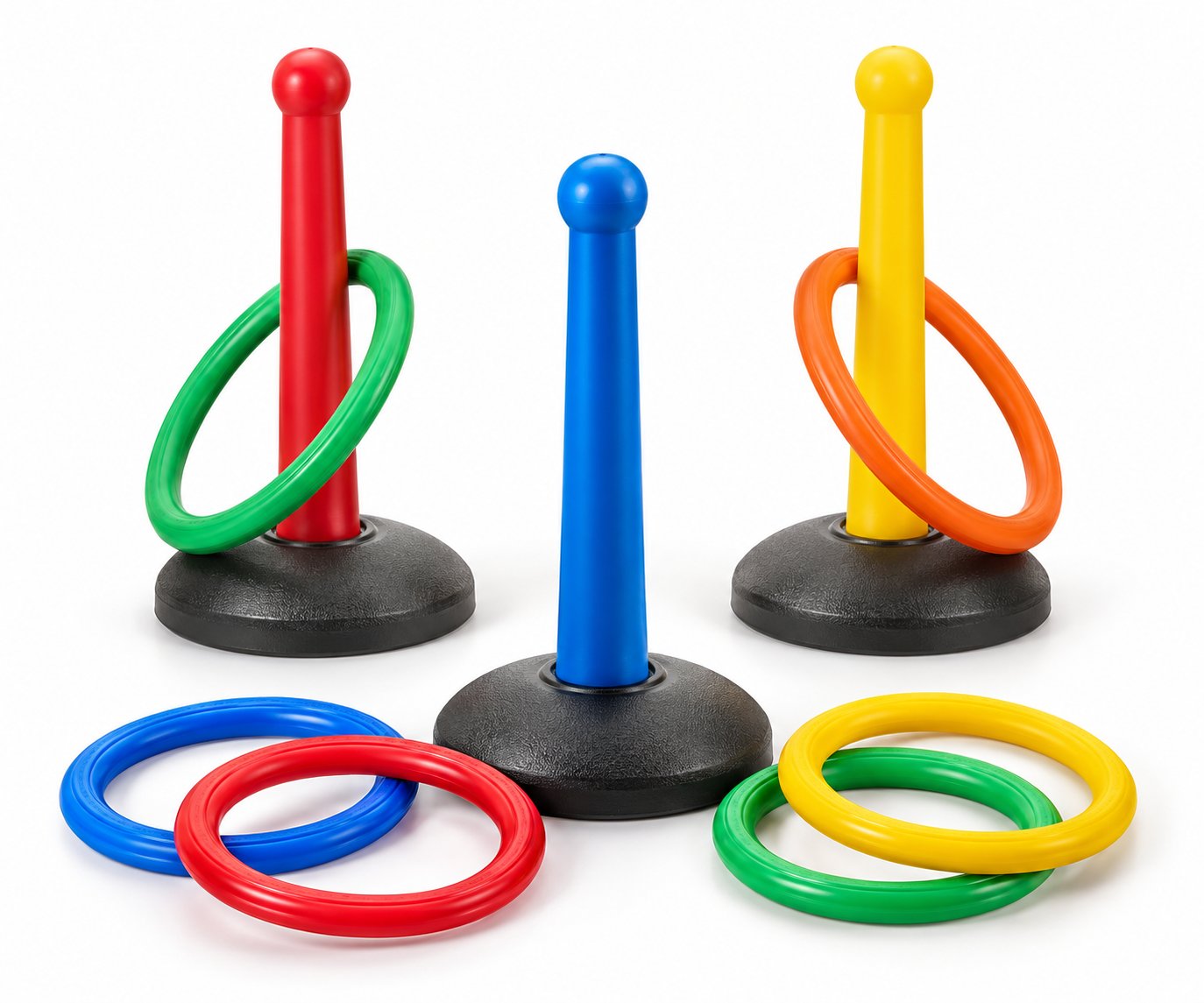
A practical guide to playing ring toss—ring-to-post distances by age, scoring variants, surface preparation, and the construction details that make a set hold up in playgrounds and retail. Includes B2B buying checks for schools, distributors, and retailers.
Playground & retail how-to
Ring toss looks simple until you set it up for a group of mixed-age children or a busy retail display. This guide covers the rules, the ring-to-post spacing that keeps the game fair for different ages, surface preparation, scoring options, and the construction details that decide whether a set survives a full season.
What you need before the first throw
The Ring Toss Garden Game Set from Lequ Wanwan includes six rings and three weighted posts. The posts are 45 cm tall with rounded tops, and each ring is 18 cm in diameter, moulded from flexible plastic that returns to shape after bending. The posts push into grass or sand without tools. The set is rated for ages 3 and up and is available at a MOQ of 500 sets, packed in a mesh carry bag with 24 sets per export carton.
Before play, check three things:
- Ground is soft enough for the post base to seat firmly—grass or sand is ideal; compacted dirt or hard surfaces may need a different anchoring plan.
- All six rings are accounted for and free of tears or sharp edges.
- Players understand the throwing line and which post is the target.
Ring toss rules that work for mixed groups
There is no single official rulebook, which is why school and playground buyers often ask for a version that is easy to explain and repeat. The basic format: players stand behind a throwing line and take turns tossing rings at the posts. A ring that lands around a post scores. A ring that bounces off or lands flat on the ground does not score. First player or team to a set number of points wins.
Three common scoring variants are worth knowing:
| Variant | How it works | Best for |
|---|---|---|
| Single-post count | Each ring around the post scores one point; first to five wins. | Young children, quick recess games. |
| Nearest-post scoring | Posts are placed at different distances; closer posts are worth more points (for example, 1 point for the nearest post, 3 points for the farthest). | Older children and family events. |
| Team relay | Two teams alternate throws; total rings on posts after a set number of rounds decides the winner. | PE classes, parties, retail demo events. |
These are optional rule variants, not fixed point values from the product specification. Choose the version that matches the age and attention span of the group.
Spacing: how far apart to set the throwing line and posts
Distance is the single biggest factor in whether ring toss feels fair or frustrating. The right spacing depends on age and arm strength. The product does not publish fixed distances, so use the ranges below as starting points and adjust after a few test throws.
| Age group | Suggested ring-to-post distance | Notes |
|---|---|---|
| Ages 3–5 | 1–1.5 m | Close enough for a successful throw; focus on fun, not competition. |
| Ages 6–8 | 1.5–2.5 m | Introduce simple scoring; keep the throwing line visible. |
| Ages 9–12 | 2.5–3.5 m | Can handle farther posts and team play. |
| Teens and adults | 3.5–5 m | Longer distances reward technique; check that the post base stays seated. |
For playgrounds and retail demo areas, mark the throwing line with a cone or tape so the distance stays consistent between groups. If the set will be used by mixed ages, set the posts at staggered distances and let each player choose a post that matches their age—this is the same idea behind the nearest-post scoring variant above.
Set-up on different surfaces
The posts push into grass or sand without tools, so the surface matters more than the assembly. On grass, push each post until the base is flush with the ground; if the grass is dry and hard, water the spot lightly or choose a softer patch. On sand, push the post deeper to compensate for loose grains. On hard surfaces such as playground rubber or concrete, the post will not self-anchor—plan for a base or move the game to a soft area.
For retail displays, set the posts in a small sand tray or a weighted base so customers can try a throw without a lawn. Keep the display area clear of other products by at least the throwing distance you choose.
Construction details that make the game repeatable
A ring toss set lives or dies on two failure points: rings that crack and posts that tip. The Lequ Wanwan set addresses these in two specific ways. The rings are moulded from flexible plastic that returns to shape after bending, which matters when rings are stepped on, sat on, or thrown against a wall. The posts have rounded tops to reduce snagging—this matters when rings are pulled off in a hurry and when the set is packed away with the rings still on the posts.
For schools and playgrounds, check these details before you commit to a supplier:
- Ring material: flexible plastic that recovers its shape, not rigid plastic that cracks.
- Post top: rounded, with no sharp edges that catch rings or fingers.
- Post base: able to seat in grass or sand without tools.
- Age rating: 3+ matches the intended user group.
- Compliance: EN71 and ASTM F963 for the target market.
Lequ Wanwan is a B2B toy manufacturer and exporter based in Fujian, China, serving North American and European buyers; the Ring Toss Garden Game Set described in this guide is EN71 and ASTM F963 compliant, and compliance documents for the specific product can be provided on request. OEM/ODM is available for buyers who need custom colors or packaging.
Buying checks for schools, retailers, and distributors
For B2B buyers, the play experience is only half the decision. The other half is whether the set can be stored, restocked, and replaced without friction. The set packs into a mesh carry bag, and export cartons hold 24 sets. Confirm the carton dimensions and weight with the supplier before booking freight, since those figures affect container planning.
Ask for a sample set and run a short wear test: bend each ring several times, push each post into grass and sand, and pack the set back into the bag. If the rings return to shape and the posts stay upright after a few throws, the construction is doing its job. For retail, check that the mesh bag displays well on a shelf and that the packaging carries the age rating and compliance marks required in your market.
Frequently asked questions
How many players can play ring toss at once?
The set includes six rings and three posts, so it suits two to six players taking turns. Larger groups can rotate in teams.
Can ring toss be played indoors?
The posts are designed to push into grass or sand. Indoors, use a sand tray or weighted base to hold the posts upright, and keep the throwing area clear.
What age is ring toss suitable for?
The set is rated for ages 3 and up. For children under 6, shorten the throwing distance and focus on play rather than scoring.
How should the set be stored?
Pack the rings and posts into the mesh carry bag after play. Check the rings periodically for tears and replace any that no longer return to shape.
Lequ Wanwan supplies the Ring Toss Garden Game Set at a MOQ of 500 sets, with EN71 and ASTM F963 compliance and OEM/ODM options. Contact the team with your target market and quantity to request a sample and confirm carton details.


