
Toy safety is not a certificate you hang on a wall — it is a sequence of in-house lab checks, sample retention, and third-party handoffs that happen before a shipment leaves the factory. This article walks through that process from a manufacturer's workflow perspective and gives importers a checklist of documents to request per item and per shipment, with clear boundaries on what company-level ISO 9001:2015, EN71 and ASTM F963 certificates do and do not cover.
Factory process · Buyer checklist
Most articles about toy safety testing explain what EN71 or ASTM F963 require. This one covers a different question: what actually happens to a toy between the production line and the container, and what documentation an importer should ask for at each stage.
The short answer is that safety work at the factory is a sequence, not a single event. In-house QC runs checks that catch problems before a batch is finished. Samples are retained so a question raised later can be traced back to a physical unit. And third-party laboratory testing is arranged per item or per shipment, because a company-level certificate does not certify every product that leaves the building.
Key takeaways
- In-house QC lab testing and third-party laboratory testing answer different questions. Importers need evidence of both, not one in place of the other.
- ISO 9001:2015, EN71 and ASTM F963 certificates held at company level describe the management system and the standards the factory works to. They are not product-specific test reports.
- For every item and every shipment, ask for the product-specific test report, its scope, and the retained sample record.
- Request documents by item and by date. A certificate with no product reference does not close a compliance file.
In this article
Where safety testing sits in the production flow
A toy does not get tested once at the end. Safety-relevant checks are distributed across the flow because the earlier a problem is found, the cheaper it is to correct. The general sequence at a factory that runs its own QC laboratory looks like this:
- Incoming material checks. Wood, paint, hardware and packaging are examined against the buyer's specification before they enter production. A non-conforming material is easier to reject at the gate than to detect inside a finished toy.
- In-process checks. As parts are cut, sanded, assembled and finished, QC inspects dimensions, surface condition, assembly integrity and finish consistency at defined points on the line.
- In-house laboratory checks. The QC lab tests samples against the parameters the factory controls — the routine checks described in the next section.
- Third-party laboratory testing. For the standards the buyer requires, samples are sent to an accredited external laboratory, and the report is issued to the buyer's file.
- Pre-shipment inspection and sample retention. Before packing, a final inspection confirms the batch matches the approved sample, and units are retained for traceability.
The important point for an importer is that steps 1 to 4 are not equivalent. In-house checks are fast, repeated and under the factory's control. Third-party reports are independent but slower and tied to the specific sample submitted. A compliant shipment usually involves both, and the buyer should be able to see evidence of both.
What the in-house QC laboratory does
An in-house QC laboratory does not replace an accredited third-party lab, and it should not be presented as doing so. Its job is to catch deviations early and to give the factory a routine measurement signal on every batch.
In practice, an in-house lab checks parameters the factory can measure directly and repeatably: dimensional accuracy against the approved drawing, surface and finish quality, color consistency against the approved standard, assembly integrity such as joints and fasteners, and packaging and labeling correctness. These are production-control checks. They tell the factory whether a batch is being built to the approved specification.
Safety-relevant characteristics — a small part that could detach, a sharp edge, a finish defect — are also caught in-process and in the lab, but the formal statement of conformity comes from the third-party test against the applicable standard. Buyers should treat the two kinds of evidence as complementary: the in-house lab shows the factory is controlling the process; the third-party report shows the submitted sample met the standard.
At Lequ Toys, the company operates its own QC laboratory, and the in-house QC and engineering teams are part of a 180-person staff. That staffing is relevant to buyers because it means QC and engineering sit inside the production organization rather than being outsourced — checks can be scheduled around the line, and a problem found in the lab can be routed to engineering the same day.
Sample retention and traceability
Sample retention is the part of the safety process buyers ask about least and rely on most when something goes wrong. The factory keeps physical units from approved and shipped batches so that a later question — a customer complaint, a regulatory inquiry, a dispute about what was actually produced — can be answered by examining an actual unit rather than a description of one.
Retention also anchors the relationship between the approved sample and the production batch. When a buyer approves a pre-production sample and the factory retains units from each subsequent batch, the two can be compared. If a finish, a color or a component changes between approval and shipment, the comparison surfaces it.
For importers, the practical question is not whether the factory retains samples, but whether the retained sample can be tied to a specific purchase order and date. Ask how samples are labeled and how long they are kept. A retention system that cannot link a sample to an order does not support traceability.
The third-party laboratory handoff
Third-party testing is a handoff, and most of the risk for a buyer sits at the boundaries of that handoff.
The factory selects or prepares samples, ships them to the laboratory, and receives a report. The report is issued for the sample submitted and the test scope requested. It does not automatically cover a different colorway, a different size, a revised component or a later production batch. This is why the buyer should specify the standard required, the item and variant to be tested, and whether the report must be issued before shipment.
What to agree before samples go out
- The standard and version the report must reference — for example EN71 or ASTM F963 — and whether any additional market-specific requirements apply.
- The exact item and variant submitted, including color and size, so the report can be matched to the purchase order.
- Who receives the report and whether the buyer must see it before the shipment is released.
- What happens on a revision — if a component, finish or supplier of a material changes, confirm whether a new test is required.
Do not assume a laboratory name, test duration or pass outcome in advance. Those are properties of a specific submission. What the buyer can and should control is the scope: item, variant, standard, and timing.
What company-level certificates do and do not cover
This is where compliance files most often go wrong. Lequ Toys holds ISO 9001:2015, EN71 and ASTM F963 certificates at company level. Those certificates are meaningful: they show the management system and the standards the company works to. They are not, and should not be read as, certification of every individual product.
A company-level certificate does not tell a buyer that a particular wooden toy, in a particular color and size, was tested and passed. That statement comes only from the product-specific test report for that item, tied to the relevant purchase order or batch. The two documents serve different purposes and should sit side by side in the buyer's file.
A buyer verification checklist
The checklist below separates what should be requested once (company-level) from what should be requested per item and per shipment (product-level). It is organized around what the buyer needs to close a compliance file, not around what the factory prefers to send.
| Document or evidence | Requested | What it tells the buyer | What it does not tell the buyer |
|---|---|---|---|
| ISO 9001:2015 certificate | Once, at onboarding | The company operates a certified quality management system | That a specific product was tested or conforms |
| EN71 / ASTM F963 company-level certificates | Once, at onboarding | The standards the company works to | Product-specific conformity; replaces a test report |
| Product-specific third-party test report | Per item and variant | The submitted sample was tested against the stated standard and scope | That every later batch or colorway is covered |
| Report scope and version reference | With each report | Which standard and version the report addresses | Anything outside the stated scope |
| Retained sample record | Per purchase order | A physical unit from the batch can be traced back to the order | That the unit matches the approved sample unless compared |
| Pre-shipment inspection report | Per shipment | The packed batch was checked before release | Laboratory conformity on its own |
Three practical rules follow from the table. First, ask for the certificate and the product report together — a certificate alone does not close a product file. Second, check the report scope against the variants you are actually ordering. Third, keep the retained sample record on file for the same period you keep the shipment documentation, so a later question can be answered.
What buyers should not do is treat any single document as a guarantee of future production. A test records a result under stated conditions; a management-system certificate describes how the company works. Neither predicts the next batch. The control against the next batch is the retained sample compared against the approved one, plus pre-shipment inspection.
How this applies to a wooden shape sorter
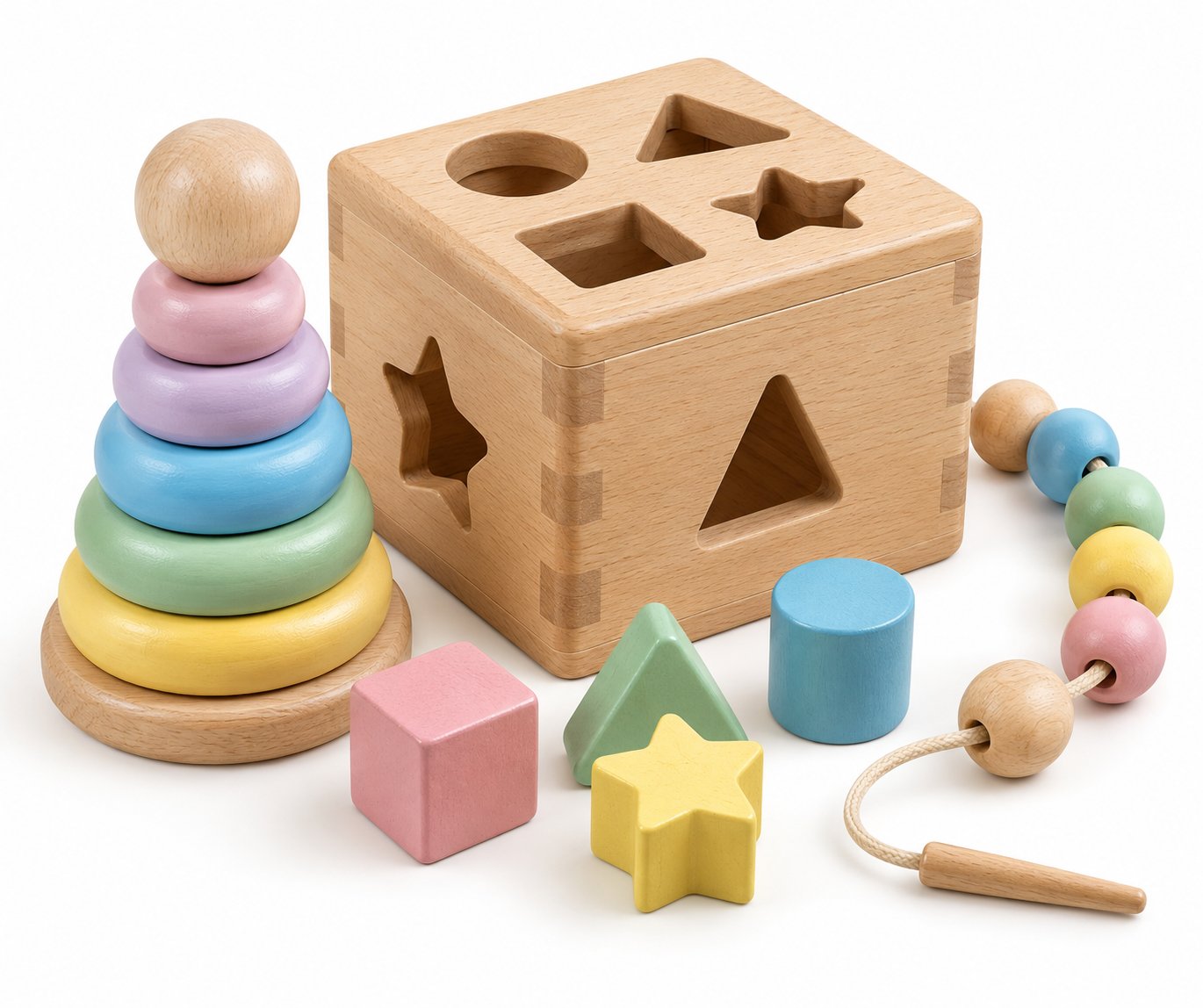
Consider a concrete item: the Wooden Shape Sorter Cube, a 12-block, 4-shape, 4-color toy for age 2+, with an MOQ of 500 sets. The product file references EN71 and ASTM F963.
For this item, the buyer's document request would look like this. At onboarding, the company-level ISO 9001:2015, EN71 and ASTM F963 certificates. For the order itself, the product-specific third-party test report for this shape sorter in the colors being purchased, with the standard and version visible on the report. A retained sample from the production batch, labeled with the purchase order and date, so the delivered units can be compared against the approved sample. And a pre-shipment inspection report confirming the packed batch before release.
This is also where the factory's scale matters in a practical way. A 12,000 square meter factory with 6 production lines and monthly capacity of 1,200,000 units, founded in 2013, runs a large number of batches. Retained samples and per-batch inspection are what make traceability possible at that volume; a buyer receiving a shipment should be able to name the batch and have the factory find the corresponding retained unit.
The buyer's job is not to audit the factory's lab. It is to specify the standard, require the product-specific report before release, and confirm that a retained sample exists for the batch. Those three steps close most of the gap between a company-level certificate and a compliant shipment.
This article describes a general factory workflow and the documents an importer should request. It does not constitute a test result or a certification of any specific product. Buyers should request product-specific test reports, certificate copies and retained sample records for each item and shipment, and verify their scope against the standard and market they are selling into.