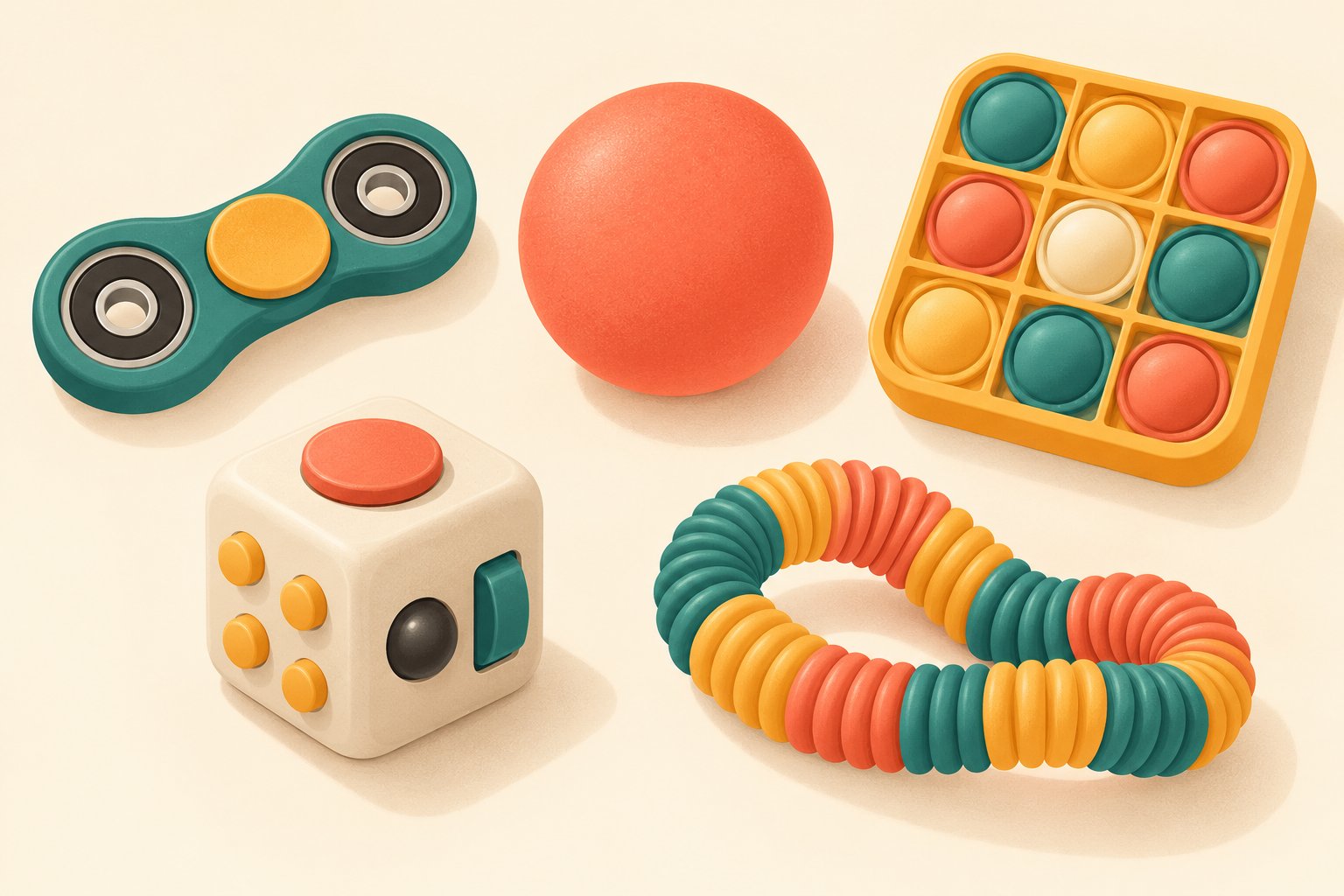
Fidget toys are small handheld items for repetitive play—spinning, squeezing, pressing, stretching. This article explains their common uses in plain language, where they sell, and the checks importers should run on material safety, durability, noise, cleaning, and EN71/ASTM F963 evidence before placing an order.
Category Explainer · Buying Checks
Fidget toys are small handheld items made for repetitive, self-directed play—spinning a wheel, squeezing a foam shape, pressing a button, stretching a band. They are not medical devices, and this article does not treat them as such. For importers, the practical questions are simpler: what are these products actually used for, where do they sell, and what should you check before you commit to a purchase order?
- Fidget toys serve everyday purposes: keeping hands busy, supporting short breaks, providing tactile input, and acting as impulse or event items.
- They sell mainly through checkout lines, party favor aisles, classroom activity boxes, and subscription-box programs.
- Before ordering, verify material safety, small-parts risk for the target age, surface durability, noise level, cleaning instructions, and EN71 or ASTM F963 compliance evidence for your market.
- Our current catalog does not include fidget toy SKUs; we do not manufacture or stock them.
What fidget toys are—and what they are not
In plain terms, a fidget toy is a small object designed to be handled repeatedly in a self-directed way. Common forms include spinners, cubes with buttons and switches, squeeze balls, stretchy strings, and clickers. The design intent is usually simple: give the hands something to do.
It is important to separate that everyday description from medical or therapeutic language. Fidget toys are not treatments, and sellers should avoid claiming they treat ADHD, autism, anxiety, or any other condition. The honest positioning is that they are consumer products—often low-cost, often bought on impulse—whose value is in the moment of use, not in a clinical outcome.
Common uses in everyday language
When buyers ask what fidget toys are used for, the answers usually fall into a few practical categories. None of them require a health claim.
- Occupying restless hands. Many people simply like having something to hold, turn, or click while they think, listen, or wait.
- Short calming or focusing breaks. A brief pause with a tactile object can be part of a routine, without implying any treatment effect.
- Tactile input. Different textures—smooth, bumpy, squishy, clicky—offer variety for people who enjoy handling objects.
- Impulse buys and event items. Low unit cost and small size make them natural add-ons at checkout or giveaways at parties and events.
For a B2B buyer, this list matters because it maps directly to retail placement. A product intended for a checkout line has different requirements from one intended for a classroom quiet-activity box.
Where fidget toys are sold and used
The retail and sourcing scenarios below are typical for this category. They are described generally, not as commitments about any specific supplier's catalog.
- Checkout impulse lines. Small, low-price items placed near the register. Packaging and display-ready format often matter more than complex features.
- Party favors and event giveaways. Sold in multi-packs or bulk, often with a theme. Age grading and small-parts warnings are critical here.
- Classroom quiet-activity boxes. Teachers or program organizers may assemble boxes of quiet, non-disruptive items. Noise level and durability become key checks.
- Subscription-box fillers. Curated boxes need items that fit a theme, ship compactly, and arrive in good condition.
Each scenario implies a different priority. A party favor buyer may accept a simpler item if the price is low; a classroom buyer may reject a clicking mechanism that is too loud. Knowing the end use helps you write a more precise purchase specification.
Buying checks for importers
The checks below are general due-diligence steps. They do not replace your own testing or legal review, and they should be confirmed with the supplier for each product and each destination market.
1. Material safety and small-parts risk
Ask what materials are used and whether the product contains small parts that could detach. For items intended for young children, small-parts risk is a primary concern. Confirm the age grading the supplier intends and check that the product design is consistent with it. Request material declarations or test reports that cover the specific materials in the product.
2. Surface durability
Fidget toys are handled repeatedly. Ask how the surface finish or coating is expected to hold up under normal use, and whether the supplier can provide relevant test data. Be cautious about photos alone—durability claims should be backed by test evidence for the specific product.
3. Noise level of clicking mechanisms
Clicking and snapping sounds are part of the appeal for some users but a problem for others, especially in classrooms or shared spaces. If your target use is quiet environments, ask the supplier to describe the mechanism and, where possible, provide a sample so you can assess the sound yourself.
4. Cleaning
Ask how the item should be cleaned—wipe-down, washable, or not suitable for washing. For products used by multiple people or in institutional settings, cleaning instructions should be clear and included in the packaging or instructions.
5. Compliance evidence for your market
For EU programs, EN71 is the relevant toy safety standard; for US programs, ASTM F963 is the relevant standard. Ask the supplier for compliance evidence that covers the exact product and materials you are buying. A certificate for a different product does not automatically cover yours. Confirm the scope of any test report and keep it on file for your own records.
| Check | What to ask | Why it matters |
|---|---|---|
| Material safety | Material list; small-parts assessment; age grading | Reduces risk of unsafe components and mismatched age labeling |
| Surface durability | Finish or coating description; relevant test data | Repeated handling can affect appearance and function |
| Noise level | Mechanism description; sample for sound assessment | Quiet environments may rule out clicking designs |
| Cleaning | Cleaning method; instructions included | Shared use requires clear hygiene guidance |
| Compliance | EN71 or ASTM F963 evidence for this product | Market access and liability management |
FAQ
Are fidget toys medical or therapeutic products?
No. They are consumer products designed for repetitive play. Sellers should avoid medical claims and describe uses in everyday language.
Do fidget toys require specific certifications?
If they are marketed as toys, they typically fall under toy safety regulations in the destination market—for example, EN71 in the EU and ASTM F963 in the US. Confirm the exact requirements with your testing provider and the supplier's compliance evidence.
Can I order fidget toys from your company?
Our current catalog does not include fidget toy SKUs, and we do not manufacture or stock them. We therefore cannot quote, sample, or inspect a fidget toy program ourselves. If your program also covers categories we do manufacture—such as plush toys, wooden educational sets, or outdoor sports sets—we can quote those directly against your specification. For the fidget portion of a mixed program, ask any supplier you approach to confirm in writing what they will take responsibility for: production, compliance documentation for the destination market, and pre-shipment inspection.