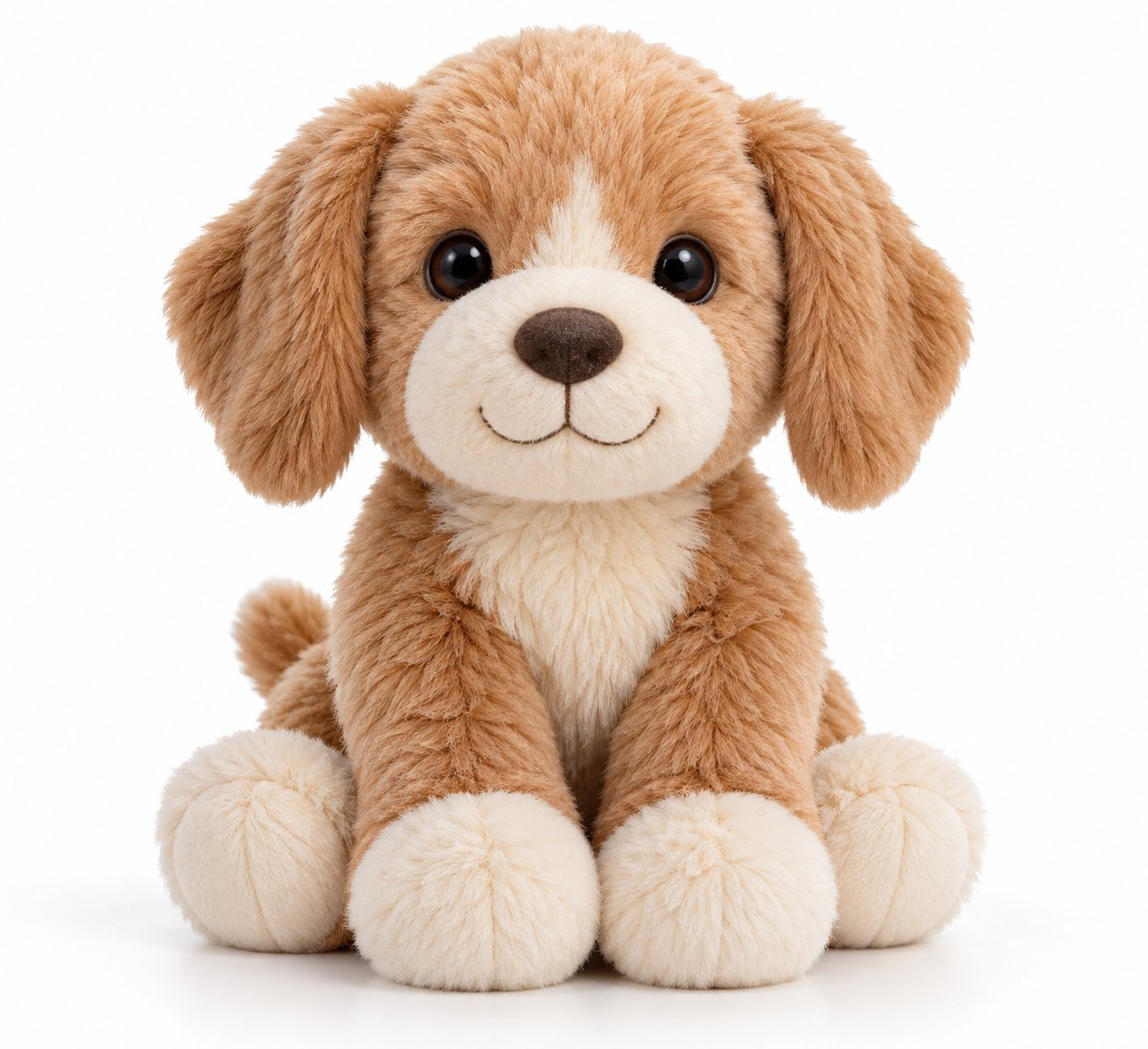
A cost-explainer for B2B buyers: learn how size, fabric, construction, packaging, and order structure drive the per-unit wholesale price of plush toys, with examples from our published range. No USD prices—only the factors that matter when you request quotes.
When buyers ask "how much are plushies?", the honest answer is that no single figure applies. Wholesale plush toy pricing is not a flat rate per piece—it moves with every specification decision you make. But that doesn't mean cost is unpredictable. A small set of factors consistently drives the per-unit price across stock and semi-custom plush, and once you understand them, you can estimate where your order will land relative to others and request quotes that actually reflect what you need.
This article breaks down those cost drivers using real products from our published range as worked examples. We won't quote prices—we have no USD figures to share—but we'll show you how each decision changes the cost profile and what information you need to provide to get an accurate quote.
Key takeaways: Plushie wholesale price is shaped by size, fabric and filling, construction detail, packaging tier, and order structure. Carton quantities also affect freight cost per unit. To get a precise quote, provide a full spec sheet covering all these points.
On this page
- 1. Size: From 15 cm to 60 cm
- 2. Fabric and Filling: The Materials Equation
- 3. Construction Detail: Embroidered Eyes and Double-Stitched Seams
- 4. Packaging Tier: Poly Bag, Display Box, or Gift Box
- 5. Order Structure: MOQ and Carton Quantities
- 6. Why Carton Quantity Affects Freight Cost per Unit
- 7. What a Quote Needs From You
- 8. Frequently Asked Questions
1. Size: From 15 cm to 60 cm
Size is the most obvious cost driver: a larger plush toy uses more fabric, more filling, and more machine time. But the relationship isn't linear: fabric consumption grows with surface area and filling with volume, so the material effect of a size change does not track the height number in any simple ratio. What matters for quoting is the nominal seated height or length, as that determines the pattern and cutting requirements.
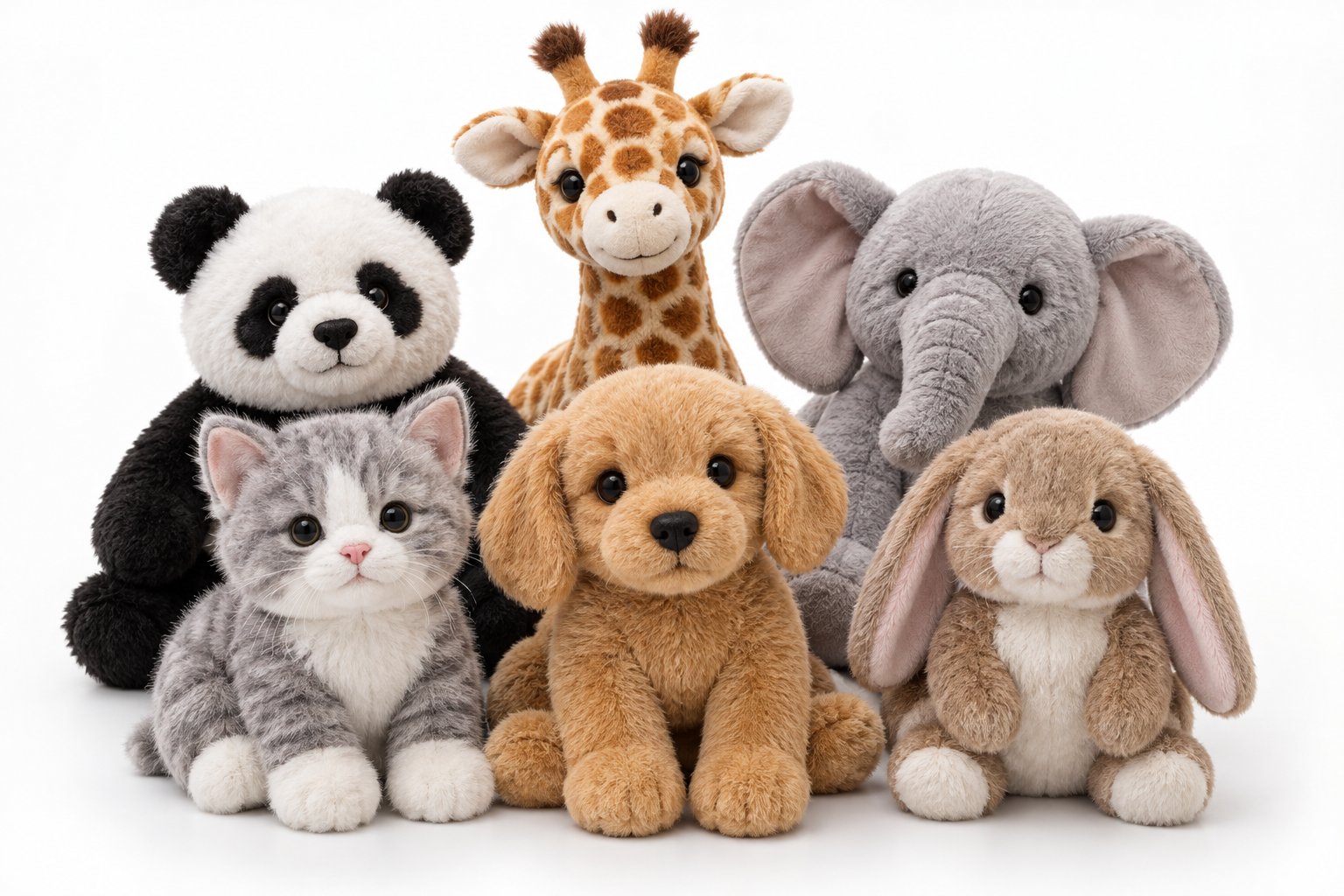
Our range illustrates the spread. At the smaller end, we offer 18 cm seated animals in a six-species counter display assortment—each unit is compact, using less fabric and filling. At the mid-range, a 30 cm seated teddy bear is a classic comfort-toy size, requiring more materials and a larger pattern. For semi-custom projects, our custom plush service covers 20–60 cm, so you can specify a size that fits your brand or retail channel.
When you request a quote, always state the intended size in centimeters (seated height or overall length). Suppliers may ask for a technical drawing or reference sample to confirm proportions.
2. Fabric and Filling: The Materials Equation
Plush fabric comes in many varieties, and the choice affects both hand-feel and unit cost. Short-pile plush is a common choice for stock and semi-custom items: it's soft, durable, and widely available in a range of colors. Longer-pile fabrics or specialty materials (like organic cotton or recycled polyester) typically increase cost because of raw material price and processing complexity—confirm material pricing at quotation rather than assuming a fixed premium.
Filling matters too. Hypoallergenic polyester fibre is the standard for most plush toys—it's lightweight, resilient, and meets common safety expectations. Higher-loft or denser fills may use more material per unit, adding to cost. For buyers targeting sensitive users, specify the filling explicitly so the supplier can confirm availability and any testing documentation.
In our range, both the 18 cm assortment animals and the 30 cm teddy bear use short-pile plush and polyester fibre filling. The plush animal assortment display pack is a good example of how a consistent material spec across multiple species can streamline production.
3. Construction Detail: Embroidered Eyes and Double-Stitched Seams
Small construction choices can have a noticeable effect on unit price. Two common upgrades are embroidered eyes and nose (instead of plastic safety eyes) and double-stitched seams.
- Embroidered features: Plastic eyes require insertion and locking, which adds a small part and a step. Embroidery eliminates the plastic component and the associated small-parts review for that feature, but adds machine embroidery time. Whether the trade-off is worthwhile depends on order volume, design complexity and the target age group, so compare it at quotation stage.
- Double-stitched seams: This reinforces stress points, extending the toy's lifespan. It requires more thread and slower sewing, so it carries a cost premium. It's often specified for items intended for heavy use or frequent washing.
Our 30 cm teddy bear comfort toy features embroidered eyes and nose, with all seams double-stitched as standard. When comparing quotes, ask suppliers to specify which construction details are included—it's a common source of price variance.
4. Packaging Tier: Poly Bag, Display Box, or Gift Box
Packaging is a cost driver that buyers often overlook. The simplest option is a poly bag—a clear plastic sleeve that protects the toy during shipping. It's lightweight and low-cost, but offers no retail presentation.
Counter display boxes are a step up: they hold multiple units and are designed to sit on a store counter, ready for sale. They add cardboard and printing costs but can reduce handling at retail. Our six-species assortment comes in a counter display box, which is included in the carton configuration.
Gift boxes represent the highest packaging tier. They typically involve rigid cardboard, custom printing, and sometimes additional inserts. For example, our plush baby comforter blanket set pairs a 30x30 cm comforter blanket with a 15 cm matching toy in a gift box—a presentation that adds material and assembly time but positions the product for premium retail.
When requesting a quote, specify the packaging tier and any printing or branding requirements.
5. Order Structure: MOQ and Carton Quantities
Order volume affects per-unit cost because fixed costs (setup, tooling, printing plates) are spread over the run. Our minimum order quantity for plush items is 1,000 pieces per style. This is a per-style MOQ, so if you order multiple styles, each must meet the threshold.
Carton quantities also matter. Here are some real configurations from our records:
| Product | Carton Quantity |
|---|---|
| Teddy bears (30 cm) | 60 pieces per carton |
| Display boxes (for 18 cm assortment) | 12 display boxes per carton |
| Comforter blanket sets | 48 sets per carton |
These figures are for reference; actual carton quantities may vary by product and packaging. Always confirm with your supplier.
6. Why Carton Quantity Affects Freight Cost per Unit
Freight is a significant part of landed cost, and carton quantity directly influences it. Shipping costs are typically based on volume (cubic meters) or weight, whichever is greater. A carton that holds more units reduces the number of cartons you need to ship, which can lower the total freight cost and, consequently, the freight cost per unit.
All else being equal, a carton that holds more units spreads the same freight cost across more pieces, lowering freight per unit. But cartons that hold more units are usually larger or heavier, and carriers charge by volume or weight—whichever yields the higher cost—so the per-unit advantage has to be calculated with actual carton dimensions and weights, not assumed from the units-per-carton figure alone.
Packaging tier also affects carton quantity: gift boxes take up more space, so fewer units fit per carton, increasing per-unit freight. That's why it's important to consider packaging and carton configuration together.
7. What a Quote Needs From You
To get an accurate wholesale price for plushies, provide your supplier with a detailed spec sheet covering:
- Size: Nominal height or length in centimeters (e.g., 18 cm seated, 30 cm seated, or custom 20–60 cm).
- Fabric and filling: Type of plush (e.g., short-pile), filling material (e.g., hypoallergenic polyester fibre), and any color requirements.
- Features: Embroidered vs. plastic eyes, double-stitched seams, any additional details like ribbons or tags.
- Packaging: Poly bag, counter display box, gift box, or custom packaging with printing.
- Quantity: Total pieces per style, and whether you need multiple styles.
- Target market: Any specific safety or labeling requirements (e.g., CE, ASTM) to ensure compliance—though note that certifications vary by supplier and product.
The more complete your spec, the more precise the quote. If you're unsure about any detail, ask your supplier for recommendations based on their experience.
8. Frequently Asked Questions
How much do plushies cost wholesale?
Wholesale plushie prices vary widely based on size, materials, construction, packaging, and order volume. Because we don't publish fixed prices, we recommend requesting a quote with your specific requirements.
What is the minimum order quantity for plush toys?
Our MOQ is 1,000 pieces per style for plush items. This applies to each distinct style or design.
Can I mix sizes within one order?
Yes, but each size and style must meet the MOQ of 1,000 pieces. Mixed orders are possible as long as each style meets the threshold.
How does packaging affect the price?
Packaging affects both material cost and freight cost. Simpler packaging like poly bags is less expensive, while gift boxes add material and assembly time, and may reduce carton quantities, increasing per-unit freight.
Do you offer custom plushies?
Yes, we offer custom plush customizable from 20 cm to 60 cm. For custom projects, please provide a detailed spec sheet and any reference images. Note that our teddy bear comfort toy is a stock item, while custom plush is made to order.
Ready to discuss your plush project? Gather your specifications and reach out to our team for a tailored quote.