A beach ball is an inflatable panel ball used for play, pools, and events. This buyer-focused guide explains what it is, how size bands work, what materials and construction mean for bulk orders, and which specs to confirm with a supplier before you commit.
Buyer Basics
A beach ball is an inflatable ball made from soft plastic panels welded or glued around a valve, designed to be light, packable, and safe for casual play. For buyers, the useful questions are not “what is it” in the abstract, but which size band fits the use case, what material and construction hold up in bulk, and which specs to lock down with a supplier before placing an order.
Key takeaways
- A beach ball is defined by its construction (inflatable panels + valve), not by a fixed size or color.
- Sizes are usually grouped into small, medium, large, and oversized/jumbo bands — but “size” can mean inflated or deflated diameter, so always confirm which one a supplier quotes.
- Material choice (PVC vs. other soft plastics) affects feel, print quality, and packed volume more than it affects basic play function.
- For B2B orders, confirm inflate/deflate dimensions, valve type, print method, packed carton dimensions, MOQ, and compliance documents.
In this article
- The plain definition
- How beach ball sizes are banded
- Materials and construction basics
- What this means for bulk orders
- What to confirm with a supplier
- FAQ
The plain definition
At its simplest, a beach ball is a lightweight inflatable sphere assembled from shaped plastic panels. The panels are joined edge-to-edge around a small valve, and when inflated the ball holds a round shape through air pressure rather than any rigid frame.
That construction explains most of the product’s behavior: it is soft on impact, it packs flat when deflated, and it can be printed across multiple panels. It also explains its limits — it is not a ball for hard surfaces, competitive sport, or heavy-duty use. It is a play and event item.
In the retail and promotional market, “beach ball” is used loosely. The same word covers a small party favor, a pool toy, a branded giveaway, and a large group-play prop. None of those are wrong; they are different size bands and print specifications sitting under one product name.
How beach ball sizes are banded
There is no single global size standard for beach balls. Suppliers and catalogs typically group them into informal bands, and the exact numbers vary by manufacturer. Treat the bands below as a way to organize a conversation with a supplier, not as fixed industry values.
| Band | Typical use | What matters most |
|---|---|---|
| Small / mini | Party favors, goodie bags, small giveaways | Packed volume per unit, print legibility on small panels |
| Medium | General play, school events, casual retail | Balance between presence and shipping cost |
| Large | Pool use, group activities, brand promotions | Panel strength, inflation retention, print coverage |
| Oversized / jumbo | Event props, photos, large group games | Inflated diameter, air volume, carton dimensions |
A common source of confusion: a supplier may quote “diameter” as the flat panel length, the deflated width, or the inflated width. These can differ meaningfully. Two balls sold as the same nominal size can look different once inflated. For any real order, ask the supplier to state whether a quoted size is inflated or deflated, and to provide both measurements.
Materials and construction basics
The body of a beach ball is a soft plastic film. PVC is the most common material in this category because it takes print well, welds reliably, and holds air at low cost. Other soft plastics appear in some programs, often chosen for feel, finish, or specific buyer requirements. The material choice affects three things a buyer should care about: surface feel, print result, and how the ball packs.
Panels and seams
Beach balls are built from multiple shaped panels joined along seams. The number of panels and the seam method are production details. From a buying standpoint, the relevant questions are whether the seams hold up under normal play inflation and deflation, and whether the supplier’s stated quality control checks seam integrity. Ask for the factory’s standard for seam testing rather than assuming a figure.
The valve
Every inflatable beach ball has a valve for inflation. Valve type and placement affect how easily the ball inflates and how well it holds air. Buyers running retail programs should confirm that the valve is recessed or protected enough to avoid snagging during play, and that the supplier’s inflation instructions match the valve design.
Printing
Because the ball is assembled from panels, artwork is usually printed on the flat film before the ball is formed. That means the print wraps across panel seams. For branded or licensed programs, confirm the print method (flexo, screen, or other), color reference, and whether the supplier provides a pre-production proof before mass production. Panel seams will always break artwork to some degree; a good supplier will show you where.
What this means for bulk orders
For a B2B buyer, the definition and construction details above translate into a short list of order-level decisions.
- Packed volume drives freight cost. A beach ball ships deflated, so the relevant number is the deflated packed size and carton quantity, not the inflated diameter.
- Size naming is not standardized. Build your purchase order around measured inflated and deflated dimensions, not around “large” or “jumbo.”
- Print complexity affects lead time. Multi-color or full-wrap artwork needs more proofing time than a one-color logo.
- Compliance scope must match the product. If a supplier states a standard for one item, confirm it applies to the specific beach ball SKU you are buying, in the specific size and material.
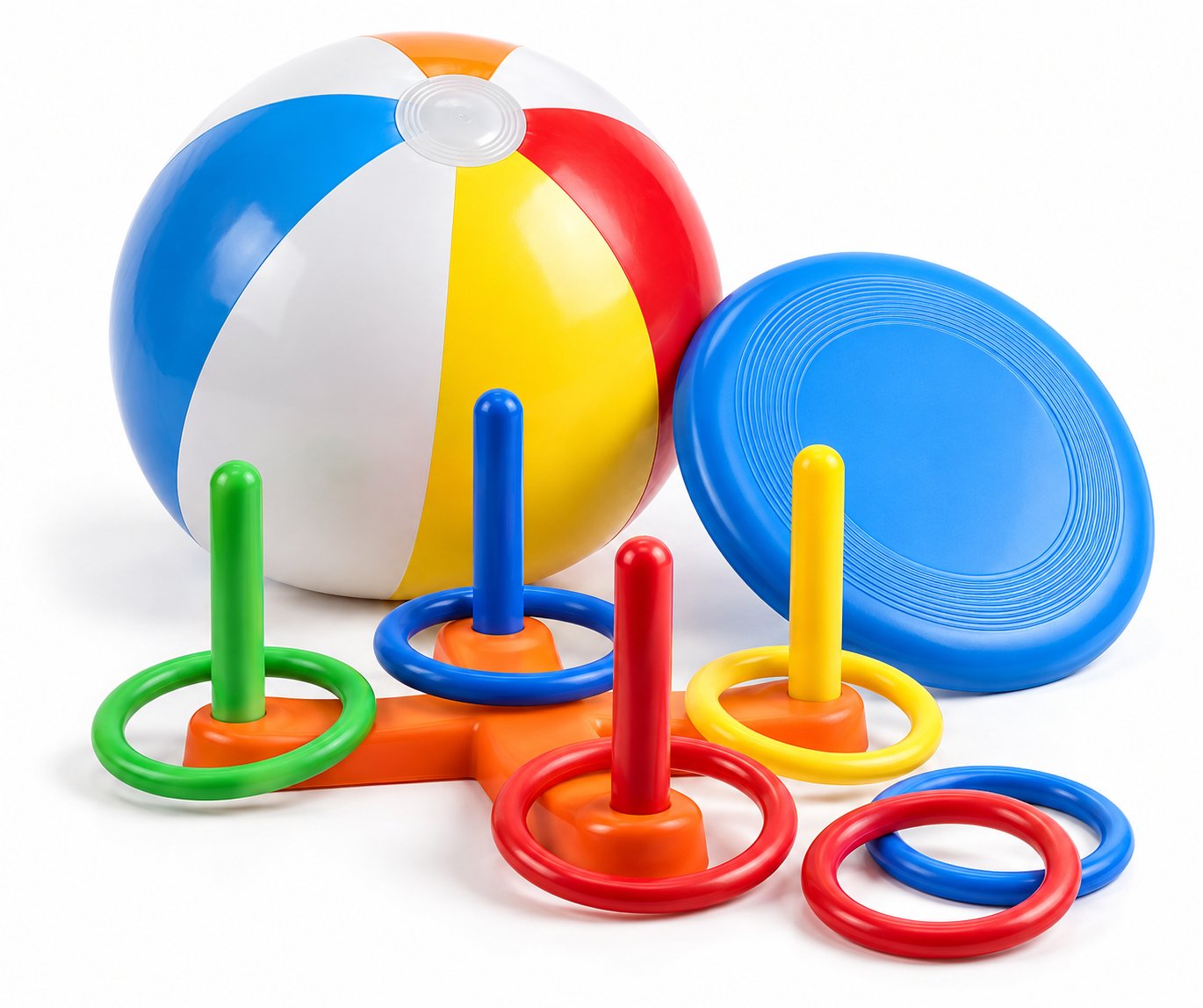
That last point matters when a beach ball ships as part of a set rather than as a standalone item. For example, the Outdoor Sports Set with Beach Ball and Ring Toss for Group Play combines a beach ball, a flying disc, and a ring toss game in one box, made from durable, weather-resistant plastic and fabric, age 3+, with EN71 / ASTM F963 compliance, MOQ 500 sets, color box + export carton packing, and OEM/ODM available. When a ball is bundled like this, confirm that the compliance documentation covers the set as sold, and that the carton configuration matches the set quantity — not just the ball quantity.
What to confirm with a supplier
Use this as a checklist for your first conversation. It is written as questions because the answers vary by supplier, size band, and program.
| Area | Question to ask |
|---|---|
| Size | Is the quoted diameter measured inflated or deflated? Can you provide both? |
| Material | Which soft plastic is used, and does the material change across size bands? |
| Valve | What valve type is fitted, and how is it positioned relative to the surface? |
| What print method is used, and will you provide a pre-production proof showing seam placement? | |
| Packing | What is the deflated packed size per unit and the master carton quantity and dimensions? |
| Compliance | Which standards apply, and for which exact SKU, size, and material? Are current certificates available? |
| Order terms | What is the MOQ per size and per print configuration? What is the lead time for a first order and for repeats? |
| Customization | Is OEM/ODM available, and what is the process for artwork approval? |
If your program mixes beach balls with other outdoor play items, it also helps to look at how comparable sets are sourced and packed. The overview on where to buy outdoor games for schools, parks and retail programs covers that channel and program side, which is a separate question from the ball’s definition and specs covered here.
FAQ
Is a beach ball the same as an inflatable ball?
An inflatable ball is the broader category; a beach ball is a specific type of lightweight, panel-built inflatable ball intended for casual play, pools, and events. Not every inflatable ball is a beach ball, but every beach ball is inflatable.
What is the most common beach ball size?
There is no single standard. Medium and large bands are the most commonly stocked sizes in retail and promotional programs, but exact measurements vary by supplier. Confirm inflated and deflated dimensions rather than relying on the size name.
What material is a beach ball made of?
Most beach balls are made from soft PVC film chosen for print quality and air retention. Other soft plastics are used in some programs. Ask the supplier which material applies to the specific SKU and size you are buying.
Can beach balls be custom printed for bulk orders?
Yes. Artwork is typically printed on the flat panels before assembly. Ask for a pre-production proof so you can see how the design crosses panel seams. Multi-color and full-wrap art usually requires more proofing time.
What compliance documents should I ask for?
Ask which standards apply to the exact product or set you are ordering, and request current certificates or test reports for that SKU, size, and material. If the ball is part of a multi-item set, confirm the documentation covers the set as sold.
A beach ball is a simple product with a small set of variables — size measurement, material, valve, print, packing, and compliance scope. Get those confirmed for the specific SKU you are buying, and the rest of the order follows predictably.