For B2B toy buyers, a Montessori toy is defined by specific design principles—not just natural materials. This article provides a checkable criteria list covering materials, single-skill focus, open-ended play, age grading, and certification, grounded in real product specs, to help retailers, distributors, and preschool buyers make informed purchasing decisions.
A Montessori toy is a play object designed to support a child's natural development through hands-on, self-directed activity. For B2B buyers—retailers, distributors, and preschool purchasers—the term is not a legal certification but a set of design principles. A toy qualifies as Montessori when it encourages open-ended exploration, isolates a single skill or concept, uses natural materials where possible, and matches the child's developmental stage. The checklist below distills those principles into concrete, verifiable criteria you can apply when evaluating suppliers and product specs.
Key Takeaways for Buyers
- Montessori is a design philosophy, not a trademark. Look for evidence of single-skill focus, open-ended play, and age-appropriate challenge.
- Materials matter, but safety compliance is non-negotiable. Natural wood with non-toxic finishes is common; always verify EN71/ASTM F963 or equivalent certification.
- Age grading should align with developmental milestones. A toy labeled 3+ should offer the right level of complexity without frustrating or boring the child.
- Ask for product specs. Dimensions, block counts, and finish details help you assess quality and suitability for your market.
Why "Montessori" Matters to B2B Buyers
Parents and educators increasingly seek out Montessori-inspired toys, driving demand across retail channels. For you, the term signals a product that supports developmental learning—a selling point that can differentiate your assortment. However, the lack of a universal standard means you must evaluate each product against clear criteria. This article provides a framework to do exactly that, using real product specifications as examples.
Selection Criteria: A Buyer's Checklist
Use the following criteria to assess whether a toy genuinely aligns with Montessori principles and meets your commercial requirements.
1. Materials and Finish
Montessori toys often favor natural materials like wood over plastic, as they provide sensory richness and durability. But material choice alone is insufficient. Check for:
- Child-safe wood: Look for hardwoods such as beech or maple that resist splintering.
- Non-toxic finish: Water-based, non-toxic coatings are preferable to solvent-based lacquers. Ask for confirmation of the finish type.
- Smooth edges: Sanded surfaces with rounded corners reduce injury risk. Specifications may state "sanded smooth with rounded edges."
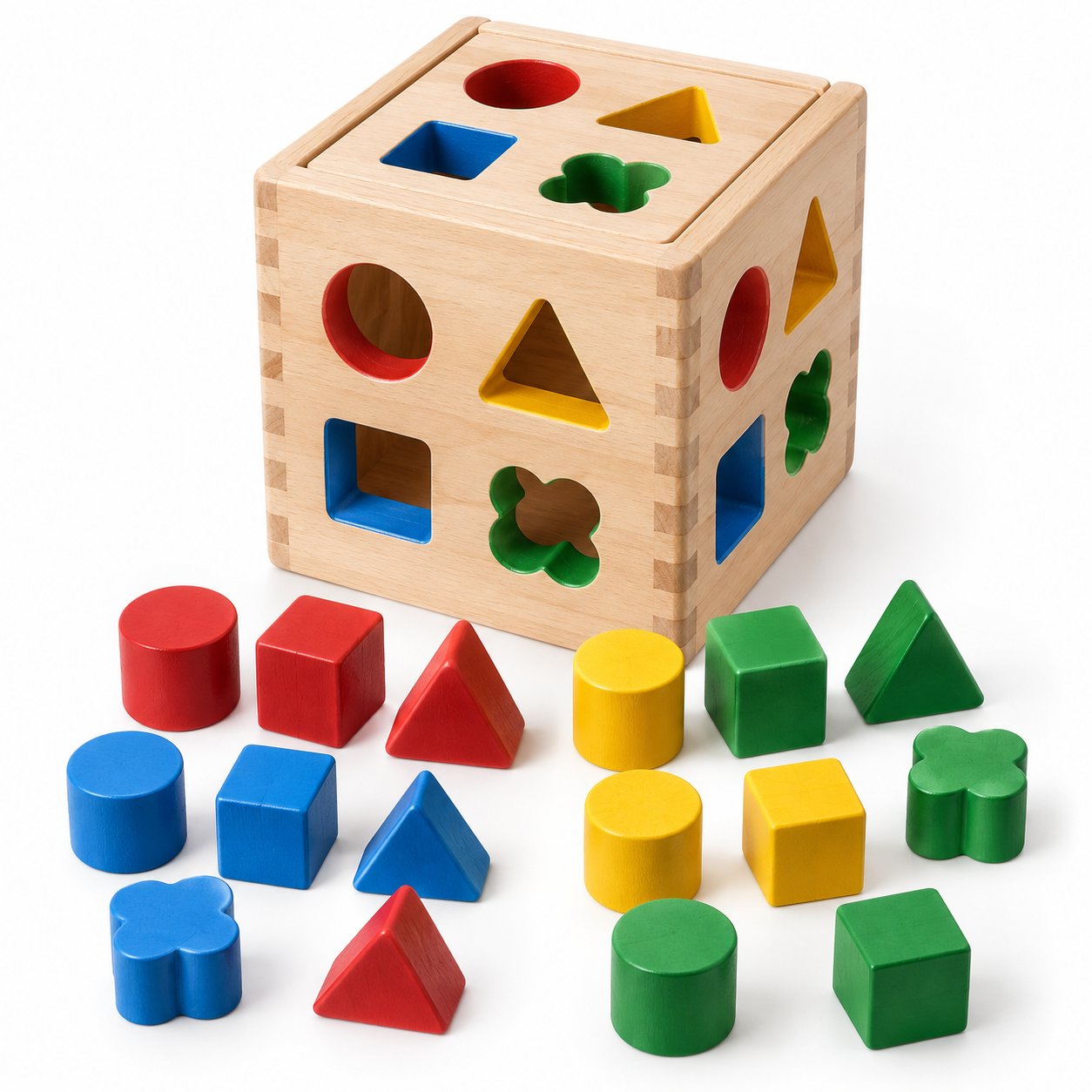
For example, our wooden shape sorting cube is made from child-safe wood with a non-toxic water-based coating and features sanded smooth edges, meeting these material expectations.
2. Single-Skill Focus
Montessori toys typically isolate one skill or concept—such as shape recognition, stacking, or threading—so the child can focus without distraction. Evaluate whether the toy's design directs attention to a primary learning objective. A shape sorter with multiple shapes and colors is a classic example: it teaches shape and color matching through a single activity. Our shape sorter cube includes 12 blocks in 4 shapes and 4 colors, providing a clear, focused task.
3. Open-Ended Play
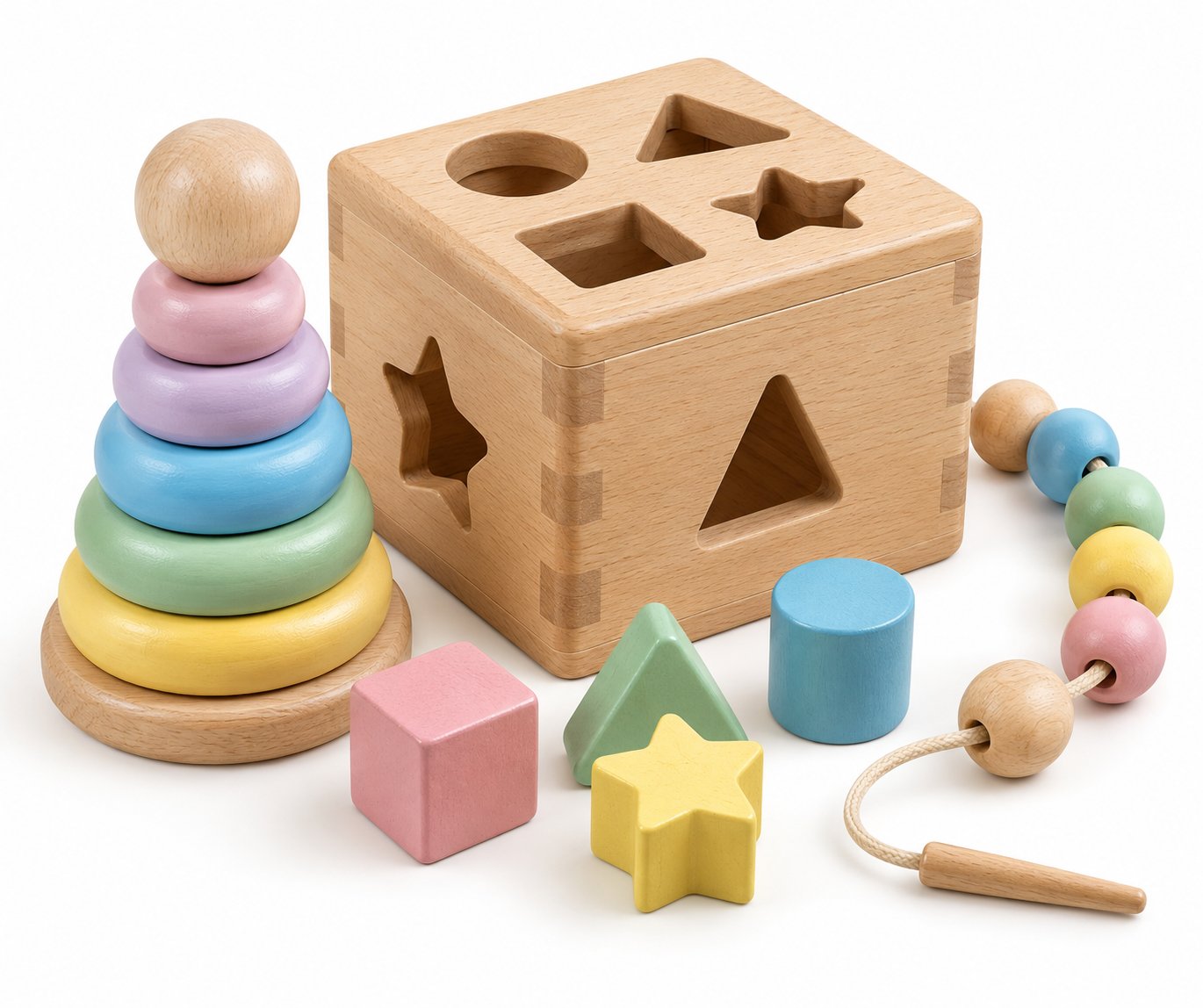
Open-ended toys can be used in multiple ways, encouraging creativity and problem-solving. Look for toys that do not dictate a single outcome. Building blocks, stacking rings, and threading toys are common examples. A set that combines a shape-sorting box, stacking toys, and a threading toy offers varied open-ended play within one product. Our Montessori learning set includes these three components, each supporting different developmental areas.
4. Age Grading and Developmental Appropriateness
Montessori philosophy emphasizes matching the toy to the child's developmental stage. Age grading should be realistic and based on the skills required. For instance, a threading toy may suit a 3-year-old, while a simpler shape sorter might be appropriate for a 2-year-old. Check the manufacturer's age recommendation and consider whether the complexity aligns with the target age group. Our learning set is graded for ages 3+, while the shape sorter cube is rated for ages 2+, reflecting their respective skill demands.
5. Safety and Certification
Compliance with safety standards is critical for any toy, regardless of its educational claims. For international markets, look for certifications such as EN71 (Europe) and ASTM F963 (US). These indicate the product has been tested for mechanical and chemical safety. Our learning set is EN71/ASTM F963 compliant, providing assurance for buyers in those regions. Always request certificates and verify they apply to the specific product and production batch.
6. Commercial Terms and Customization
As a B2B buyer, you also need to assess MOQ, lead times, and customization options. Our learning set has an MOQ of 500 sets and offers OEM/ODM services, allowing you to adapt packaging or product features to your market. Confirm these details with the supplier during negotiation.
Comparison of Featured Products
| Feature | Wooden Montessori Educational Toy Set | Wooden Shape Sorting Cube |
|---|---|---|
| Components | Shape-sorting box, stacking toys, threading toy | 12 blocks in 4 shapes and 4 colors |
| Age Range | 3+ | 2+ |
| Materials | Child-safe wood with non-toxic finish | Wood with non-toxic water-based coating; sanded smooth with rounded edges |
| Dimensions | Packing and component dimensions available on request | Cube 15x15x15 cm; block thickness 2.5 cm |
| Special Features | EN71/ASTM F963 compliant; OEM/ODM available | Removable lid for quick reset |
| MOQ | 500 sets | 500 sets |
How to Evaluate a Supplier
Beyond product criteria, assess the supplier's reliability and transparency. Request:
- Product samples to check finish, size, and overall quality.
- Certification documents (e.g., EN71, ASTM F963) for the specific product.
- Clear MOQ, lead time, and payment terms.
- OEM/ODM capabilities if you need customized packaging or branding.
Our learning set is EN71/ASTM F963 compliant, and we offer OEM/ODM services to support your private label needs. Contact us to discuss your requirements.
Frequently Asked Questions
What does Montessori toys mean?
"Montessori toys" refers to play materials designed according to the educational principles of Maria Montessori. These toys emphasize hands-on, self-directed learning, often focusing on a single skill (like stacking or sorting) and using natural materials. They are intended to support a child's natural development by allowing open-ended exploration and matching the child's developmental stage. The term is descriptive, not a certification, so quality and alignment with Montessori principles vary among products.
Are all wooden toys Montessori?
No. While wooden toys are common in Montessori settings because of their natural feel and durability, being wooden does not automatically make a toy Montessori. A wooden toy must also meet other criteria: single-skill focus, open-ended play, age-appropriate challenge, and safe, non-toxic finishes. For example, a wooden puzzle with a fixed image is less Montessori than a set of wooden blocks that can be arranged in countless ways. Always evaluate the design intent, not just the material.
How can I verify if a toy is truly Montessori-aligned?
Check for the criteria outlined in this article: materials, single-skill focus, open-ended play, age grading, and safety certification. Ask the supplier for product specifications and certification documents. Samples can help you assess quality and design. There is no official Montessori certification for toys, so your judgment as a buyer is key.
Ready to source Montessori-aligned toys for your market?
Explore our product range and request a quote with your specifications.
Contact Us