
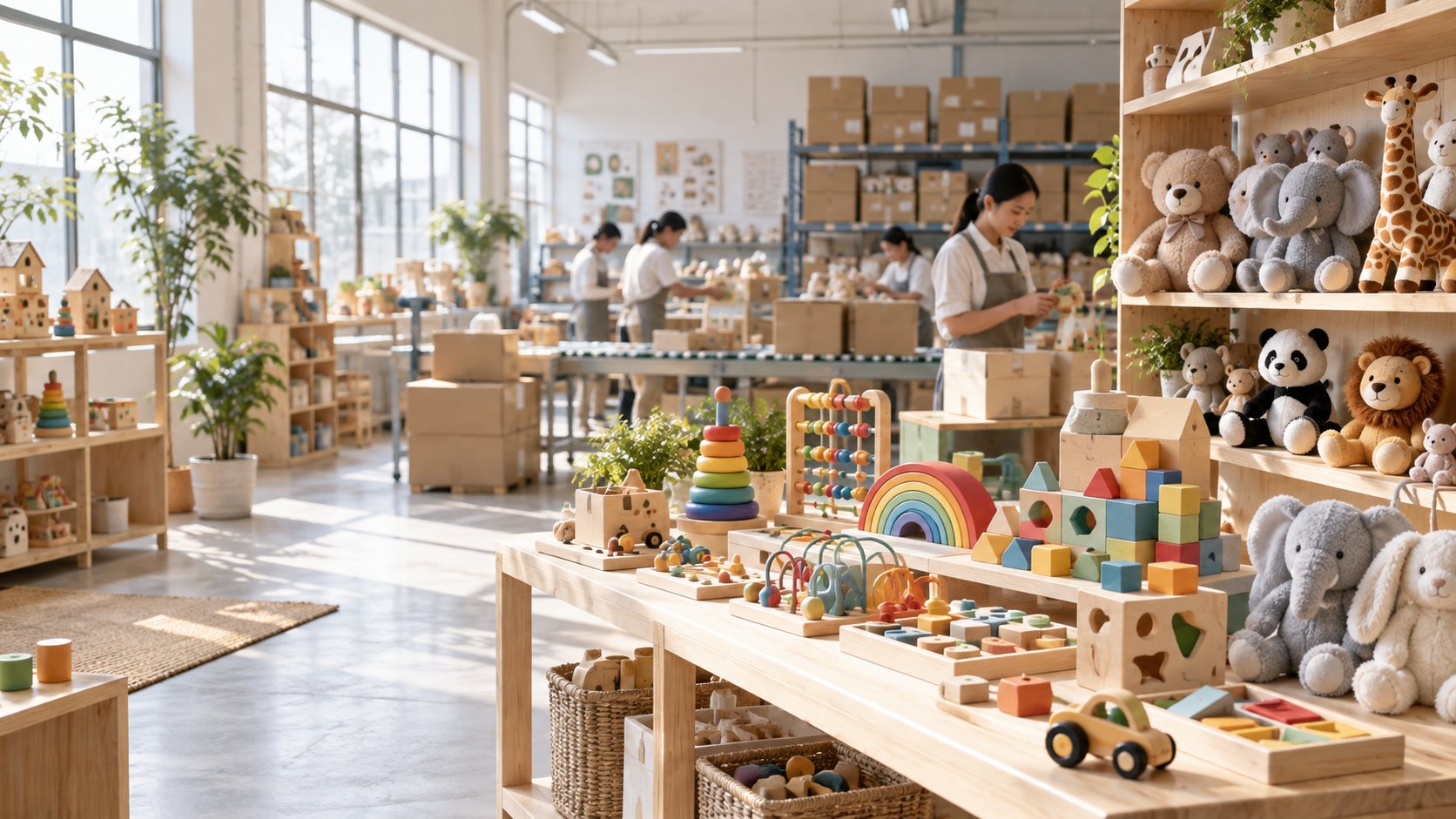
An OEM product is made to your design and specification by a contract manufacturer. This guide explains OEM, ODM and private label for toys, with a comparison of who owns the design, how sampling works, typical MOQs and branding control — so you can choose the right model before commissioning a toy program.
Toy Sourcing Guide
If you are commissioning a toy program and a supplier asks whether you want OEM, ODM or private label, the answer is not just a price point — it decides who owns the design, how sampling runs, what MOQ applies and how much of the brand you control. Here is how the three models differ, with the decisions each one hands to you.
Key takeaways
- OEM (original equipment manufacturer): you supply or own the design and specification; the factory manufactures to it.
- ODM (original design manufacturer): the factory’s existing design is adapted with your branding and selected changes.
- Private label: a finished, catalog product is branded as yours: minimal design input.
- Your choice determines design ownership, sample rounds, MOQ exposure and how far your brand can differentiate.
What an OEM product actually means
An OEM product is a good manufactured by one company to the design, specification and often the brand of another. In toys, the buyer (the brand owner) defines the product — shape, function, materials, colors, packaging, safety requirements — and the OEM factory builds it. The factory may contribute engineering feedback, tooling and production method, but the product identity belongs to the buyer.
The term is sometimes used loosely: some suppliers call any customized order “OEM.” For a buyer, the practical test is simple: whose design is being manufactured? If you bring the design and the factory executes it, that is OEM. If the factory brings a design and you put your name on it, that is closer to ODM or private label.
OEM vs ODM vs private label: what you control
The three models differ mainly in where the design comes from and how much of it you can change. The table below maps the typical control split.
| Decision area | OEM | ODM | Private label |
|---|---|---|---|
| Design source | Buyer-owned design or detailed brief | Factory’s existing design, adapted | Factory’s finished catalog item |
| Design ownership | Buyer | Usually factory; buyer licenses or brands it | Factory |
| Customization scope | Full: structure, materials, colors, sizes, packaging | Partial: colors, branding, packaging, sometimes size | Branding and packaging only |
| Sampling | Multiple rounds from brief to approved sample | Sample from existing mold/pattern with changes | Stock sample or catalog reference |
| Typical MOQ exposure | Higher; tied to tooling and setup | Moderate | Lower; often stock-based |
| Brand differentiation | Highest | Medium | Lowest |
| Time to market | Longest | Medium | Shortest |
Private label is the narrowest: you take a product that already exists and apply your brand, with minimal design input. This guide focuses on the OEM and ODM decisions, where the design and tooling questions matter most.
How each model maps to real toy program decisions
Design ownership and IP
In OEM, the buyer typically owns the drawings, tooling and product concept, which matters if you plan to defend a unique feature or scale the line later. In ODM, the factory’s design is the starting point; your brand sits on top, and the underlying design may remain available to other buyers unless a specific exclusivity arrangement is agreed. Private label carries no design ownership at all. Before committing, clarify in writing who owns the tooling and the design files, and whether the same design can be sold to others.
Sampling path
OEM sampling usually runs from a written brief to an approved sample, with rounds for structure, materials and packaging. ODM sampling starts from an existing pattern and adjusts selected elements. Private label often uses a stock sample for reference. More sample rounds add time but catch fit, finish and safety issues earlier — particularly for plush, electronic and outdoor toys where materials and small parts affect compliance.
MOQ and tooling
OEM orders carry the highest setup because new tooling or molds may be required; MOQ reflects that investment. ODM sits in the middle, and private label is usually the lowest. A supplier may state a MOQ per model; for example, the Custom Plush Stuffed Animal with Hypoallergenic Filling for Gifting lists an MOQ of 1,000 pcs and is available for both OEM and ODM, with size customizable from 20–60 cm. That gives a concrete reference point for a plush program, though MOQ for a fully new OEM design depends on tooling and construction.
Branding and packaging
All three models can carry your logo, but the depth differs. OEM lets you specify custom packaging, inserts, labels and even the product’s colors and materials. ODM lets you brand the product and packaging around a fixed core design. Private label usually means logo and packaging on a stock item.
Which model fits your toy program?
Use these questions to narrow the choice:
- Do you have a design or a defined product concept? If yes, OEM is the natural route.
- Do you need to differentiate on structure or function? If the selling point is a unique feature, OEM protects it better than ODM.
- Is speed to market the priority? ODM or private label shortens the path.
- What MOQ can you commit to? OEM tooling usually implies a higher first order; ODM and private label can start lower.
- Who will own the design and tooling? Decide this before sampling, not after.
At Fujian Lequ Wanwan Co., Ltd., a B2B toy manufacturer founded in 2013 and serving North American and European buyers, OEM/ODM customization runs from brief to approved sample with custom colors, sizes, materials, packaging and branding. The company operates six production lines across educational, plush, outdoor and RC/electronic toy categories, with a combined monthly capacity of 1.2 million pieces in a 12,000 sqm facility staffed by 180 people, including in-house design, engineering, quality control and export documentation teams. It holds ISO 9001:2015 and its toy lines are EN71 and ASTM F963 certified.
What to confirm before you commission
Whichever model you choose, the commercial and compliance details decide whether the program runs smoothly. Ask the supplier to confirm:
- Who owns the design, drawings and tooling, and whether the design can be reused for other buyers.
- The number of sample rounds included and the approval criteria for each.
- The MOQ for your specific design, and how it changes with size, material or packaging.
- Which safety standards apply to your market and how the product will be tested — for example EN71 for Europe and ASTM F963 for the US.
- Packaging format and carton configuration, such as poly bag plus export carton.
For a plush program, the example product above illustrates a typical configuration: soft plush fabric, hypoallergenic filling, age 0+, size customizable 20–60 cm, MOQ 1,000 pcs, poly bag and export carton, EN71/ASTM F963 compliant, with OEM/ODM available. Use it as a reference when you specify your own requirements.
FAQ
Is OEM the same as private label?
No. In OEM, the buyer owns the design and the factory manufactures to it. In private label, the buyer brands an existing finished product with little or no design input.
Can an ODM product be exclusive to my brand?
Exclusivity is a commercial term, not a built-in feature of ODM. Ask the supplier to confirm in writing whether the design can be sold to other buyers and under what conditions.
Does OEM always require a higher MOQ?
OEM often requires tooling or setup that raises the first-order quantity, but the exact MOQ depends on the product and construction. Confirm the MOQ for your specific design rather than assuming a category figure.


