Replacement ring toss rings are rarely sold as standalone retail items. This guide explains where they actually come from, how to match ring diameter, material flexibility, and post compatibility, and what to verify before you order spares for a school, playground, or event fleet.
Sourcing Guide
So your ring toss set has six posts, three rings left, and a busy season ahead. Or you run a school PE cupboard where rings get stepped on and stretched out of shape. You are not looking for another full garden game set. You need rings.
That is the problem: ring toss rings are almost never sold as freestanding consumer products. There is no standard shelf item called a replacement ring. What exists is a small number of channels, and each one has a different cost and a different risk. Here is where they come from and what to check before you order.
On this page
- Why replacement rings are hard to find
- The three real sources for ring toss rings
- Ring and post compatibility: what to verify
- Material and flexibility: why it matters more than color
- Safety and compliance before you buy
- Order quantities and mixed spare parts
- FAQ
Why replacement rings are hard to find
Ring toss sets are sold as sets. The ring is a low-value component inside a boxed product, and a retailer has no reason to stock it alone. For toys that are usually hung on a peg, not sold as a spare parts program. So the ring only enters the supply chain as part of a set, a school equipment order, or a rental fleet order.
That shapes your options. You can buy from the original supplier, buy from a supplier who makes a matching ring, or buy a whole new set. Each path has a different break-even point, and the break-even depends on how many rings you actually need and how tightly your existing posts lock you in.
The three real sources for ring toss rings
Spare parts from the original supplier
If the set came from a manufacturer that still runs the tooling, the cleanest path is to ask for replacement rings. This is the only source that guarantees the same diameter, material, and color as your existing rings. It is also the only source that can tell you whether the ring was tested with the post in the same set.
The trade-off is that spare rings are usually a wholesale or project request, not a retail checkout. Expect a minimum order quantity, and expect the supplier to ask which set you are replacing. If you bought the set through a distributor, the distributor may not be able to source rings at all.
A matching ring from a ring toss manufacturer
Factories that make ring toss games can often produce or supply rings that match a specification, even when the original supplier is gone. The practical question is not whether a factory can extrude a plastic ring. It is whether the ring matches your post. Record your ring diameter, the ring thickness, the material, and the clearance you want when the ring lands over the post. Then ask the supplier to confirm those values, not just to send a photo.
Rebuying the full set
Sometimes the whole set is the better buy. If your posts are cracked, if the set is discontinued, or if only one supplier can match the ring at an acceptable lead time, a new complete set can cost less per usable piece than sourcing orphan rings. It also resets the spare parts problem: you get a set with a current model number, and a supplier who can quote rings later.
The trade-off is the opposite of what buyers expect. Rebuying a set is not always wasteful; sourcing a few rings can be slow and expensive if nobody makes them as a standalone item. For a school replacing a handful of rings, a small order from the original supplier still usually wins. For a rental operator with worn posts, a full re-set is often the honest answer.
Where these rings fit: a practical reference
Most commercial and school ring toss sets use a flexible ring and a fixed post. The table below shows the verified specification of one current product so you can compare it against the equipment you already own.
| Item | Verified specification | Why to check it against your set |
|---|---|---|
| Ring material | Flexible PP that returns to shape after bending | Rigid rings crack or stay oval; flexibility affects how the ring sits on the post |
| Ring diameter | 18 cm | Must clear the post top and land the way your existing set does |
| Post height | 45 cm | Scoring distance depends on post height and ring size together |
| Post material | Weighted plastic with rounded tops | Weight keeps the post upright; rounded top reduces snagging |
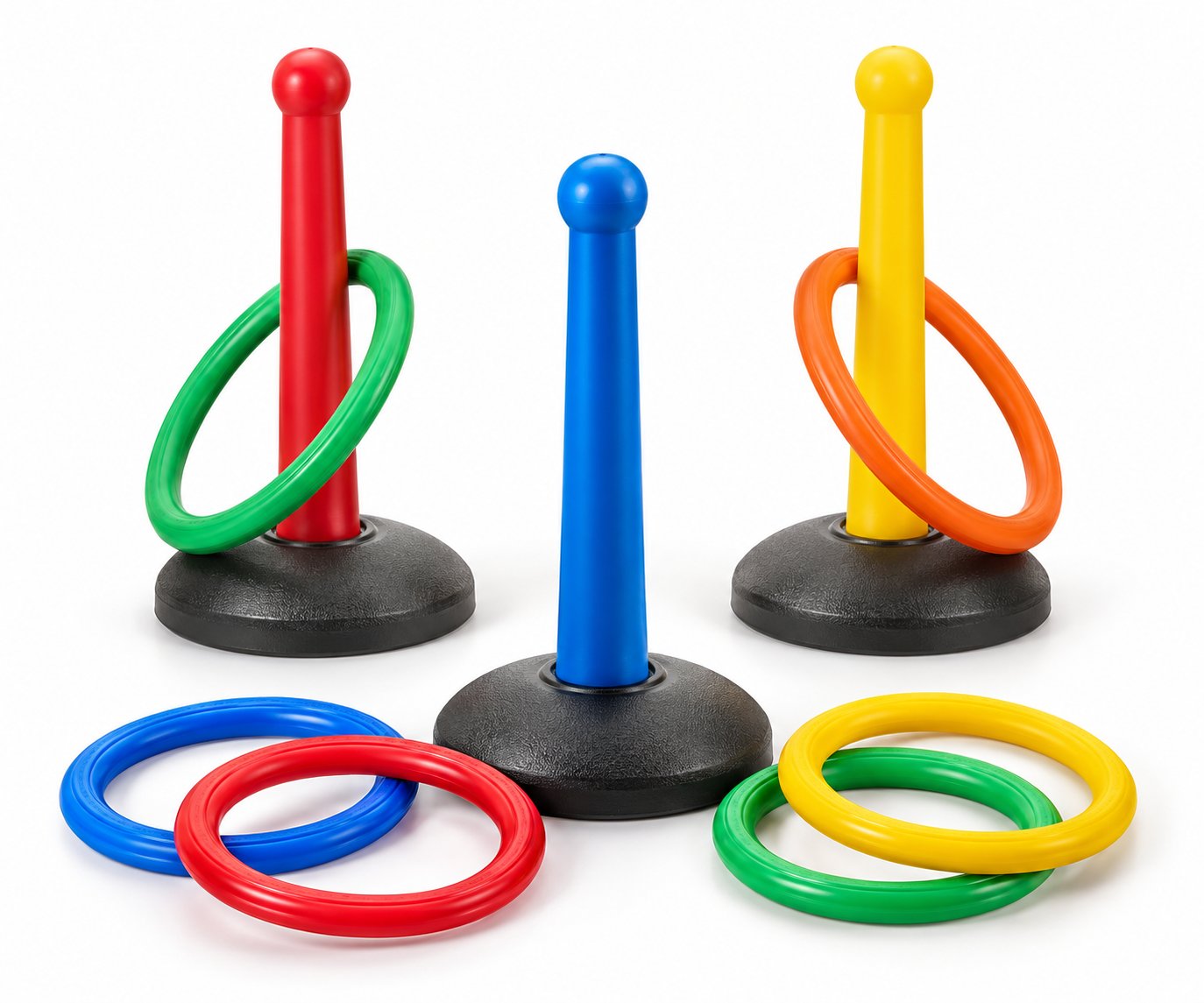
| Set contents | 6 rings and 3 weighted posts | Useful reference for ring-to-post ratio when you order spares |
| Setup | Posts push into grass or sand without tools | Surface type affects how firmly the post sits and how far it should sink |
The reference product is the Ring Toss Garden Game Set with 6 Rings for Playgrounds, shown here as a spec example. Use the same fields to describe your own set when you request spares.
Ring and post compatibility: what to verify
A ring that is 18 cm across is not automatically a match for a post that is 45 cm tall from another maker. Diameter is the starting point, not the whole answer.
- Measure the existing ring, not the post. Use the inner diameter of the ring because that is the opening the post passes through. A stretched or warped ring will give you a false reading, so measure a ring that still returns to its round shape.
- Measure the post top diameter. The ring must clear the widest point of the post, including any rounded cap or flange. If the post top is wider than the ring opening, a spare ring from another supplier is useless.
- Check wall thickness, not just diameter. A thin ring flutters and is hard to throw accurately. A thick ring feels heavy and is harder for children to grip. Ask the supplier for the ring wall thickness.
- Confirm whether the ring is tested with the post. A supplier that makes both can confirm the ring lands on the post cleanly. A supplier that only makes rings may have a nominal diameter but no matched post.
- Check color compatibility if you mix rings. If you are adding rings to a school kit, ask whether the supplier can match the existing color set, because mixed colors can confuse scoring games.
The most common sourcing mistake is ordering on diameter alone. If you can send the supplier three numbers, ring inner diameter, ring wall thickness, and post top diameter, you remove most of the fit risk before the first production run.
Material and flexibility: why it matters more than color
Ring toss rings live outdoors and get thrown, bent, stepped on, and stacked in a storage bag. The material determines how long they survive that.
The reference set uses flexible PP rings that return to shape after bending. That means a ring that is temporarily squashed in a mesh bag comes back round before the next session. It also means a ring that gets stepped on is less likely to crack than a rigid ring. If you are replacing rings in an existing set, ask the supplier to confirm the same material behavior: bend the sample and check whether it returns to a round shape or stays creased.
Flexibility has a limit. A ring that is too soft may not hold its flight path and can be harder to throw. A ring that is too hard may crack at low temperatures. If your site is used in winter, ask the supplier what the ring does when it is cold. If they cannot answer, treat it as an open question rather than an assumed yes.
UV exposure matters for outdoor rings in sunny climates. Ask whether the ring material is intended for extended outdoor use, and ask for the material data on that point. Do not assume that a flexible ring is automatically UV-stable.
Safety and compliance before you buy
For schools, playgrounds, and public events, compliance is a purchasing requirement, not a nice-to-have. The reference set is EN71 and ASTM F963 compliant, which are the two toy safety standards most often requested by school and playground buyers.
When you order replacement rings, do not assume that the compliance certificate for the full set automatically covers a separately ordered ring. Ask the supplier to confirm which standard the ring itself was tested against, which model or batch the report covers, and whether the report is current.
- Request the test report that matches the exact product being shipped, not a generic company certificate.
- Check that the report names the ring, not only the set, if the ring is being invoiced separately.
- If the ring is sold to schools, confirm the age recommendation and whether there is a small parts warning relevant to your users.
This is the area where a cheaper ring usually fails. A supplier that cannot show a matching test report is a risk you cannot fix after the container arrives.
Setup surface and what it means for rings
Posts push into grass or sand without tools on the reference set. That setup detail matters when you order rings because the ring must work with the post at the height it sits. Firm ground leaves more post above the surface; soft sand buries more of it. If your event moves between surfaces, confirm the usable post height above the ground on each surface, and check that the ring still clears the top.
Order quantities and mixed spare parts
Replacement rings are usually a wholesale or project purchase. The reference product carries an MOQ of 500 sets, which tells you the production scale the factory runs at. If you only need a small number of rings, ask whether the supplier can supply rings as a spare parts line, and ask what quantity makes that practical.
If you maintain a fleet of sets, it can be worth ordering rings and posts together so that both fit the same specification. Ring-to-post ratio matters for the game, but for spares the useful question is how many rings you lose per set per season. Track that for one season; it will tell you your real annual order quantity better than any general rule.
For larger programs, OEM/ODM is available on the reference product, which means a supplier can produce rings to your own specification, including color and packaging. That is the path to take when you need rings that match a large existing inventory and no current supplier can match it off the shelf.
FAQ
Can I buy ring toss rings without buying a full set?
It depends on the supplier. Rings are generally not a standalone retail product, so the reliable path is to ask the original manufacturer or a ring toss manufacturer for a spare parts order. Expect a minimum order quantity and a request for your existing ring and post measurements.
What size are ring toss rings?
There is no single standard. The reference set uses rings with an 18 cm diameter on 45 cm posts. Always match the ring to your existing post rather than assuming a common size.
How do I know a replacement ring will fit my posts?
Measure the ring inner diameter, the ring wall thickness, and the post top diameter, then ask the supplier to confirm all three. Diameter alone does not guarantee fit.
Are replacement rings required to be EN71 or ASTM F963 compliant?
For school, playground, and public event use, buyers normally require it. Ask the supplier for the test report that matches the exact ring being shipped, and confirm which standard and batch it covers.
Can I order rings in custom colors?
OEM/ODM is available on the reference product, so color and packaging can be specified for larger orders. Ask the supplier what quantity is required for a custom run.
Next step
If you are replacing rings, start with the set you already own. Note the ring inner diameter, ring thickness, post top diameter, material behavior, and the standard your school or venue requires. Then ask a ring toss manufacturer to confirm those values against a real specification. If you want a full set reference to compare against, the Ring Toss Garden Game Set with 6 Rings for Playgrounds lists the verified ring and post dimensions. For the wider sourcing picture across channels, see the companion guide on where to buy ring toss games.