Understand what drives the cost of soft foam flying disc sets for bulk orders, from material and piece count to printing and order volume. Learn how to compare supplier quotes and what to check on samples.
What Drives the Cost of a Flying Disc Set?
When you're sourcing soft foam flying disc sets for retail or promotional use, the unit cost you see on a quote is the result of a handful of variables. Understanding which ones matter most—material, size and weight, piece count, accessories, printing, packaging, and order volume—helps you compare supplier quotes on equal footing and avoid surprises later.
Key takeaways:
- Material type (soft foam vs. hard plastic) is the biggest cost lever.
- Set composition—number of discs, carry bag, packaging—adds incremental cost.
- Printing and branding add per-unit cost, with setup fees at low volumes.
- Order volume affects both piece price and tooling/setup amortization.
- Always compare quotes on the same specification and request samples.
Material: Soft Foam vs. Hard Plastic
The choice between soft foam and hard plastic is the first major cost driver. Soft foam discs, like those made from flexible PU foam, typically cost more per unit than basic hard plastic discs because the material itself is more expensive and the molding process can be slower. However, soft foam offers safety advantages for young children—our Soft Foam Flying Disc Set uses 20 cm discs weighing 85 g, suitable for ages 3 and up.
Hard plastic discs are cheaper to produce in high volumes but are less forgiving on impact and may not meet the same safety expectations for toddler play. If your target market is families with young children, the higher material cost of soft foam is usually justified by the product's positioning.
Within soft foam, density and formulation matter. A denser foam may increase durability but also weight and cost. Suppliers should confirm the foam type and any relevant safety standards (e.g., EN71, ASTM F963) for your destination market.
Diameter and Weight
Disc size and weight affect material consumption and molding cycle time. A larger diameter requires more foam and may need a larger mold, increasing both material and tooling costs. Weight is a function of density and volume; a heavier disc uses more material. For reference, a 20 cm disc at 85 g is a common specification for soft foam sets aimed at young children. If you need a lighter or heavier disc, expect the price to shift accordingly.
Set Piece Count and Accessories
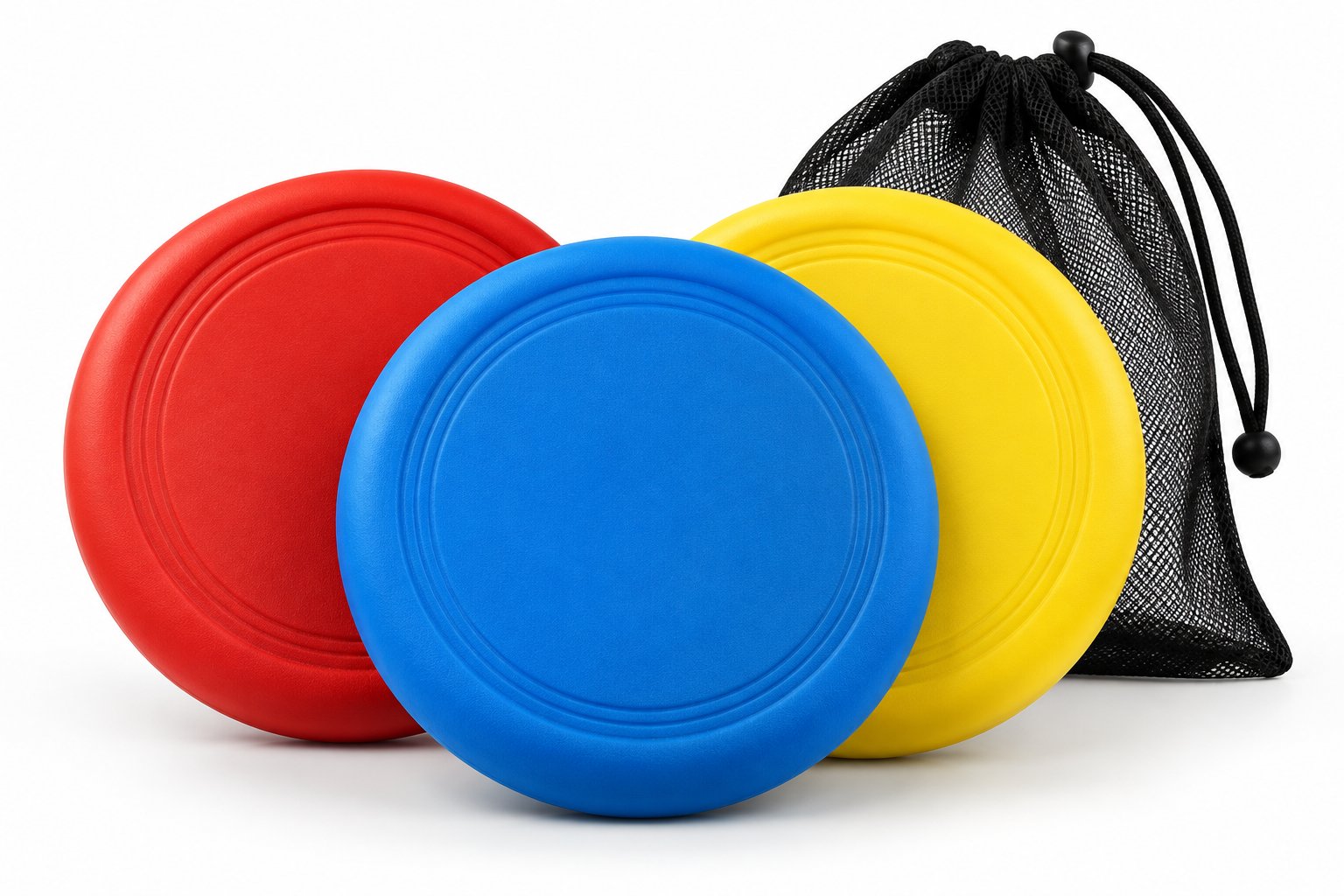
The number of discs per set directly multiplies your material and labor cost. Our standard set includes 3 discs in different colours. Adding more discs increases cost roughly linearly, though packaging and handling may not scale at the same rate.
Accessories like a mesh carry bag add convenience and perceived value. A simple mesh bag is a modest cost addition, but it also affects packaging volume and shipping weight. If your set includes a bag, confirm its material and construction—flimsy bags can undermine the product's quality image.
Printing and Branding
Custom printing—logos, patterns, or text on the discs or bag—adds cost through setup (screens, plates, or digital setup) and per-unit ink/labor. For small orders, setup fees can be significant; for larger orders, they amortize. Consider whether you need full-color printing or a single-color logo, and whether printing on the disc, the bag, or both is necessary.
OEM/ODM services are available for our soft foam set, meaning you can customize colors, packaging, and branding. Be clear about artwork requirements and approval steps to avoid rework costs.
Packaging
Packaging serves protection, presentation, and logistics. A simple poly bag is cheapest; a printed header card or color box adds cost but can improve shelf appeal. Our set includes a mesh bag and an export carton holding 36 sets. The carton specification affects shipping cost per unit—more sets per carton can reduce freight per unit but may increase handling weight. Confirm carton dimensions and weight with your supplier to estimate freight accurately.
Order Volume
Volume is the most direct lever on piece price. Our MOQ is 500 sets. As volume increases, you can often negotiate better per-unit pricing because fixed costs (molds, setup, printing plates) are spread over more units and production efficiency improves. However, larger orders require more working capital and storage. Balance your cash flow and inventory capacity against the savings.
Ask suppliers for a price break schedule (e.g., 500–999 sets, 1,000–2,999 sets, 3,000+ sets) to see how price scales.
How to Compare Supplier Quotes
Quotes can be misleading if they don't cover the same scope. Use this checklist to ensure apples-to-apples comparison:
- Specification: Confirm disc diameter, weight, material, number of discs, and accessories.
- Printing: Clarify if printing is included, number of colors, and setup fees.
- Packaging: Specify bag type, header card or box, and carton quantity.
- Certifications: Ask for EN71 and ASTM F963 compliance (or other required standards) and whether test reports are available.
- MOQ and price breaks: Note the MOQ and request a tiered price list.
- Lead time: Confirm production and shipping lead times, and whether they are guaranteed.
- Payment terms: Understand deposit and balance terms.
- Sample cost and timeline: Ask if sample fees are refundable against orders.
Request quotes in writing and ask suppliers to itemize costs where possible. A transparent quote is easier to compare and reduces the risk of hidden charges.
What to Check on Samples
Samples are your chance to verify quality before committing to bulk. Focus on:
- Material feel: Is the foam soft yet resilient? Does it return to shape after compression?
- Weight and balance: Weigh a disc and check if it flies straight (test a few throws).
- Rim finish: Look for smooth, rounded edges without flash or sharp seams.
- Color consistency: Check that colors match your specification and are evenly distributed.
- Printing quality: Verify logo clarity, color accuracy, and adhesion (rub lightly).
- Bag and packaging: Inspect stitching, material strength, and print quality on the bag; check carton labeling.
- Compliance documentation: Request copies of test reports for the exact product and materials.
Test the sample with the intended age group if possible—supervise young children and observe how the disc performs in play.
Beyond Toys: Disc Golf Equipment
Note that searches for "disc" can also refer to disc golf equipment, which is a different product category with its own cost structure (specialized plastics, flight ratings, and smaller MOQs). This article focuses on toy and leisure flying discs for kids and families. If you're sourcing disc golf discs, consult a specialized supplier.
FAQ
What is the typical MOQ for soft foam flying disc sets?
Our MOQ is 500 sets. MOQs vary by supplier and customization requirements.
Can I customize the colors and add my logo?
Yes, OEM/ODM is available. You can choose disc colors, bag color, and printing. Setup fees may apply.
Are the discs safe for young children?
Our set is designed for ages 3 and up and is made from soft PU foam. Always supervise children during play.
What certifications should I look for?
For the EU, EN71; for the US, ASTM F963. Confirm with your supplier that the specific product and materials have been tested.
How long does production take?
Lead time depends on order volume and customization. Request a production schedule from your supplier.
For detailed specifications and to discuss your requirements, visit our Soft Foam Flying Disc Set page or contact us directly.