

A trade buyer's guide to plush toy cleaning that separates what you can print on a care label from what your supplier can actually document. Covers the three distinct commitments of surface cleaning, whole-item washing and drying, the care specification items to write into a purchase order, and how a counter display box changes cleaning cadence at retail.
The cleaning method for a plush toy is the simple half of this question. The care claim is the half that generates returns. When a shopper reads a care label, they read it as a promise, and a retailer or importer passes that promise on to every customer who buys the item. If the label says more than your supplier tested on the sample you approved, the gap comes back as a refund, a chargeback or a listing complaint. This article sets out how to clean plush toys in trade terms: which cleaning commitment applies to a given construction, what evidence a supplier must put behind it, and how to write a care instruction you can defend.
What this article settles for a buyer
- Surface cleaning, whole-item washing and drying are three separate commitments, not one care claim.
- Which of the three applies depends on filling, seam construction and whether hard or detachable parts are present.
- Promise only what the supplier can document and what was actually tested on your approved sample.
- Our current plush models document wipe-clean care only; machine washing is a question to settle at sample stage, not an assumption.
Three commitments that get collapsed into one care label
Buyers and suppliers regularly trade care language as if there were one answer. There are three, and they carry different risk.
Surface cleaning
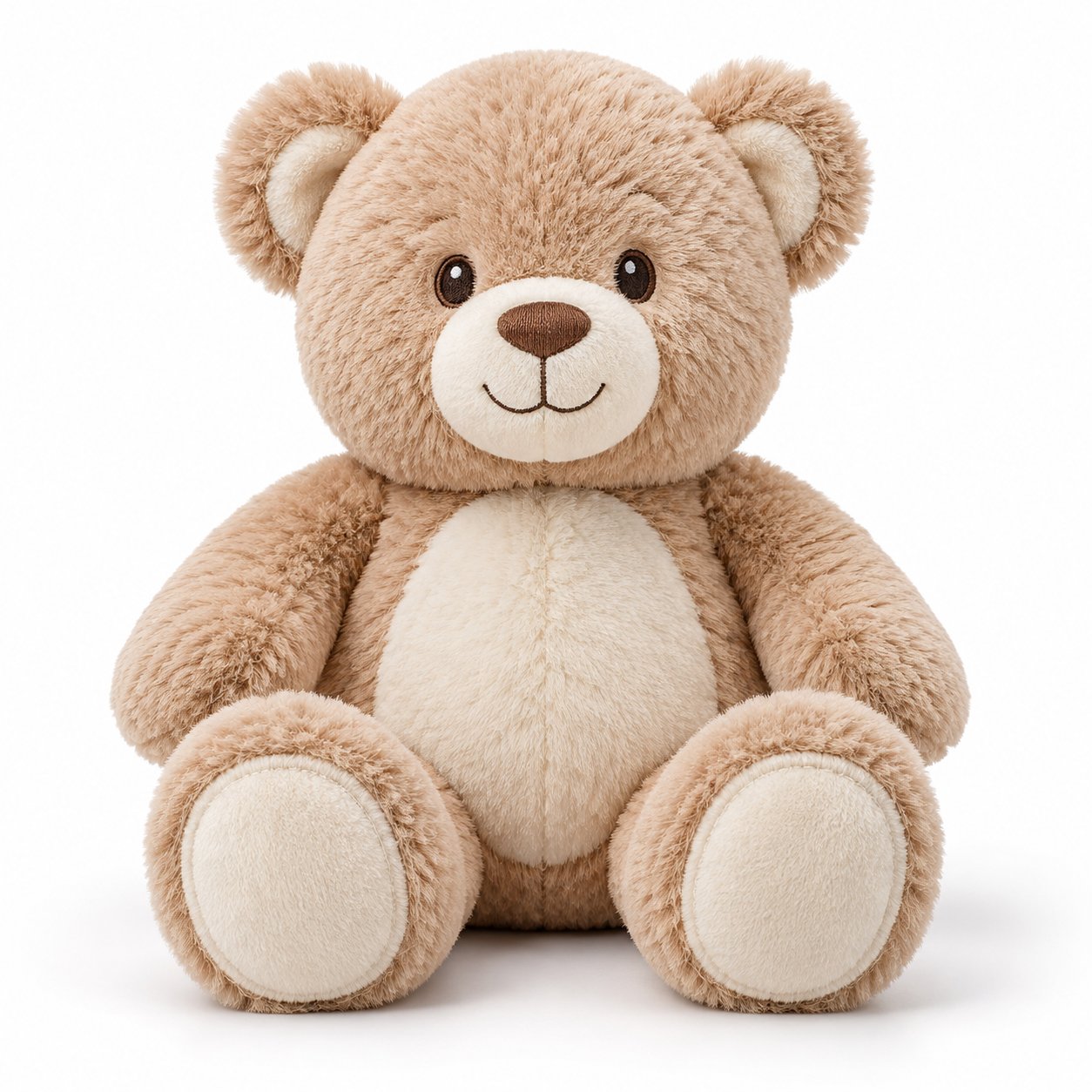
Surface cleaning means refreshing the outer fabric without wetting the filling. It applies when the article has a short-pile face, embroidered or stitched features rather than moulded or glued hard parts, and a filling that should not be saturated. It is the lowest-risk claim because the item is never soaked through, so seam behaviour and filling loft are not put under stress. Both of our current plush models fall into this band: the plush teddy bear comfort toy for infants uses a short-pile surface with hypoallergenic polyester fibre filling and embroidered eyes and nose instead of plastic parts, and the plush animal assortment in counter display box uses short-pile plush, polyester fibre filling and embroidered facial features. The recorded care instruction for both is wipe clean with a damp cloth. That is the extent of what the current product records support.
Whole-item washing
Whole-item washing means immersing or machine washing the entire article and is a materially different promise. Whether it applies depends on the filling (loose fibre versus a bagged or bonded core), the seam construction and thread, the presence of any rigid insert, sound module, glued trim or detachable accessory, and the colour fastness of the face fabric and any contrast panels. Neither product record for the two models above states that machine washing, soaking or immersion is approved. Do not carry a washable instruction across from another plush programme, and do not assume that a double-stitched seam on its own makes an item machine washable. If machine washing matters for your channel, raise it as a development question and settle it by running an actual wash test on your approved sample before any label text is printed.
Drying
Drying is where most care claims quietly fail. Heat and tumbling affect pile, filling recovery and any adhesive or trim. A drying instruction is a separate commitment and needs its own evidence. Where the documented method is wipe-clean, drying is a simple air-dry step in a well-ventilated area. Where a buyer intends to promise machine drying, that must be tested on the sample in the same round as the wash test, because a passing wash result says nothing about a dryer.
A practical surface-cleaning sequence for short-pile plush
The sequence below is written for retail and after-sales staff, and it doubles as a check on whether the care text you print is operationally sensible. It assumes a wipe-clean article such as those described above.
- Check the article first for any loose trim, opening seam or detached part, and set aside anything that fails a hand pull at the seams and features.
- Remove surface dust and loose debris with a soft brush or a vacuum on a low setting with a soft attachment, working with the pile rather than against it.
- Dampen a clean, light-coloured cloth, wring it out so it is barely wet, and wipe the face fabric in small sections.
- Work from the cleaner areas toward soiled areas so you are not spreading marks across the item.
- Do not flood the fabric. The cloth should be damp, not wet, and liquid should not be pressed into seams or the filling.
- Allow the article to dry thoroughly in a well-ventilated area before it goes back on display or into a poly bag.
Failure modes that turn into complaints
- Over-wetting. A cloth that is too wet drives moisture into the filling, which is slow to dry and can leave the item feeling heavy or musty.
- Rubbing embroidery and stitched features. Abrasive scrubbing on embroidered eyes and noses can fuzz the stitching or distort the feature.
- Cleaning a damaged item. Wiping across an open seam spreads moisture into the filling and the seam then fails under handling.
- Bagging before dry. Packing a damp article into a poly bag traps moisture and creates a complaint on opening.
- Assuming the label covers more than it does. The most expensive failure is a care claim that says washable when the article was only ever tested as wipe-clean.
Care specification items to write into the purchase order
Care text belongs in the specification, not in a footnote. The table below lists the items worth stating explicitly, and what the supplier must provide against each.
| Specification item | What the buyer states | What the supplier must supply |
|---|---|---|
| Cleaning method | The exact method permitted for the model, for example surface wipe with a damp cloth | Written care instruction matching the approved sample, not a generic category statement |
| Filling composition | The filling declared on the label and in the specification | Confirmed filling type and construction, including whether it is loose fibre or a contained core |
| Hard and detachable parts | Whether any rigid part, sound module or detachable accessory is present | Confirmation of construction, including embroidered versus attached features |
| Seam construction | The seam standard required for the programme | Statement of seam type and stitching used on the model |
| Wash and dry testing | Whether a wash or dry claim is required, and the conditions to be tested | Wash test evidence on the approved sample if such a claim is requested, with the result stated as tested |
| Labelling language | Target market and required care wording | Artwork check against the approved text before production |
| Compliance documents | The exact model and programme being ordered | EN71 and ASTM F963 compliance documentation covering the exact model ordered |
On the last row, be specific with your supplier: a certificate or test report must cover the exact model and configuration you are buying, not a neighbouring item in the range. Our two current plush models are EN71 and ASTM F963 compliant, and the document set for your order should be checked against the model number you are actually purchasing.
How a counter display box changes cleaning cadence in store
An assortment packed in a counter display box creates a handling pattern that a single-item SKU does not. Shoppers pick up, squeeze and return animals to the box, so the same items are touched repeatedly across the trading day. The plush animal assortment in counter display box for retail packs six plush animals with one display box, with animals at 18 cm seated height and an age range of 3+.
Three practical consequences follow. First, the display stock needs a routine surface wipe on a regular cadence rather than only when a mark is spotted, because the box concentrates handling. Second, staff need to check for seam opening and loose trim as part of that routine, since repeated handling finds weak seams before a customer does. Third, the care text should sit where store staff can see it, not only on the individual item, because the person maintaining the display is usually not the person who read the purchase order. The same wipe-clean logic applies here as to the infant comfort toy: the recorded care instruction for this assortment is surface cleaning, and the assortment is not documented as machine washable or machine dryable.
Questions buyers ask about plush toy care
Can you make these plush toys machine washable?
That is a development question rather than a current specification. Our existing plush models document wipe-clean care only, and their product records do not state that machine washing, soaking or tumble drying is approved. If your channel needs a washable claim, raise it before sampling so the construction, filling and seam standard can be evaluated for it, and settle the claim with a wash test on the sample you approve.
What care wording can we print on the retail label?
Print only the method the supplier has documented for the model and that you have verified on the sample. For our current models that means a surface wipe instruction. Care wording that goes beyond the documented method shifts the return risk to you, because the shopper is following a promise you published.
Do the compliance documents cover care claims too?
No. EN71 and ASTM F963 compliance is a separate matter from care testing, and the document must cover the exact model ordered. A compliance file does not establish that an item survives washing or drying; only a test on the relevant construction does that.
Does the age range affect which cleaning method we should specify?
It affects how the product is used and how often it needs refreshing, which is worth reflecting in the care instruction and in store routine. The infant comfort toy is rated 0+, while the animal assortment is rated 3+. In both cases the cleaning method you may print is the one documented and tested for that model, not a method borrowed from the other.
What to send a supplier to get a care claim you can defend
Send a short written brief rather than an open question. State the model or models you are considering, the channel they will sell through, and the cleaning method you want to be able to promise on the label. Ask the supplier to confirm the filling and seam construction of the proposed model, to state in writing which cleaning method is documented for it, and to say plainly whether any wash or dry claim has been tested on that construction. Ask for the care instruction text as it will appear on the label and on the packaging, and ask for the compliance documentation against the exact model number you intend to order. Then verify the answer on the sample: run the documented method yourself, check what happens to the pile, the seams and the stitched features, and only then approve label copy. If a wash or dry claim is part of your plan, put it in the brief as a test requirement so the sample round settles it, instead of discovering the limit after the cartons have shipped.
Care instructions in this article reflect the recorded product information for the two plush models referenced. Confirm the care method and documentation for the exact model and configuration on your order before finalising label artwork.

