
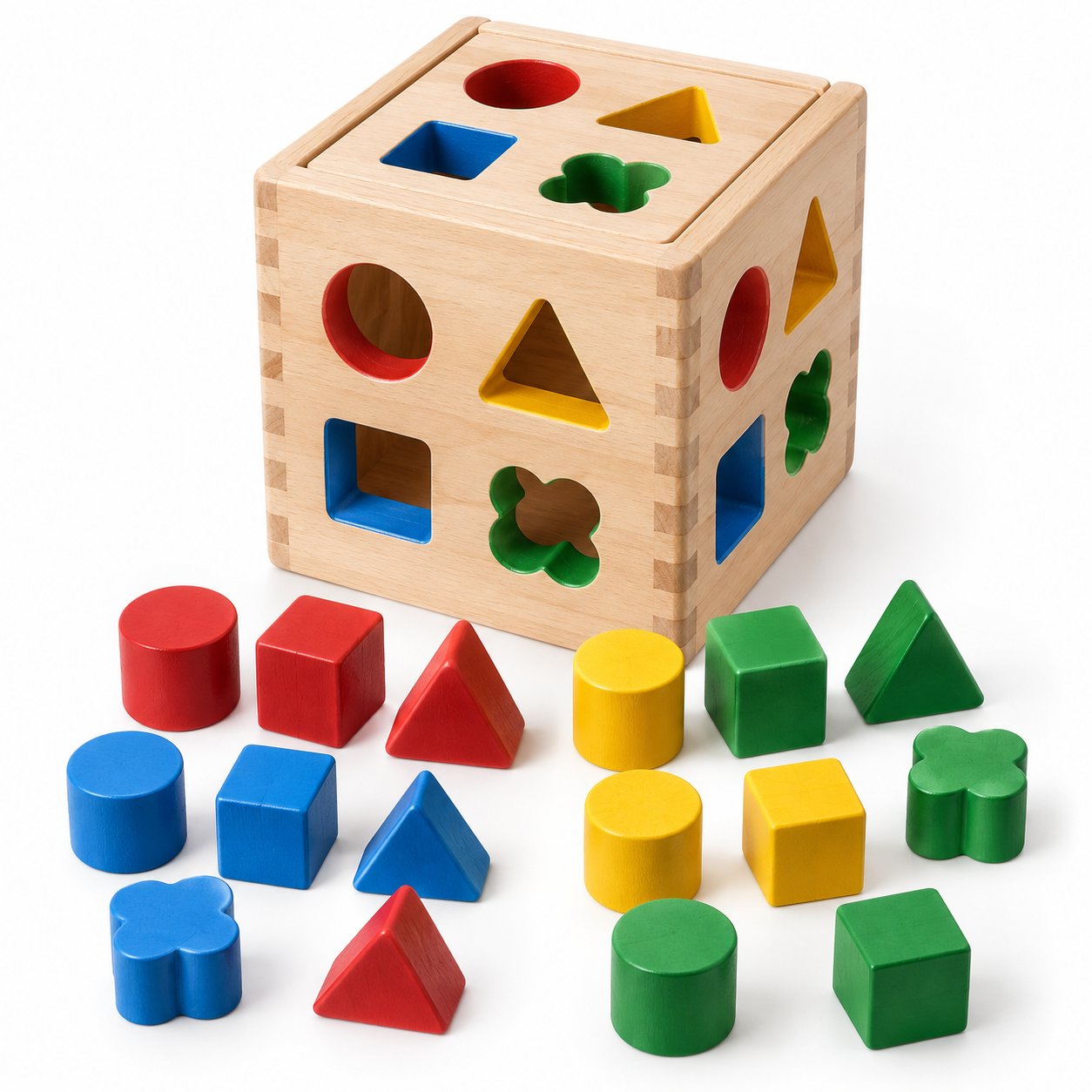
A practical guide for B2B toy buyers on how shape sorters are age-graded, what to verify on the label and product, and how to plan a play progression from 2+ sorting to 3+ Montessori sets.
What Age Is a Shape Sorter For? The Short Answer

Most shape sorters are designed for children from about 18 months to 3 years, but the age printed on the box is a starting point, not a guarantee. The reason is developmental: sorting shapes requires a child to recognize a form, match it to a hole, and rotate the piece until it fits. That hand-eye coordination and problem-solving usually emerges around 18–24 months. Products aimed at younger toddlers feature larger, easier-to-grip blocks and simpler shape sets.
For buyers, the practical question is not just “what age is a shape sorter for?” but “what age is this shape sorter appropriate for, and what on the label and in the product supports that claim?” Age grading is a claim that must be verified against physical design, safety documentation, and finishing details.
Why Age Grading Matters to B2B Buyers
Age grading drives everything from retail compliance to returns. A sorter labeled 2+ but containing small parts may fail small-parts requirements for that age band. A sorter labeled 3+ may miss the toddler market entirely. For importers, the grade must be defensible: it should match the actual block sizes, the finish, and the safety documentation in the file.
Age grading is not an arbitrary marketing sticker. It reflects a manufacturer’s judgment about the minimum age at which the product is safe and developmentally useful, based on block dimensions, material, coating, and foreseeable use. Your job as a buyer is to confirm that the grade is supported by the physical product.
How to Read and Verify Age Grading on a Shape Sorter
Age grading on a shape sorter rests on four verifiable pillars: the age label and documentation, block size relative to small-parts risk, finish and coating, and play progression. Each pillar should be checked before you commit to a PO.
1. The Age Label and Safety Documentation
The age label should be consistent across packaging, product instructions, and any online listing. More importantly, it should be backed by test reports for the target market. For example, a solid wood shape sorter cube with 12 chunky blocks in 4 shapes and 4 colors is graded 2+ in our product specification. That grade is supported by block dimensions and the absence of small parts; ask for the EN71/ASTM F963 test reports that cover this model.
Ask for the actual test reports, not just a certificate of compliance. Check that the tested model numbers match the product you are ordering, and that the reports are current. If the supplier offers OEM/ODM, confirm how custom changes (size, paint, packaging) affect the validity of existing test reports.
2. Block Size vs. Small-Parts Risk
The most common age-grading failure is a mismatch between block size and the age band. Blocks that could fit entirely into a small-parts cylinder are a hazard for children under 3. Even if the product is labeled 3+, buyers should verify that the blocks are genuinely too large to be a choking risk for the intended age.
In practice, look at the smallest dimension of the smallest block. A chunky block with a thickness of 2.5 cm and a footprint well above small-parts thresholds is a different risk profile from a thin, small block. For the 2+ cube described above, the 15×15×15 cm cube and 2.5 cm block thickness are part of the safety rationale. Ask the supplier to confirm block dimensions in writing and to explain how the design avoids small-parts hazards for the labeled age. The practical check is the small-parts evaluation in the destination market’s test report: ask whether the smallest block passes it for the labeled age, and get that conclusion documented rather than estimating from photos.
3. Finish, Coating, and Edge Treatment
Surface finish is an age-grading issue, not just a cosmetic one. Younger children mouth toys, so non-toxic coatings and smooth, rounded edges matter. A sorter sanded smooth with rounded edges and finished with a non-toxic water-based coating is a stronger candidate for a 2+ grade than a product with sharp edges or an unverified paint system.
For B2B buyers, request the coating specification and confirm that the finish is appropriate for the age grade. If the product uses solid wood, confirm the species and moisture content, as these affect stability and splinter risk. A removable lid that allows blocks to be reset quickly is also a practical feature for group settings, but it should be secure enough that a toddler cannot easily access internal fixings.
4. Play Progression and Developmental Fit
Age grading should reflect what the child can actually do at that age. A 2+ sorter with 4 shapes and 4 colors is appropriate for shape recognition and simple matching. A 3+ Montessori learning set that combines shape sorting, stacking, and threading is a next step because it adds fine-motor and sequencing challenges.
When you review a supplier’s range, check that the progression is coherent. If the same supplier offers a 2+ shape sorter and a 3+ Montessori set, the age grades should reflect increasing complexity, not just different packaging. This coherence helps retailers build a shelf story and reduces the risk of returns from parents who find the product too easy or too difficult.
Age Grading at a Glance
| Check | What to Verify | Why It Matters |
|---|---|---|
| Age label | Consistent across packaging, instructions, and listings | Prevents compliance and returns issues |
| Test reports | EN71/ASTM F963 reports for the exact model | Supports the claimed age grade |
| Block size | Smallest block dimension and thickness | Reduces small-parts risk for the labeled age |
| Finish | Non-toxic water-based coating, rounded edges | Addresses mouthing and handling by young children |
| Play value | Shape and color count, progression to next set | Matches developmental stage and shelf logic |
What Comes After Shape Sorting? Planning the Next Step
Shape sorting is an early step. Once a child has mastered fitting blocks into holes, the next developmental stage involves stacking, threading, and more open-ended construction. A Montessori learning set that combines shape sorting, stacking, and threading is graded 3+ in our range, reflecting the additional fine-motor control and concentration required.
For buyers, this progression is useful for assortment planning. A 2+ shape sorter can anchor the toddler segment, while a 3+ Montessori set can extend the range for slightly older children. The key is to confirm that each product’s age grade is independently supported, rather than assuming that because one product is 2+, the next one is automatically 3+.
FAQ
Most shape sorters are appropriate from around 18 months to 3 years, with many products labeled 2+. The appropriate age depends on block size, finish, and the child’s developmental stage. Buyers should verify the age label against test reports and physical dimensions.
Not necessarily. A 2+ grade assumes a child who no longer mouths objects indiscriminately. For a 1-year-old, you would need a product specifically designed and tested for that age, typically with larger, softer components. Always follow the manufacturer’s age label.
Confirm that the report covers the exact model and age grade, is issued by a recognized lab, and is current for the destination market. For EN71 and ASTM F963, check that the tested sample matches your production specifications, including block size and coating.
Age grading is a product safety claim, not a packaging choice. Changing the label without re-testing can create compliance risk. If you plan OEM/ODM changes, ask the supplier how those changes affect the existing test reports and age grade.
For buyers evaluating a shape sorter range, request the product specifications and test reports for the exact models you are considering. A supplier who can document block dimensions, coating, and compliance for each age grade is easier to qualify and less likely to create returns.

