
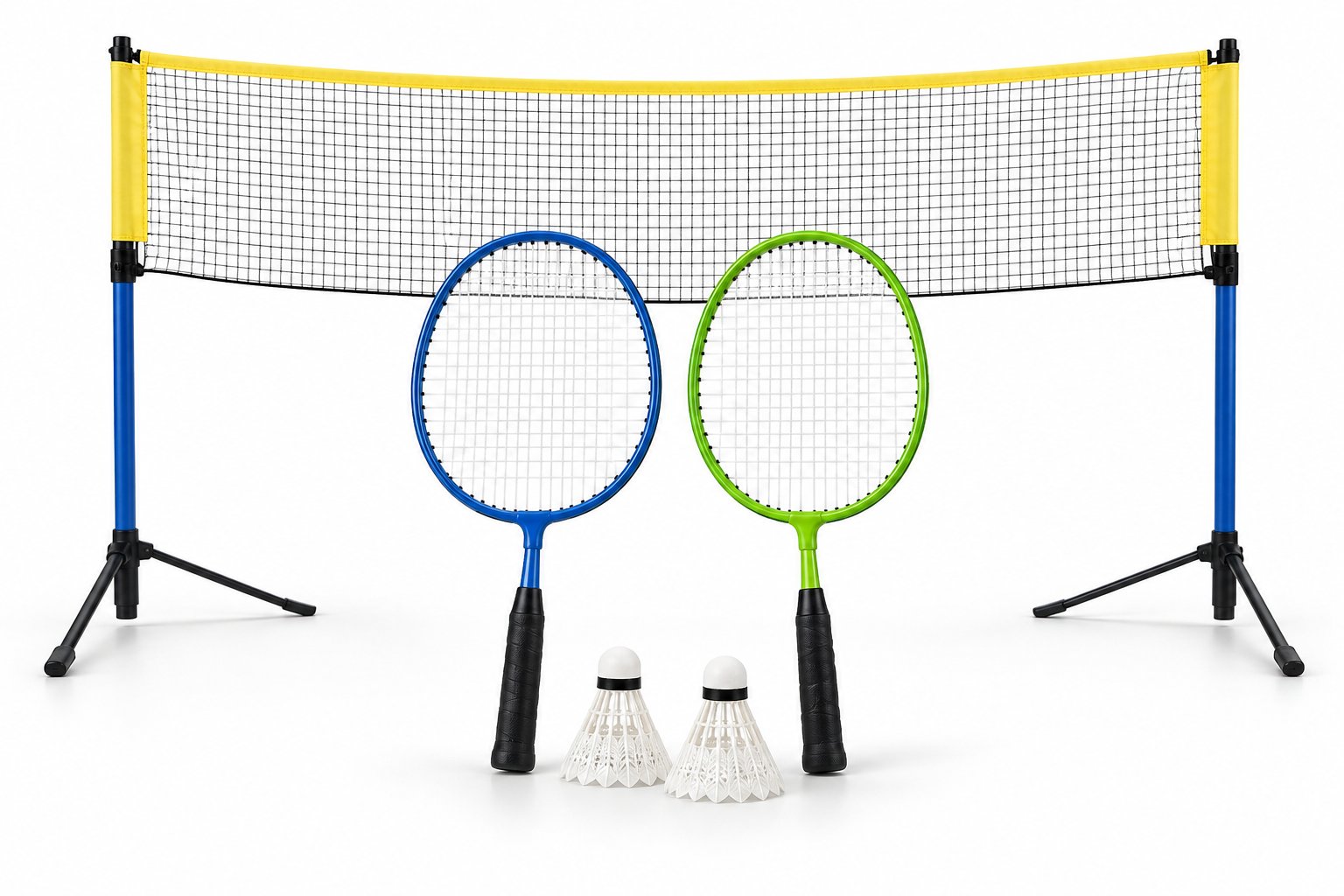
A plain-English anatomy of a badminton racket — frame, strings, shaft, and grip — plus the specs buyers compare on kids' sets, how junior rackets differ from adult ones, and what to check on a sample before ordering.
Racket Anatomy for Buyers
A badminton racket is a lightweight hitting tool made of four main parts: the frame (head), the strings, the shaft, and the grip. The frame holds the string bed, the shaft connects the head to the handle, and the grip is what the player holds. For kids' sets, buyers also compare length, weight class, frame material, and grip comfort — and those specs differ from adult rackets in ways that matter for safety and playability.
Key takeaways
- A racket has four core parts: frame, strings, shaft, and grip. Each affects how the racket plays and how long it lasts.
- Junior rackets are shorter and lighter than adult rackets, with smaller grips and softer frame materials for young players.
- When sourcing kids' sets, confirm length, weight class, frame material, grip type, and compliance (such as EN71 or ASTM F963) on a physical sample.
- Our Junior Badminton Set with Net for School Sports Lessons gives a concrete reference: 53 cm rackets, composite frames, soft grips, and a 300 × 60 cm net.
What are the parts of a badminton racket?
Every badminton racket, from a child's first set to a tournament model, is built from the same four components. Understanding what each part does helps buyers judge quality and spot the differences between adult and junior rackets.
1. The frame (head)
The frame is the oval or isometric loop at the top of the racket that holds the strings under tension. It is usually made of aluminum, steel, carbon fiber, or a composite blend. Adult performance rackets tend toward carbon fiber for stiffness and light weight; kids' rackets often use composite or aluminum for durability and lower cost. The frame's shape and thickness affect the sweet spot — the area where a hit feels most solid.
2. The strings
The string bed is woven across the frame and provides the actual hitting surface. String material, thickness, and tension determine how much power and control the racket delivers. Adult players often choose string tension to suit their style; junior rackets typically come pre-strung at a moderate tension that suits beginners and casual school play. Buyers sourcing kids' sets should confirm that strings are properly tensioned and evenly woven on the sample.
3. The shaft
The shaft is the thin rod connecting the frame to the handle. Its stiffness influences how much flex the racket has during a swing. Stiffer shafts suit powerful adult players; more flexible shafts are easier for children to bend and control. Shaft material usually matches the frame — composite or aluminum for junior sets, carbon fiber for advanced adult rackets.
4. The grip (handle)
The grip is the wrapped handle at the base of the racket. It affects comfort, sweat absorption, and how securely a player can hold the racket. Adult grips come in several sizes; kids' rackets use smaller grips with softer, tackier materials so small hands can hold them without slipping. For school sets, a soft grip is a practical choice because it reduces hand fatigue during lessons.
Which specs matter on kids' badminton rackets?
Buyers comparing junior rackets usually look at five specs: length, weight class, frame material, grip comfort, and string setup. These determine whether a set is appropriate for the intended age group and how well it will hold up in school or club use.
| Spec | What it means | Why it matters for kids' sets |
|---|---|---|
| Length | Total racket length from butt to frame tip | Shorter rackets are easier for children to swing and control; adult rackets are longer and heavier |
| Weight class | Overall racket weight, often grouped as lightweight, medium, or heavy | Lighter rackets reduce strain on young arms; exact weight should be confirmed with the supplier |
| Frame material | Aluminum, steel, composite, or carbon fiber | Composite and aluminum are common in junior sets for durability; carbon fiber is typical in adult performance rackets |
| Grip comfort | Grip size, material, and softness | Small, soft grips help children hold the racket securely and play longer |
| String setup | Pre-strung tension and string material | Moderate tension suits beginners; confirm even weaving and tension on the sample |
Exact weight, balance, and string tension are not standardized across suppliers. Buyers should request these values from the supplier rather than assume them from a catalog photo.
How do kids' rackets differ from adult rackets?
Junior rackets are scaled down versions of adult rackets, but the differences go beyond size. A child's racket is designed around smaller hands, shorter arms, and developing coordination.
- Length: Kids' rackets are shorter, making it easier for children to reach and swing without overextending. Adult rackets are longer for reach and power.
- Weight: Junior rackets are lighter overall. A lighter racket is less tiring for young players and reduces the risk of strain.
- Grip size: Junior grips are smaller in diameter and often softer, so small hands can wrap around them comfortably.
- Frame material: Junior sets often use composite or aluminum frames that tolerate rough handling; adult performance rackets use carbon fiber for stiffness and low weight.
- String tension: Junior rackets are typically pre-strung at a moderate tension for beginners; adult players may customize tension for power or control.
For school sports lessons, these differences matter because the racket needs to be safe, durable, and easy for a child to use without supervision. Sets like the Junior Badminton Set with Net for School Sports Lessons are built around this use case: 53 cm rackets, lightweight composite frames with soft grips, and a nylon net sized for school courts.
What to verify on a sample before ordering
Catalog specs and photos are a starting point, but a physical sample is the only way to confirm quality and suitability. Before placing a bulk order for kids' badminton sets, check the following on the sample:
- Racket length and weight: Measure the actual length and weigh the racket. Confirm these match the supplier's stated specs and suit the intended age group.
- Frame and shaft integrity: Flex the frame and shaft gently. Look for cracks, uneven joints, or rough edges that could harm children.
- String tension and weaving: Press the string bed. It should feel evenly tensioned with no loose or crossed strings.
- Grip comfort and size: Check that the grip is soft, securely wrapped, and appropriately sized for small hands.
- Compliance markings: Confirm the set carries the required safety compliance for your market, such as EN71 or ASTM F963 for toys. Ask for the relevant test reports.
- Set completeness: Verify that the set includes all components — rackets, net, shuttlecocks, pegs, and carry bag — and that assembly is tool-free if that is a requirement.
For reference, our junior set includes two 53 cm rackets, a 300 × 60 cm nylon net, two shuttlecocks, four ground pegs, tool-free assembly, and a carry bag, with 16 sets per carton. It is EN71 and ASTM F963 compliant and suitable for ages 6+. MOQ is 500 sets, with OEM/ODM available.
FAQ
What is a badminton racket made of?
Most rackets have a frame and shaft made of aluminum, steel, composite, or carbon fiber, a string bed of synthetic strings, and a grip made of synthetic or polyurethane material. Junior sets commonly use composite or aluminum for durability.
How long should a kids' badminton racket be?
Junior rackets are shorter than adult rackets. Our junior set uses 53 cm rackets, which suits children aged 6 and up. The right length depends on the child's height and the intended use, so buyers should confirm with the supplier against their target age group.
What is the difference between a kids' racket and an adult racket?
Kids' rackets are shorter, lighter, and have smaller, softer grips. They often use more durable frame materials and come pre-strung at moderate tension. Adult rackets are longer, heavier, and may use carbon fiber for performance.
What certifications should a kids' badminton set have?
For toy safety in North America and Europe, look for ASTM F963 and EN71 compliance. Ask the supplier for the relevant test reports for the specific set you are ordering.
Can I customize the rackets or packaging?
OEM and ODM options are available for our junior badminton set, including custom colors, branding, and packaging. Contact us with your requirements.
Next step
If you are sourcing kids' badminton sets for schools, retail, or promotional use, start with a sample to confirm the specs that matter: length, weight class, frame material, grip comfort, and compliance. Our team at Fujian Lequ Wanwan Co., Ltd. can provide product details and sample arrangements for the Junior Badminton Set with Net for School Sports Lessons.


