Lead time in toy manufacturing covers every stage from sample approval to container loading. This article breaks down the segments that make up a toy OEM timeline, explains which factors extend or compress each stage, and lists the scheduling questions to confirm with a supplier before you place an order.
What Is Lead Time in Manufacturing? Toy OEM Timelines
Lead time is the total elapsed time between a confirmed purchase order and the point at which goods are ready for shipment. In manufacturing, it is not a single step but the sum of sequential stages: planning, material procurement, production, quality control, packing and dispatch. Each stage must finish before the next begins, and delays in one carry forward into all the rest.
For buyers sourcing toys through OEM or ODM programs, lead time is the number that determines when stock reaches a warehouse, when a retail season can be served and how much working capital sits in transit. This article explains what makes up a toy OEM lead time, which variables shift it, and what to confirm with a supplier before committing to an order.
- Lead time is the full interval from order confirmation to readiness for shipment, not just factory assembly time.
- Toy OEM timelines break into distinct segments: sampling, material sourcing, production, quality checking, packing and export handling.
- Customization depth, tooling, order volume, testing requirements, peak-season capacity and sample approval rounds are the main variables.
- Exact durations vary by project and should be confirmed on the quotation and production schedule—not assumed from another product or industry.
The stages that make up a toy OEM lead time
Toy manufacturing is a sequence of dependent steps. A delay at sampling pushes material procurement, which pushes production and every later stage. Understanding each segment lets a buyer see where time is genuinely required and where it can be shortened by better preparation.
1. Sampling and design approval
Before bulk production, the supplier produces a sample that matches the intended product. For ODM work, this may start from an existing platform and adapt colors, packaging or piece counts. For full OEM, a new design must be reviewed for construction, material choice and assembly method. The buyer then examines the sample, requests changes if needed, and signs off.
Sampling takes time because it involves tooling adjustment, material selection and a physical build that must be checked against the buyer's specification. Each revision round restarts part of that work. A clear, complete specification on the first request reduces the number of rounds.
2. Material procurement
Once the sample is approved, the supplier orders raw materials and components: plastic resin, colorants, packaging board, printed inserts and any third-party parts. Procurement duration depends on whether materials are standard stock items or custom orders. Custom-colored resin, printed packaging and non-standard components generally require longer ordering windows than standard grades.
Buyers can influence this stage by confirming material specifications early and by avoiding last-minute changes to packaging artwork after approval.
3. Production
Production covers molding, assembly and any secondary operations such as printing or labeling. Order quantity is the most direct driver here: larger volumes take longer to run through the same equipment. Product complexity also matters—a set with many distinct parts requires more molding cycles and more assembly steps than a simple single-piece item.
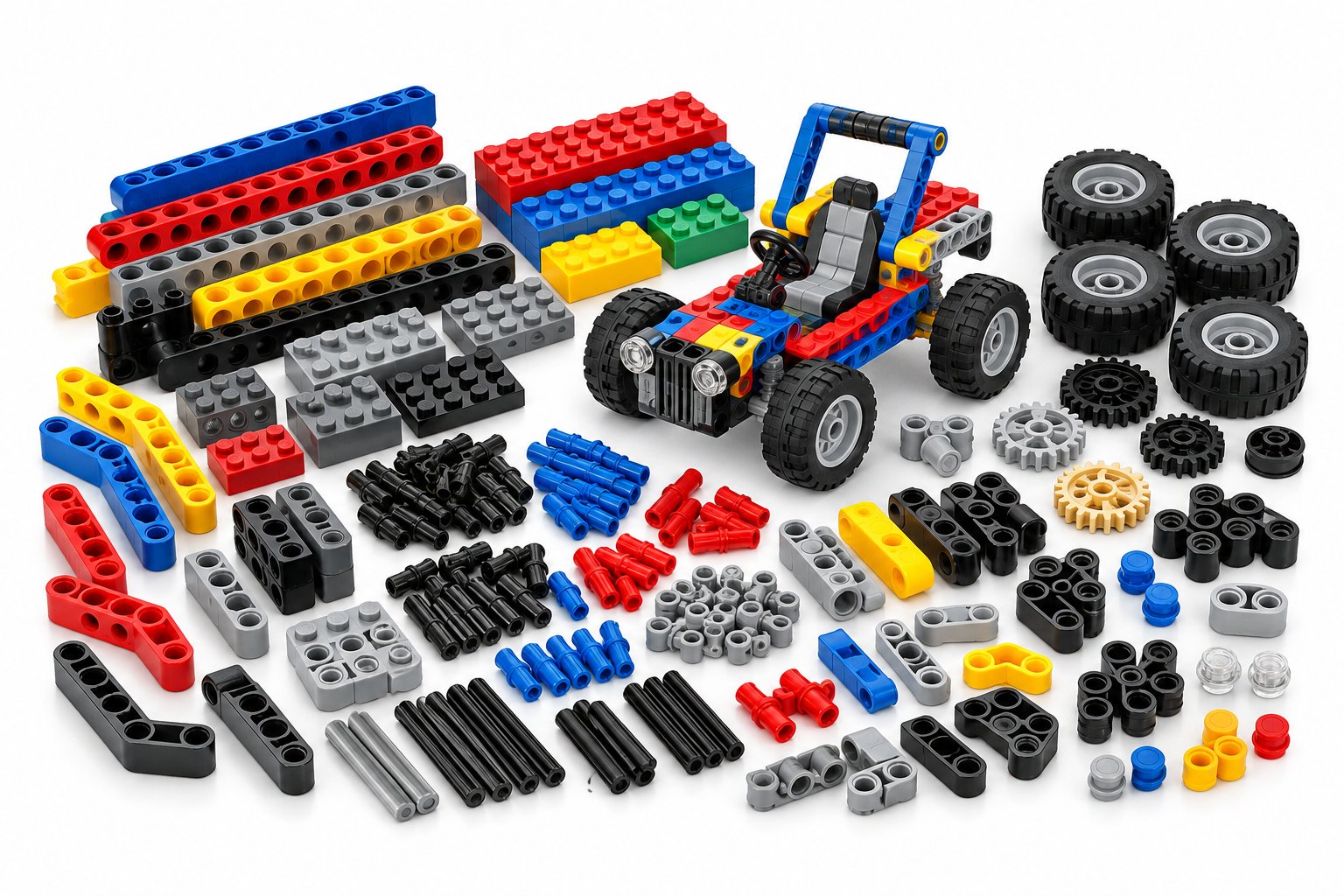
For reference, an OEM building block set such as our STEM Building Blocks Set with 120 Pieces contains 120 pieces—beams, plates, wheels and connectors—and each part type must be molded and then assembled and packed. That piece count gives a concrete sense of how part variety, not just total weight, shapes production time.
4. Quality control
Quality checks run during and after production. Inline inspection catches issues while the line is running; final inspection verifies the finished goods against the approved sample and specification. If the product must meet safety standards such as EN71 or ASTM F963, relevant checks and documentation are completed at this stage. Any nonconformity found here can require rework or replacement, which adds time.
5. Packing
Packing converts finished goods into shippable units. It includes bagging or boxing, inserting manuals or accessories, applying labels and packing into export cartons. Packing is often underestimated: a product with a storage box plus an export carton involves two packing levels, and each level needs its own materials and labor. Late changes to packing configuration can extend this stage.
6. Export handling and dispatch
The final segment covers preparing goods for shipment: consolidating cartons, completing export documentation and making the goods available for the carrier. This stage is partly governed by the supplier and partly by freight arrangements. Buyers who book their own freight should align carrier schedules with the supplier's readiness date.
| Stage | What happens | What drives duration |
|---|---|---|
| Sampling & approval | Prototype built, reviewed, revised and signed off | Design complexity, number of revision rounds |
| Material procurement | Resin, components and packaging ordered and received | Standard vs. custom materials, packaging artwork |
| Production | Molding, assembly, secondary operations | Order quantity, part count, assembly steps |
| Quality control | Inline and final inspection against specification | Testing requirements, findings requiring rework |
| Packing | Inner packing, labeling, export cartons | Packing levels, customization, artwork changes |
| Export handling | Carton consolidation, documentation, carrier readiness | Freight booking, documentation completeness |
Factors that change a toy OEM timeline
Two orders for similar products can have different lead times. The variables below explain why, and each one is something a buyer can either prepare for or negotiate.
- Customization depth. A stock design with a private label needs less work than a fully new toy with custom tooling, unique packaging and modified components. More customization means more stages that must be reviewed and approved.
- Tooling and molds. New molds must be designed, machined and tested before production begins. Tooling is a one-time front-end investment that sits entirely ahead of the production run.
- Order volume. Larger quantities take longer to produce on the same equipment. Volume also affects material procurement, since larger orders may require more raw material than is held in stock.
- Certification and testing. Products intended for North America or Europe must meet applicable standards such as ASTM F963 or EN71. Testing and documentation occur at defined points and can extend the schedule if samples must be submitted to a laboratory.
- Peak-season scheduling. Toy demand is seasonal. Factories receive order concentrations ahead of major retail periods, and capacity at those times is allocated across customers. A confirmed production slot matters more than an estimated start date.
- Sample approval rounds. Every revision round adds a cycle of build, ship and review. Clear specifications and consolidated feedback reduce these cycles.
Questions to confirm before placing an order
Lead time figures are only meaningful when tied to a specific order and a specific schedule. Before committing, ask the supplier to confirm the following in writing:
- What is the lead time measured from? Is it counted from purchase order date, deposit receipt or sample approval? The starting point changes the meaning of the number.
- Which stages are included in the quoted lead time? Confirm whether sampling, testing and packing are inside the quoted window or additional.
- Is the production slot reserved? Ask when the order is scheduled on the factory calendar, especially for peak-season orders.
- What are the sample approval milestones? Clarify how many revision rounds are anticipated and how each round affects the schedule.
- What testing or certification steps are planned, and when? Confirm the standards to be met and the point in the timeline when samples go to the laboratory.
- What happens if materials are delayed? Ask how material lead time is tracked and what alternatives exist for critical components.
- What is the packing configuration, and is it fixed? Changes to packaging after approval can extend the packing stage.
- How will readiness for shipment be communicated? Agree on the notification point so freight booking can be aligned.
For a product like the 120-piece STEM building blocks set—ABS, BPA-free, press-fit assembly, MOQ 500 sets, packed 12 sets per carton—the answers to these questions determine when a container can actually be loaded. The specifications are fixed on the product page; the schedule is confirmed per order.
Conclusion
Lead time in toy manufacturing is the sum of sampling, procurement, production, quality control, packing and export handling. It is not a fixed industry number, and it should not be borrowed from another product category. The reliable approach is to ask a supplier to break down each segment for your specific order, confirm the starting point of the quoted timeline, and secure a production slot before committing.
If you are planning a toy OEM or ODM order for the North American or European market, send us your specifications and we will confirm the relevant schedule points for your project.