A practical buying guide for daycare and preschool operators comparing direct-from-manufacturer sourcing, domestic distributors, and wholesale platforms. Learn what to specify, how to vet suppliers, and how to manage freight and compliance when purchasing outdoor play equipment wholesale.
Preschools and daycares buy outdoor play equipment the way they buy anything else that stays outside and gets climbed on every day: by checking durability, safety-relevant construction, replacement parts, and landed cost — not by browsing the prettiest catalog page.
What this guide covers
Key takeaways
- The right channel depends on order size, budget cycle and how much specification control you need — not on which option sounds cheapest per unit.
- Ask for load ratings, material specs, fixings, and post-installation inspection guidance; those determine whether a set survives a playground year.
- For playground purchases, freight is often a large share of total cost — always compare on landed cost, not ex-works price.
- Spare parts availability and whether components can be re-ordered individually matter as much as the initial price.
The four channels — and what each is actually good for
Most preschool and daycare buyers end up choosing between four sourcing routes. Each has a different cost structure and different risks.
Direct from a manufacturer
You work with the factory that makes the equipment. This suits centers that are furnishing multiple playgrounds, replacing a full installation, or standardizing across a group of sites.
- Advantages: full control over specifications, colors and configurations; ability to order spare parts later; lower per-unit cost at volume.
- Watch for: you carry the responsibility for checking that the product matches your local safety expectations; communication may cross time zones; minimum order quantities may apply.
Domestic distributors and school-supply companies
A distributor holds stock locally and delivers quickly. This is the practical route when you need equipment this month, or when your budget cannot cover a container shipment.
- Advantages: short lead times, local returns and warranty handling, someone else manages import procedures.
- Watch for: higher unit prices; limited ability to change colors, sizes or configurations; you may not know the original manufacturer, which makes later spare-part matching harder.
Wholesale marketplaces and B2B platforms
Online marketplaces list many suppliers side by side. They are useful for price benchmarking and for finding suppliers to contact, but listings alone do not verify manufacturing quality.
- Advantages: quick comparison of price ranges and product formats.
- Watch for: photos may not reflect the delivered product; identical listings may come from trading companies rather than factories; inspection and after-sales terms vary widely.
Second-hand and surplus equipment
Some centers buy used play structures from closing facilities. This can reduce upfront cost, but it shifts risk onto you:
- You cannot confirm the equipment's full service history or whether it was overloaded or modified.
- Faded or cracked plastic, corroded fixings and missing fasteners are common and may not be visible in photos.
- If the original manufacturer has discontinued the model, replacement parts may be unavailable.
| Channel | Best suited to | Typical trade-off |
|---|---|---|
| Direct manufacturer | Multi-site groups, full playground fit-outs, buyers who need spare parts | Longer lead time; minimum order quantities may apply |
| Domestic distributor | Urgent replacement, single units, no import capacity | Higher unit price; limited customization |
| B2B marketplace | Sourcing research and price benchmarking | Supplier quality varies and must be verified independently |
| Second-hand / surplus | Tight budgets, temporary installations | Unknown service history; parts may be unavailable |
What to specify before you request quotes
Suppliers quote faster and more accurately when you give them a specification instead of a description. The list below is the minimum a daycare or preschool buyer should prepare. It also becomes your checklist when the goods arrive.
- Age range and number of children: equipment sized for 2–5 year olds has different dimensions and fall-height requirements than equipment for older children. State how many children will use the structure at the same time.
- Space dimensions: length, width and any slope or surface type. Include the required safety zone around each structure, not just its footprint.
- Material specification: for plastic parts, ask for the polymer type; for metal parts, ask about wall thickness and finish; for timber, ask about species, surface treatment and whether edges are rounded.
- Fixings and hardware: ask for bolt material and finish, and whether tamper-resistant fixings are used. These details drive how the equipment performs after seasons of rain and sun.
- Load and use assumptions: tell the supplier the maximum intended user weight and whether adults may also climb or sit on the structure.
- Spare parts: confirm that individual components — slides, swing seats, brackets, caps — can be re-ordered, and ask for the current spare-part list.
- Documentation: request an installation manual, maintenance guidance and a parts list with the quotation, in your language if possible.
If a supplier cannot answer these points before the order, treat it as information about how post-sale support will go.
How to vet an outdoor play equipment supplier
Price lists are easy to produce. The following checks separate suppliers who can support a daycare account from those who only ship once.
Sample first, then scale
Order one unit or one representative component. Inspect it against your own specification list: wall thickness, weld or seam quality, edge finishing, hardware, packaging, and whether the manual matches the shipped item. A sample that passes inspection is a far stronger signal than a catalog or a certificate image.
Ask about the production process, not just the product
Specific questions get specific answers: How are metal parts prepared before coating? How are plastic parts formed and de-flashed? How are fixings checked before packing? Suppliers who manufacture in-house describe their own process; traders tend to give general statements.
Check compliance claims carefully
Different markets apply different playground equipment standards. Ask the supplier which standards or test reports apply to the specific model you are buying, and check that the report covers that model — not just a similar product in the catalog. A company-level certificate does not automatically cover a specific product. Your own market's requirements remain your responsibility to confirm.
Confirm commercial terms in writing
- Lead time from deposit, and how it changes for repeat orders
- Incoterm and named port or delivery point
- Payment terms and currency
- What is covered if parts arrive damaged or missing
- Packing method and how mixed models are labeled
A note on lead time and pricing
Lead times and unit prices for outdoor play equipment vary substantially with order size, configuration and destination. Any quotation you receive should state the configuration it is based on; generic published prices rarely match the delivered specification. Confirm current lead time and terms directly with the supplier for your specific order.
Freight, packaging and landed cost
Play structures are bulky. Slides and climbing units are often shipped knocked-down, but a full playground can still occupy significant container space. Three practical points:
- Calculate landed cost, not ex-works price. Add freight, insurance, duties, port or terminal handling, and inland delivery to your site. A lower unit price on a bulky item can cost more once freight is added.
- Ask for a packing list with dimensions and weights per carton. This lets you check container utilization and plan unloading. Confirm whether packaging is suitable for outdoor storage during transit and your own on-site staging.
- Plan assembly. Ask whether installation is straightforward for your maintenance team, whether any special tools are needed, and whether anchor fixings are included.
Buying outdoor play equipment wholesale
Wholesale purchasing for daycares usually means one of two situations: a single center buying enough equipment to fill a new playground, or a group or purchasing cooperative consolidating orders for several sites.
When buying in volume:
- Standardize the core items across sites — same swing frames, same slide models — so spare parts fit any location and staff only learn one assembly procedure.
- Ask about mixed containers. Many suppliers of preschool outdoor play equipment will combine different models in one shipment, which helps smaller buyers reach a volume price point without over-ordering one item.
- Negotiate the parts list, not just the price. A modest discount plus a stocked spare-parts kit is often worth more than a deeper discount with no parts support.
- Re-order to the same specification. Keep your own specification sheet on file so that when you reorder in two years, the new batch matches what you installed.
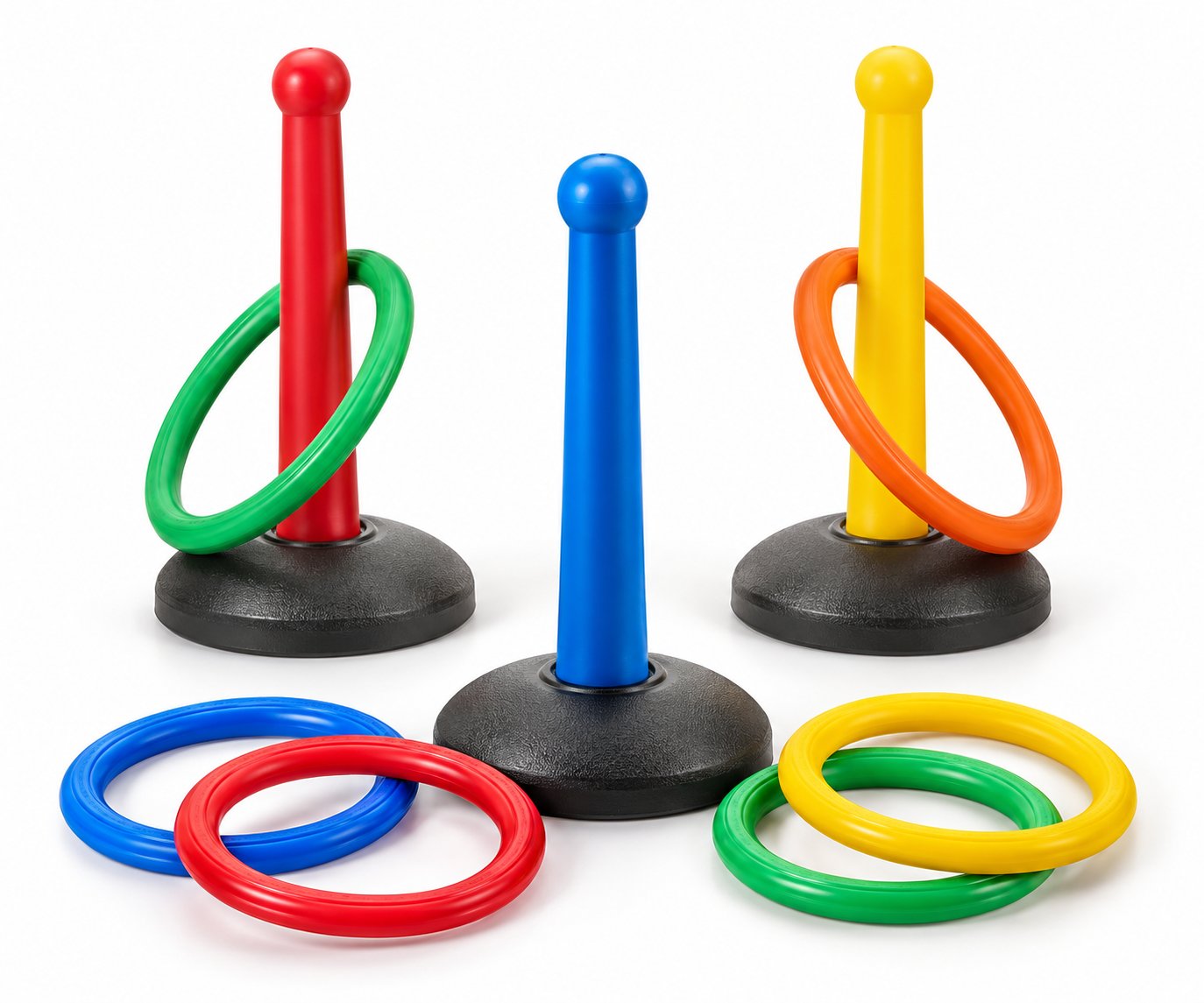
For smaller outdoor programs, packaged garden games can be a practical complement to fixed equipment: a ring toss garden game set for playgrounds (six rings, three weighted posts, EN71 / ASTM F963 compliant, MOQ 500 sets) or an outdoor sports set for group play (beach ball, flying disc and ring toss in weather-resistant materials, MOQ 500 sets) extend active play without the footprint of a full structure.
FAQ
Should a daycare buy directly from a manufacturer or through a local dealer?
It depends mainly on order size and urgency. Direct manufacturer sourcing gives more specification control and lower per-unit prices at volume, but you take on import procedures and longer lead times. A local dealer is faster and handles warranty locally, at a higher unit price. For a single urgent replacement, a dealer is usually the practical choice; for a full playground or multi-site rollout, direct sourcing is worth the extra coordination.
What information should I send when requesting a quotation?
Send the number and age range of children, the space dimensions including the safety zone, the models or types you want, your target quantity, the delivery destination and port, and any material or color requirements. Also ask for lead time, packing details and spare-part availability. Suppliers can quote far more accurately from this than from a general inquiry.
How do I check that equipment is suitable for my market?
Ask which standards or test reports apply to the exact model you are buying, and verify that the report covers that model. Then compare the supplier's documentation against your own market's requirements, which you or a local inspector should confirm. Company-level certificates are not a substitute for model-specific evidence.
Can I order spare parts after the initial purchase?
Ask this before ordering, and request the current spare-part list with the quotation. Slides, swing seats, brackets and caps are the components most often replaced. If the supplier cannot confirm ongoing parts availability, factor that risk into your decision.
Next step
If you are specifying equipment for a preschool and want pricing, lead time or spare-part information for your configuration, contact the supplier with your dimensions, target quantity and delivery port. That information is what a manufacturer needs to give you a usable quote.