A channel-by-channel comparison of where schools, sports program coordinators, and sporting goods retailers buy kids badminton sets — direct-from-manufacturer, import distributors, and wholesale platforms — plus the kid-specific spec, packaging, and compliance checks that differ from adult equipment.
Sourcing Channels
If you are searching for where to buy badminton sets for a school PE program, a youth club, or retail shelves, the buying route matters as much as the set itself. A batch of 40 sets for one school and a 600-set opening order for a retail chain are not the same purchase.
This guide compares the three routes most institutional and trade buyers use — direct from the manufacturer, import distributors, and wholesale platforms — and flags the kid-specific specifications that separate a real school badminton set from an adult set sold in child-friendly colors.
Key takeaways
- Schools and clubs usually need smaller quantities and fast, complete delivery; retailers need margin, carton counts, and compliance paperwork.
- Direct-from-manufacturer buying gives control over age-appropriate specs, packaging, and OEM/ODM, but minimum order quantities apply.
- Compliance documents (EN71 / ASTM F963) and unit counts per carton should be confirmed before any purchase order.
Start With the Buyer's Real Question
"Where to buy badminton set" sounds simple, but the person typing it could be three different buyers with three different problems:
- A school teacher or PE coordinator needs enough complete sets for one or two classes, all identical, so no child is left waiting.
- A sports program coordinator needs a repeatable specification they can reorder season after season without re-evaluating everything.
- A toy or sporting goods retailer needs a product that meets local toy-safety rules, ships in retail-ready packaging, and leaves room for margin.
Each route below solves one of these better than the others. The right answer depends on your order size, your compliance obligations, and how much control you want over the product itself.
The Three Buying Routes Compared
| Route | Best fit | What you control | What to watch |
|---|---|---|---|
| Direct from manufacturer | Retailers, importers, distributors, large school districts | Specs, racket length, net size, packaging, OEM/ODM branding, carton configuration | MOQ applies (e.g. 500 sets); longer planning cycle |
| Import distributors | Program coordinators reordering a fixed spec | Little product control; you buy what is stocked | Check that the stocked set is genuinely child-sized, not an adult set |
| Wholesale platforms | Small or trial orders, single-site schools | Minimal — no spec or packaging changes | Compliance documentation may be incomplete per listing |
Route fit is a planning guide, not a rating of any specific supplier.
Route 1: Buying Direct From the Manufacturer
Direct sourcing is the route that lets a buyer specify the product rather than accept whatever a distributor has in stock. For a retail or school-facing program, that control usually shows up in three places: dimensions, packaging, and documentation.
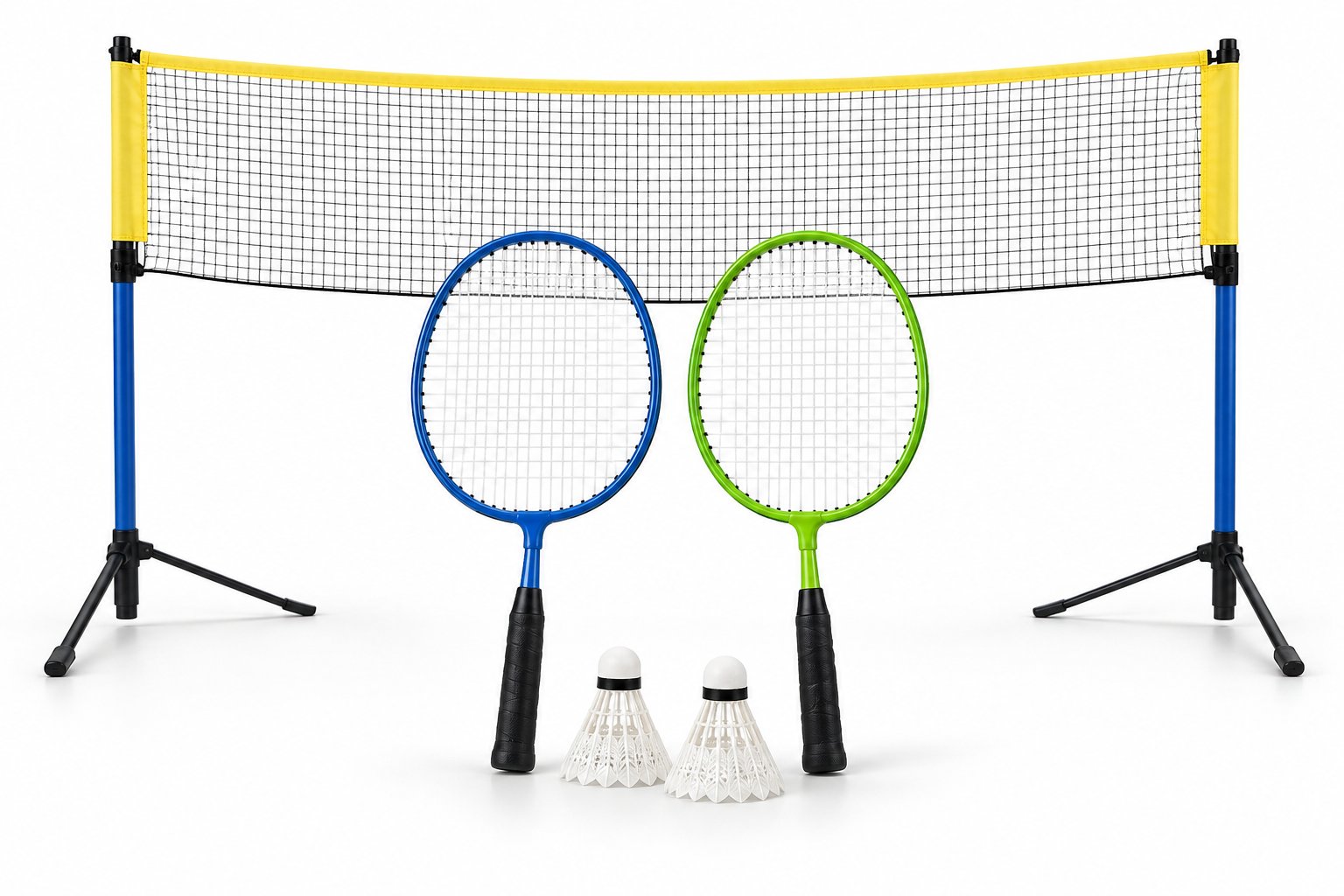
Take a purpose-built school set such as a Junior Badminton Set with Net for School Sports Lessons. The specification matters because it is designed around children, not shrunk from an adult model: racket length is 53 cm, the net measures 300 x 60 cm and assembles without tools, and each set contains 2 short-handle child-sized rackets, 2 shuttlecocks, and 1 net with 4 ground pegs. The set is listed for age 6+ and complies with EN71 / ASTM F963 — the two standards most relevant to buyers selling into Europe and North America respectively.
That combination is the argument for direct buying. A retailer can request OEM/ODM customization on branding or packaging; a school district can standardize on one SKU and reorder it. The trade-off is order size: this set carries an MOQ of 500 sets, which suits a distributor, a multi-school program, or a retail opening order, but not a single classroom.
What to check before ordering direct
- Racket length and handle: confirm the racket is child-sized (this set is 53 cm) rather than an adult racket with a shortened grip.
- Set contents: count rackets, shuttlecocks, net, and pegs per set — a "set" can mean different things across suppliers.
- Net assembly: tool-free assembly with ground pegs matters for schools that set up and pack away every lesson.
- Carton configuration: this product packs 16 sets per export carton, with a carry bag per set — useful for both retail handling and school storage.
- Compliance paperwork: request EN71 / ASTM F963 documentation for the specific product, not a general company certificate.
Route 2: Import Distributors and Wholesalers
Distributors are the fastest route when you need a known product quickly and can accept a fixed specification. They buy in bulk from manufacturers and hold stock locally, which shortens delivery for program coordinators who reorder mid-season.
The limitation is product control. If your requirement is age-appropriate sizing or particular packaging, a distributor can only supply what they stock. When comparing distributor options, ask for the racket length, net dimensions, and set contents in writing, then match them against your age group.
Route 3: Wholesale Platforms
General wholesale and marketplace platforms work for small or trial orders — a single school testing a new activity, or a buyer validating demand before committing to a container. Listings are easy to compare on price, which is also their weakness: a low unit price often reflects a smaller set, thinner packaging, or missing compliance documentation.
If you use this route, treat each listing as unverified until you see the specification and the test documentation in writing.
Kid-Specific Spec and Packaging Checks
Children's badminton equipment fails at the point where an adult product is relabeled as junior. These checks separate the two:
- Racket length and grip: a shorter handle and lightweight composite frame with soft grip suit smaller hands; an adult-length racket does not.
- Net size: a 300 x 60 cm net is sized for school gym or yard use and packs down easily.
- Assembly: tool-free net assembly with ground pegs reduces setup time and lost parts.
- Age labeling: age 6+ is stated on this set; confirm the label matches your market's expectations.
- Packaging: a carry bag per set plus an export carton of 16 sets gives you both retail handling and transport protection.
- Safety standards: EN71 for the EU, ASTM F963 for the US — confirm which document your supplier can provide and for which product.
A documented QC process is also worth asking about. For an order of 500+ sets, you want to know how the specification is verified between the sample and the bulk shipment, not just that a sample looked right.
Matching the Route to Your Situation
| Your situation | Most practical route | Why |
|---|---|---|
| Single school, 10–30 sets | Wholesale platform or local distributor | Below typical factory MOQ; speed matters more than spec control |
| Multi-school district or club program | Direct manufacturer or distributor | Consistent spec and reorderability across sites |
| Retail chain, 500+ sets | Direct manufacturer | MOQ met; OEM/ODM packaging and compliance control |
| Importer testing a new line | Direct manufacturer (sample first) | Validate spec and packaging before a full order |
Frequently Asked Questions
Where do schools usually buy kids badminton sets?
Small single-site schools tend to buy through local distributors or wholesale platforms because order quantities are below factory MOQs. Districts and larger programs that need consistent specification often buy direct or through a distributor that holds a fixed SKU.
Can a retailer order a kids badminton set under its own brand?
OEM/ODM customization is available on this product, which allows branding and packaging to be adapted to a retail program. Minimum order quantity is 500 sets, so this suits a retail opening order rather than a trial.
What safety standards should the set meet?
For Europe, EN71; for North America, ASTM F963. This Junior Badminton Set with Net for School Sports Lessons complies with both. Confirm the documentation covers the exact product you are buying.
How many sets come in a carton?
This set packs 16 sets per export carton, and each set includes a carry bag. Carton counts determine your landed handling cost, so confirm them before quoting retail pricing.
Next step. If you are sourcing a kids badminton set for a school program or retail line in North America or Europe, send your target quantity, market, and packaging requirements, and ask for the specification sheet plus EN71 / ASTM F963 documentation for the exact product before you place an order.