
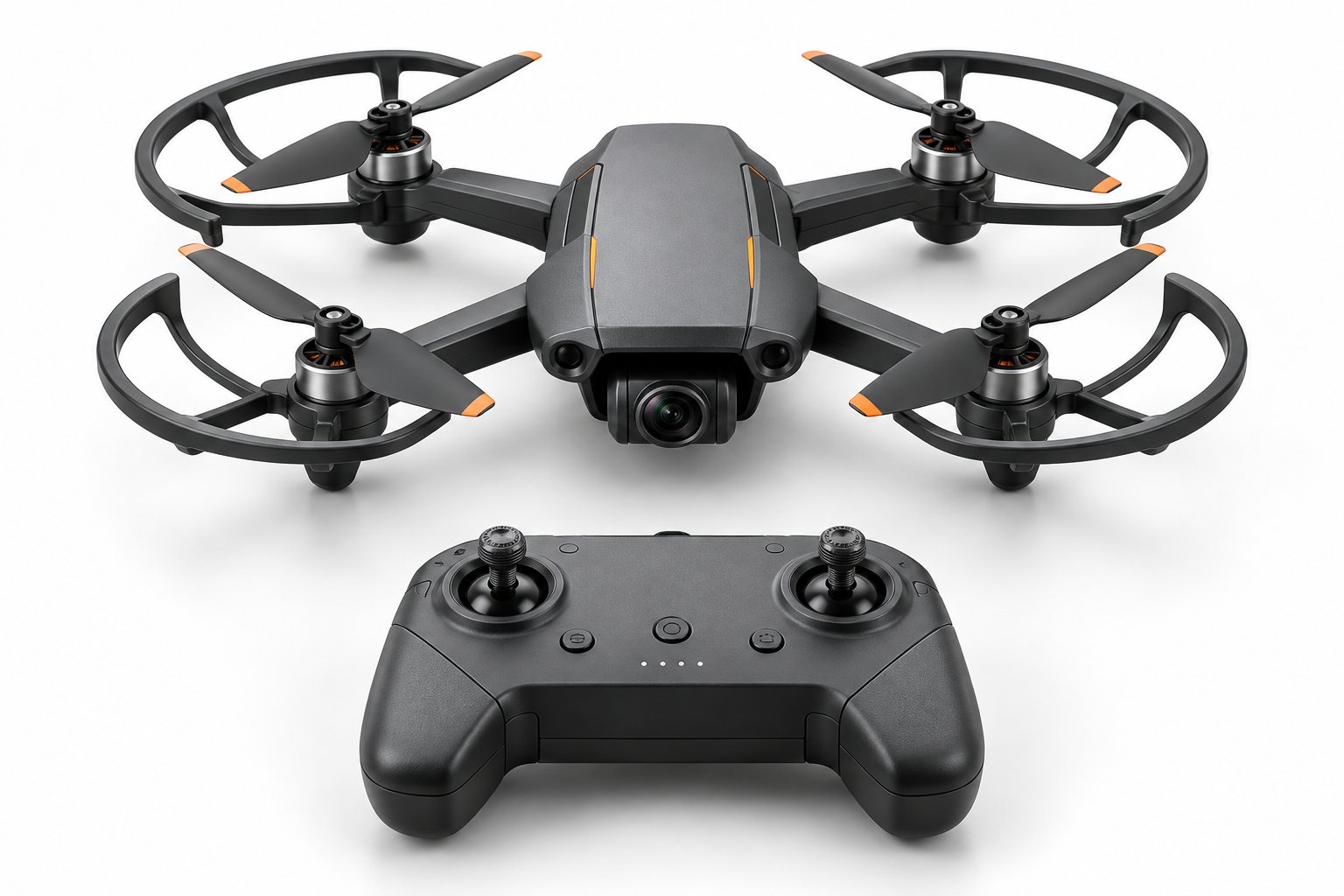
Toy-grade mini drone quotes vary widely because the same shell can be built around very different camera, battery, flight-assist and safety specifications. This article breaks down the cost factors buyers in North America and Europe should compare before requesting a quotation, without quoting any dollar figures.
Cost Factors for B2B Toy Buyers
Buyers searching for a mini drone price usually find retail listings, not supplier cost structures. For a toy-grade model, the quote depends less on the shell than on four internal choices: camera module, battery and charging method, flight-assist features, and safety guards and materials. This article explains what drives those costs and what to confirm when requesting quotations — without giving any dollar figures, because a unit cost only means something against a specific specification and order volume.
Key takeaways
- Mini drone price factors are mainly specification choices: resolution, battery type, sensor set, and guard design.
- Camera modules with higher recording resolution, or additional sensors, move cost more than cosmetic changes.
- The battery and charging method affect both unit cost and the retail price the market will accept.
- Altitude hold, headless mode and one-key take-off and landing add electronics and firmware work.
- Propeller guards and materials influence tooling, packaging weight and compliance testing.
- Ask for a quotation that states the exact configuration, MOQ, compliance standard and packaging before comparing suppliers.
Why two mini drones with the same look can cost different amounts
A toy-grade four-axis drone such as the Mini RC Drone with 720p Camera and Altitude Hold can be built around different camera, battery and sensor choices while keeping the same color box. Suppliers quote the configuration, not the product name. That is why two quotations for a “mini camera drone” can differ significantly: one may include altitude hold, headless mode and propeller guards on all four arms, while another omits them to hit a lower target cost.
For retail buyers and distributors, the practical question is not “what is the lowest price” but “which configuration matches my market, my shelf price and my compliance requirements.” The sections below break down the main cost drivers in the order they usually appear on a supplier bill of materials.
Camera module: resolution and recording path
The camera is often the first item buyers ask to change. On toy-grade models, the module cost is driven by the sensor and the recording path rather than the lens alone.
- Resolution: a 720p camera records to microSD in the configuration described above. Higher-resolution modules require a different sensor and more storage handling, which changes the quote.
- Recording path: recording to a microSD card means the drone carries a card slot and the buyer must consider whether a card is included in the box.
- Camera-only versus FPV-style use: a model that only records is simpler than one that also streams to a phone, which adds a transmitter and app work.
When requesting a quotation, state the exact recording resolution, whether a microSD card is included, and whether the camera needs to be removable. Each of these changes the module and the price band.
Battery and charging: flight time versus convenience
Battery choice affects cost, packaging and the retail story. The example configuration uses a 3.7 V rechargeable battery with USB charging and a flight time of about 8 minutes.
- Battery capacity: a larger cell adds weight and cost, and may shorten motor life or change the flight time claim.
- USB charging: simple and low-cost, but it charges slowly and ties the buyer to a cable.
- Included batteries: one battery versus two changes the box contents, the carton weight and the unit cost.
Buyers should confirm whether spare batteries are available, whether the charger is integrated or a separate item, and what flight time is being quoted under test conditions. Toy-grade flight time claims are usually stated for a specific load and indoor condition; the same drone flying with a camera and guards will differ from a bare unit.
Flight-assist features: what adds electronics and firmware
Altitude hold, one-key take-off and landing, and headless mode are firmware and sensor features. They add a barometric sensor or additional control logic, plus testing time on the line.
- Altitude hold: keeps the drone at a stable height, which helps younger flyers. It requires a pressure sensor and calibration.
- One-key take-off and landing: mostly firmware, but it changes the controller layout and the manual.
- Headless mode: makes direction control independent of the drone’s nose, useful for beginners aged 8 and up.
- Control range: the described configuration reaches up to 50 m. A longer range needs a stronger transmitter and may trigger different compliance considerations.
For a retail line aimed at first-time flyers, these features are often worth the added cost because they reduce returns. Buyers should confirm exactly which assists are included, not the category name.
Guards, materials and compliance
Propeller guards on all four arms are a safety and durability feature, and they change tooling, packaging and testing.
- Guard design: full guards protect the propellers and the user, but they add plastic, weight and assembly time.
- Materials: the frame and guard material affect impact resistance and carton weight. Lighter cartons reduce freight cost per unit, which matters on a 20-piece carton shipped to North America or Europe.
- Compliance: a toy drone sold into these markets must meet the applicable toy safety standard. The example model is stated as EN71 / ASTM F963 compliant. Buyers should confirm this against their own market and age grading.
Compliance testing is a fixed cost that suppliers spread across the order. That is one reason a supplier with an in-house QC laboratory and existing test documentation can quote more predictably than one starting from scratch. OEM/ODM work also adds tooling and sample cost, which should be quoted separately from the unit price.
Packaging and order terms
Packaging is part of the cost conversation, not an afterthought. The described configuration ships in a color box plus export carton, 20 pieces per carton.
| Cost factor | What changes it | What to confirm in a quote |
|---|---|---|
| Camera module | Recording resolution, microSD handling, removable or fixed | Resolution, card included or not |
| Battery | Cell capacity, number of batteries, charging method | Flight time claim, spare battery option |
| Flight assists | Altitude hold, headless mode, one-key take-off and landing | Which assists are included |
| Guards and materials | Full guards versus partial, material grade | Guard coverage on all arms |
| Compliance | EN71 / ASTM F963 test scope and age grading | Test reports for the exact model |
| Packaging | Color box, carton quantity, OEM/ODM branding | Pieces per carton, carton dimensions |
| Order terms | MOQ, lead time, payment terms | MOQ 500 pieces, production schedule |
MOQ also shapes unit cost. The example configuration has an MOQ of 500 pieces. Below that volume, tooling, testing and print setup are spread over fewer units, so the effective unit cost rises even if the supplier does not change the quoted price.
What to put in a quotation request
To compare suppliers fairly, send one specification and ask each supplier to quote against it. A useful request includes:
- Target age grade and market (for example, age 8+ for North America and Europe).
- Camera resolution and whether microSD recording is required.
- Battery type, number of batteries in the box, and charging method.
- Required flight-assist features (altitude hold, headless mode, one-key take-off and landing).
- Guard coverage and any material preference.
- Compliance standard required (EN71 / ASTM F963 or the standard for your market).
- Packaging format, carton quantity, and any OEM/ODM branding.
- Order quantity, destination country and required delivery window.
Ask for the unit cost, tooling or sample cost, packaging cost and compliance documentation as separate line items. A single lump-sum price hides which factor you are paying for and makes negotiation harder.
Common mistakes when comparing mini drone costs
- Comparing quotes that specify different camera resolutions or battery counts.
- Assuming a lower quote includes the same guard coverage or compliance testing.
- Ignoring carton weight and quantity, which affect total landed cost.
- Leaving OEM/ODM branding and packaging requirements until after the price is agreed.
- Requesting a price before confirming the age grade and destination market.
FAQ
Does a 720p camera cost less than a higher-resolution module?
Resolution is one of the main camera cost drivers, but the recording path and whether the camera is removable also matter. Ask for a quote against your exact resolution requirement.
Can the flight time be increased without changing the battery?
Flight time depends on battery capacity, motor load, camera use and guard weight. If you need a different flight time, request the specification that achieves it and confirm the test condition.
Are propeller guards always included?
Not necessarily. On the example configuration, guards are fitted on all four arms. Confirm guard coverage in writing if it affects your retail listing or safety positioning.
What MOQ should we expect?
The described model has an MOQ of 500 pieces. MOQ and unit cost are linked; ask the supplier how price changes at higher volumes.
Do you support OEM/ODM?
Yes. OEM/ODM customization is available, including packaging and branding. Confirm tooling and sample lead times separately from the unit price.
Request a quotation for your specification
Send your target market, age grade, camera resolution, battery and packaging requirements. We will quote against that configuration so you can compare cost factors directly.
Request product details and a quotation through the product page or the site contact form.


