
A buyer's evaluation framework for shortlisted plush toy manufacturers, covering sampling quality, material and stitching standards, MOQ and customization flexibility, and communication and QC processes. Learn what to request, how to judge responses, and when to walk away.
Supplier Evaluation Guide
You have a shortlist of plush toy manufacturers. Now the question is not where to find them but how to tell which one can deliver your order without surprises. This framework covers four areas that separate a capable manufacturer from one that merely quotes a low price: sampling quality, material and stitching standards, MOQ and customization flexibility, and communication and QC processes. Use it to structure your evaluation and ask the right questions before you commit.
Key takeaways
- Evaluate samples as production prototypes, not just showpieces.
- Material and stitching standards should be stated in writing and verified on the sample.
- MOQ and customization flexibility determine whether your order is a good fit for the factory.
- Communication speed and QC documentation reveal how the manufacturer handles problems.
What you will find in this article
1. Sampling quality: the prototype is the promise
A plush toy sample is your first physical look at how a manufacturer interprets your design. Treat it as a production prototype, not a display piece. The sample should match your specification in size, shape, color, fabric, filling, and accessories. It should also show how the factory handles the less obvious details: seam placement, embroidery density, label attachment, and packaging.
Ask yourself these questions when you receive a sample:
- Does the plush match the approved design files in proportion and silhouette?
- Is the filling evenly distributed, with no lumps or thin spots? Even distribution is a handling check you can make on the sample. Whether the filling is hypoallergenic is a material specification, not something you can judge by feel — ask the manufacturer for the filling’s written specification and any related compliance documents.
- Are embroidered features clean and dense, or can you see the backing fabric through the stitches?
- Do seams align symmetrically and lie flat without puckering?
- Are all labels and tags attached securely and in the agreed positions?
Request at least two samples: one for your team to evaluate and one to keep as a reference. Note any deviations and ask the manufacturer to explain how they will correct them in production. A factory that treats sample feedback seriously will provide a revised sample or a clear action plan. One that dismisses minor issues may carry the same attitude into mass production.
2. Material and stitching standards: what to look for
Material and stitching determine how a plush toy feels, how long it lasts, and whether it meets safety expectations. The manufacturer should provide written specifications for fabrics, filling, threads, and any plastic parts. Where safety is a concern, request test reports for the specific materials proposed for your order. A company-level certificate such as ISO 9001:2015 indicates a quality management system, but it is not an item-level safety certification. Ask for the compliance documents that apply to your product and market.
On the sample, inspect the stitching closely:
- Look for double-stitched seams on high-stress areas such as arms, legs, and ears. For instance, the Plush Animal Assortment Display Box uses double-stitched seams across its six 18 cm animal styles; confirm with the supplier which seams are double-stitched on the specific design you order, and write the agreed coverage into the purchase order.
- Check that seam allowances are consistent and that no raw edges are exposed.
- Test the strength of small parts (eyes, noses, ribbons) by gently tugging; they should be securely fastened.
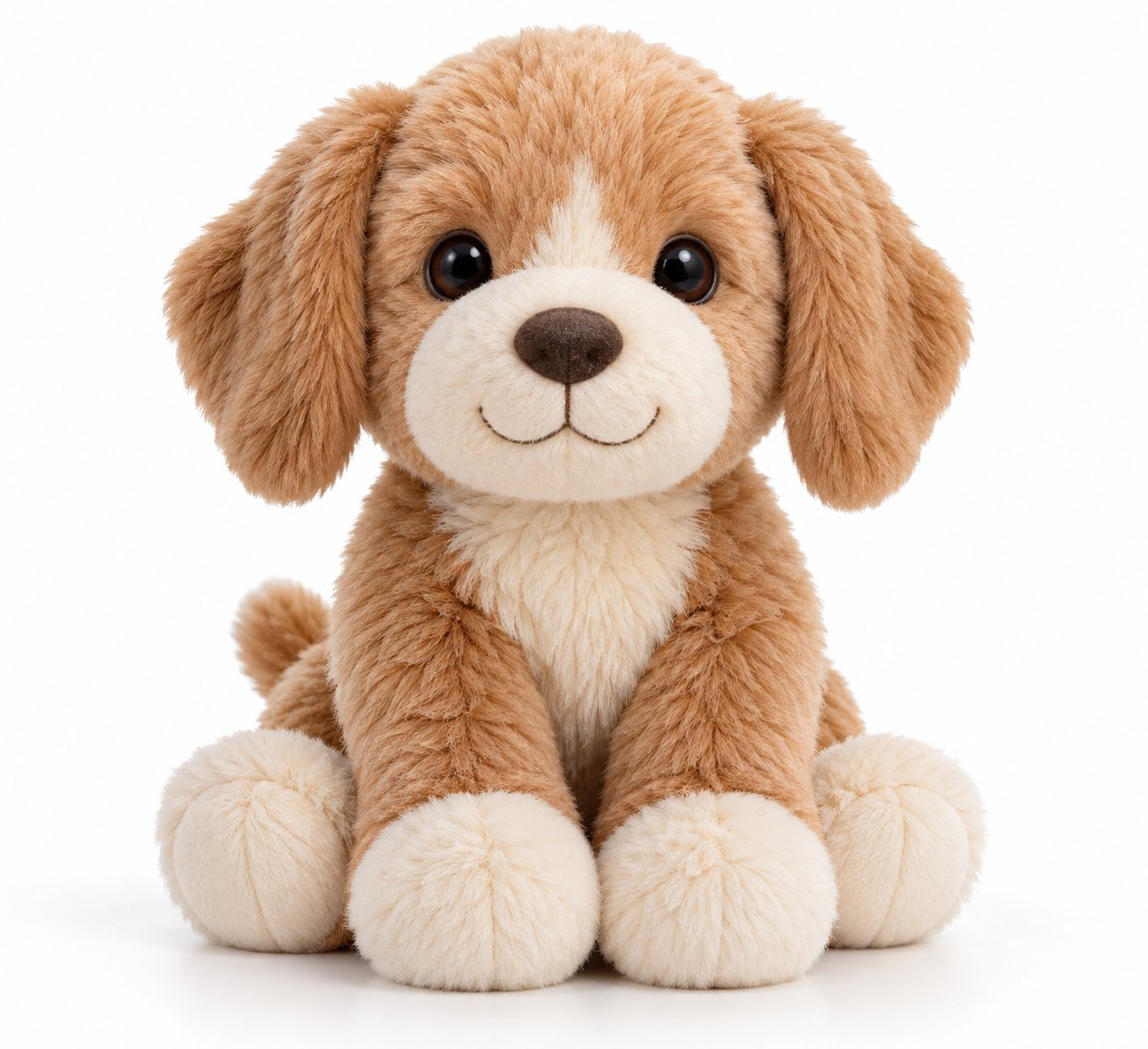
- Confirm that the filling is evenly distributed and matches the agreed written specification. The soft plush stuffed animal is specified from age 0+ with hypoallergenic filling; because age 0+ is a safety designation, request the compliance documents that apply to infant toys in your target market, and use the sample to verify construction details against those documents rather than as proof of safety.
Put your material and stitching requirements in the purchase order, referencing the approved sample. This gives you a clear basis for inspection and acceptance.
3. MOQ and customization flexibility
Minimum order quantity (MOQ) and customization options tell you whether the factory is set up for your order size and design. A manufacturer with a high MOQ may not be interested in smaller runs, or may charge significantly more per unit. Ask for the MOQ for your specific design, including any customized elements.
Customization flexibility covers:
- Size range: Can they produce your required dimensions? For example, the soft plush stuffed animal is available in custom sizes from 20-60 cm, with an MOQ of 1000 pcs. Confirm that your size falls within their capability.
- Design modifications: Can they adjust shapes, colors, and features, and do they charge for design changes?
- Packaging: Can they provide custom packaging, labels, and display solutions? The Plush Animal Assortment Display Box ships as 6 styles at 18 cm, with an MOQ of 1000 packs.
- Tooling and setup: Are there additional costs for new patterns, molds, or embroidery programs?
Compare MOQs and customization terms across your shortlisted manufacturers. A higher MOQ with lower per-unit cost may be better for large runs, while a lower MOQ with higher flexibility may suit a test order or niche product.
4. Communication and QC process
How a manufacturer communicates during the evaluation phase is a preview of how they will handle production. Responsiveness, clarity, and willingness to share information are good signs. Pay attention to:
- Response time and language: Do they answer your questions within a response window you define, and address technical points point by point in writing?
- Documentation: Do they provide written specifications, test reports, and inspection reports? For example, a factory with 180 staff including QC and export documentation teams, 12,000 sqm, and 6 production lines may have the infrastructure for detailed QC, but you should still ask to see sample reports.
- QC process: What are their inspection points? Do they inspect incoming materials, in-process production, and finished goods? What is their procedure for handling defects?
- Capacity and scheduling: Can they meet your desired delivery window? Monthly capacity of 1,200,000 units indicates scale, but confirm that your order fits their current schedule.
Ask for a QC checklist or a sample inspection report. If they cannot provide one, that is a signal that their QC process may not be documented or consistently applied.
Next steps
Use this framework to evaluate each shortlisted manufacturer consistently. Score them on sampling quality, material and stitching standards, MOQ and customization flexibility, and communication and QC — set your own scoring criteria and record them for each supplier so comparisons stay consistent. Then request a production sample and a written quotation that includes all specifications and terms. Compare not just price but total cost of ownership, including defect risk and communication overhead.
If you are evaluating Lequtoys as a potential partner, you can review the soft plush stuffed animal and the plush animal assortment display box as starting points. Founded in 2013, Lequtoys operates a 12,000 sqm factory with 6 production lines and a monthly capacity of 1,200,000 units. The company holds an ISO 9001:2015 company-level certificate and has its own QC laboratory. For specific compliance documents related to your product, request them directly.
Ready to evaluate a plush toy manufacturer? Request a sample and a detailed quotation from Lequtoys today.


