
A plain-language explanation of the frisbee game — casual throw-and-catch play plus simplified rules — followed by a checklist for choosing discs that are genuinely safe for children, covering material, edge shape, weight and certification.
Buyer guide
A frisbee game is simply two or more people throwing and catching a flying disc. That is the whole idea. Everything else — scoring, zones, team rules — is a layer players or teachers add on top. For anyone sourcing discs for children, though, the game is the easy part; the disc is the decision that matters.
- What the frisbee game actually is
- Two ways it is played: casual catch and simplified rules
- What makes a disc safe for children
- A selection checklist for buyers
- How a soft foam disc fits the requirements
What Is the Frisbee Game?
The frisbee game is a throwing-and-catching activity played with a flying disc. One player throws; another catches. The disc flies because of its shape and the spin the thrower puts on it, and the game lives in that simple exchange. You do not need a pitch, a referee or matching kit. A flat open space, two people and one disc are enough.
That simplicity is exactly why the activity appears in so many settings: school breaks, family afternoons, camp programmes, indoors on a rainy day if the disc is soft enough, and retail shelves aimed at children. The word "frisbee" is often used generically for any flying disc, regardless of who made it. What a buyer is actually sourcing is a flying disc of a particular material, size and weight — the name is marketing, the specification is the product.
Two Ways the Game Is Played
Most versions of the game fall into one of two patterns. Knowing which one your end user has in mind tells you what the disc needs to do.
1. Casual throw-and-catch
Two people stand a comfortable distance apart and pass the disc back and forth. A dropped disc means the throw is repeated or the players swap positions. There is no scoreboard and no fixed layout. This is the form children default to, and it is where the disc's safety and hand-feel matter most, because the disc is thrown repeatedly at close range and often caught by beginners.
2. Simplified rules with zones or targets
Teachers and youth organisers often add light structure so a group can play together: a marked zone where players must catch the disc, a target hoop or basket, or a rule that a disc caught while standing still earns a point. These are local inventions, not a fixed rulebook, and they vary by club and school. A disc used in this form still only needs the same core properties — stable flight, comfortable grip, safe edges — because the rules change the game, not the object.
Key point for buyers: the game format is decided by the end user, not the supplier. What you specify to a factory is the disc: material, diameter, weight, edge treatment, age suitability and conformity. That is the part you can actually buy and verify.
What Makes a Flying Disc Safe for Children?
Safety in a flying disc comes down to four things: what it is made of, how its edge is finished, whether its weight suits small hands, and whether it has been tested against the standards your market requires. Each one is a check you can apply to any supplier's sample.
Material
Soft foam and soft polyurethane discs are the usual choice for young children. A rigid hard-plastic disc that hits a child in the face or head transmits far more impact than a soft foam disc of the same size. Soft material also makes the disc easier to grip and catch for small hands and gives a softer drop onto indoor floors.
Edge shape
A rounded, rolled edge is gentler than a thin, sharply moulded rim. Run a thumb around the rim of a sample: if it feels like it could press or scrape, it is not the right disc for a child's game. The edge also affects how the disc feels on release, which matters for beginners learning to throw.
Weight and diameter
A disc that is too heavy is hard for a child to throw accurately and hurts more if it hits someone. Too large and it will not fit a small hand. For children around three years and up, a diameter of roughly 20cm and a weight of about 85g is a workable combination — light enough to control, large enough to catch, and with enough mass to fly predictably in still air.
Conformity and age marking
For retail in the EU and the UK, toys are expected to meet EN71; for the US market, ASTM F963 is the reference standard for toy safety. Ask to see the applicable test documentation for the exact product you are buying — the certificate should name the product, not just the factory. Age marking matters too: a disc marked for ages three and above carries a different set of small-part and material expectations than one aimed at older children.
A Selection Checklist for Buyers
Use these points when comparing samples or writing a specification. Each one should be answerable with a fact, not an assurance.
| Check | What a good answer looks like | Why it matters |
|---|---|---|
| Material | Soft foam or soft PU, stated as the body material | Reduces impact force if the disc hits a child |
| Rim | Rounded edge, described in the spec | Prevents scraping and pressing injuries |
| Diameter | A stated figure, e.g. 20cm | Fits a child's hand and is easy to catch |
| Weight | A stated figure per disc, e.g. 85g | Controllable throw; predictable flight |
| Age suitability | Marked on the product, e.g. 3 years and up | Aligns the toy with the right safety expectations |
| Certification | EN71 and/or ASTM F963 test documents naming the product | Supports retail compliance in the target market |
| Set contents | Number of discs and any carry bag | Affects retail pack, price per unit and shelf appeal |
| Order terms | MOQ, carton quantity, OEM/ODM availability | Determines whether your order size and branding are workable |
How a Soft Foam Disc Fits These Requirements
A concrete example makes the checklist easier to apply. Our Soft Foam Flying Disc Set is made from soft PU foam with a rounded edge, supplied as three discs in red, blue and yellow with a black mesh carry bag. Each disc is 20cm in diameter and weighs 85g, and the set is marked for ages three and above.
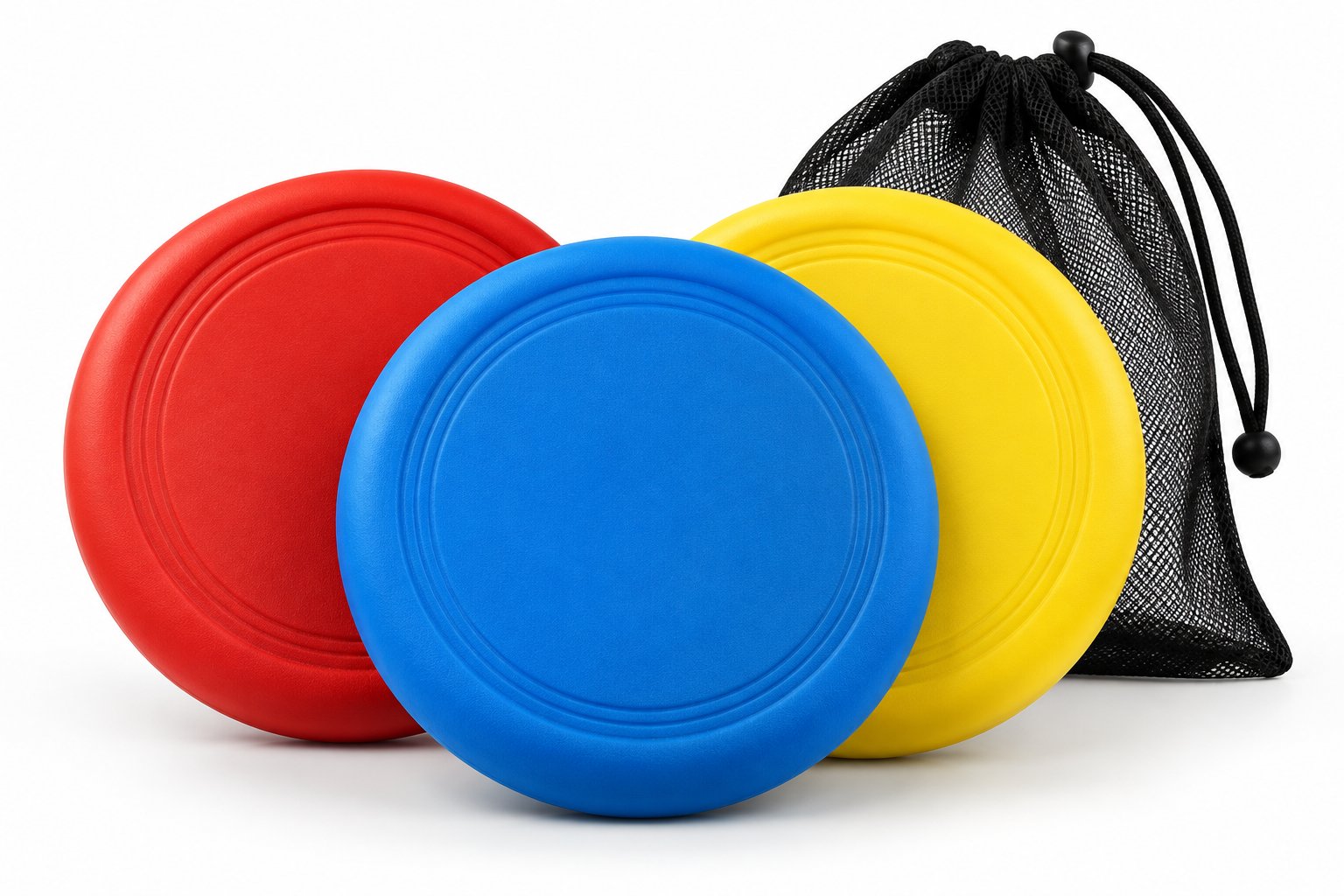
On conformity, the set is tested to EN71 and ASTM F963. Those are the two reference points a buyer for EU/UK and US retail will recognise, and they should be checked against the specific product documents on order. For buyers planning a private-label programme, OEM and ODM are supported. Commercial terms start at MOQ 500 sets, with 36 sets per carton.
Three colours in a mesh bag gives a retail-ready unit rather than loose discs, which matters if you are selling into toy shops, school suppliers or online marketplaces where a photographed set sells better than a single disc. If your requirement is a plain disc in bulk without a bag, that is a different pack configuration and worth raising early so the carton count and pricing can be quoted accurately.
Matching the Disc to the End User
A disc that suits a school playground is not automatically the right disc for a family garden or an indoor club session. The variables that change are the same ones from the checklist, weighted differently:
- School and camp use: multiple discs in bright colours, soft enough for close-range throws, with a carry bag so the set stays together between sessions.
- Indoor use: softness of material dominates, because the disc will hit walls, furniture and floors far more often than it hits a person.
- Retail sets: packaging, colour mix and carton efficiency drive the buy, alongside the certification documents required by the market.
None of these change the core specification. They change how you state it.
Frequently Asked Questions
Is "frisbee" the same as "flying disc"?
In everyday use, yes — the word is widely used for any flying disc. In procuring, it is safer to specify the product by material, diameter and weight rather than by the generic name.
What age are soft foam discs suitable for?
The set described above is marked for ages three and above. Age suitability should always be confirmed on the product you are buying, since it is tied to the toy safety assessment for that item.
Can the discs be branded?
OEM and ODM are supported for this product. Branding affects tooling, packaging and minimum order, so confirm the details with the supplier before finalising your specification.
What are the minimum order and carton quantities?
MOQ is 500 sets, packed 36 sets per carton.


