A practical planning guide for nonprofit and event organizers covering how a duck race fundraiser works, what to decide before ordering ducks, how to plan quantity and numbering, which buoyancy and material questions to put to suppliers, and the permissions and cleanup obligations attached to the waterway itself.
Fundraiser Planning
A duck race fundraiser is one of the few community events that scales cleanly from a few hundred participants to several thousand without changing its core mechanics. Volunteers number each duck, release them at a start line, and the first ducks to reach the finish win prizes for the people who sponsored them. The complexity sits almost entirely in the preparation: choosing the right ducks, deciding how many to order, and clearing the waterway and cleanup obligations with the authorities who control the water.
This guide is written for nonprofit staff and event organizers who are at the stage of confirming plans rather than brainstorming. It covers what a duck race is, the decisions to settle before you place a duck order, and the checks that protect the event on the day.
On this page
- What a duck race is and how the race runs
- Planning checks before ordering ducks
- Duck types, numbering, and quantity planning
- Buoyancy and material questions for suppliers
- Waterway permissions, safety, and cleanup
- FAQ
Key takeaways
- A duck race is a lottery-shaped fundraiser: each duck corresponds to a sponsor, and finishing position determines prizes.
- The race format, not the duck, decides what you need to order.
- Numbering and record-keeping matter more than duck color or decoration for a fair result.
- Waterway permission, insurance, safety cover, and duck recovery are the organizer's responsibility, not the supplier's.
- Ask suppliers specific questions about material, buoyancy behavior, and uniform numbering rather than relying on catalog photos.
What a duck race is and how it works
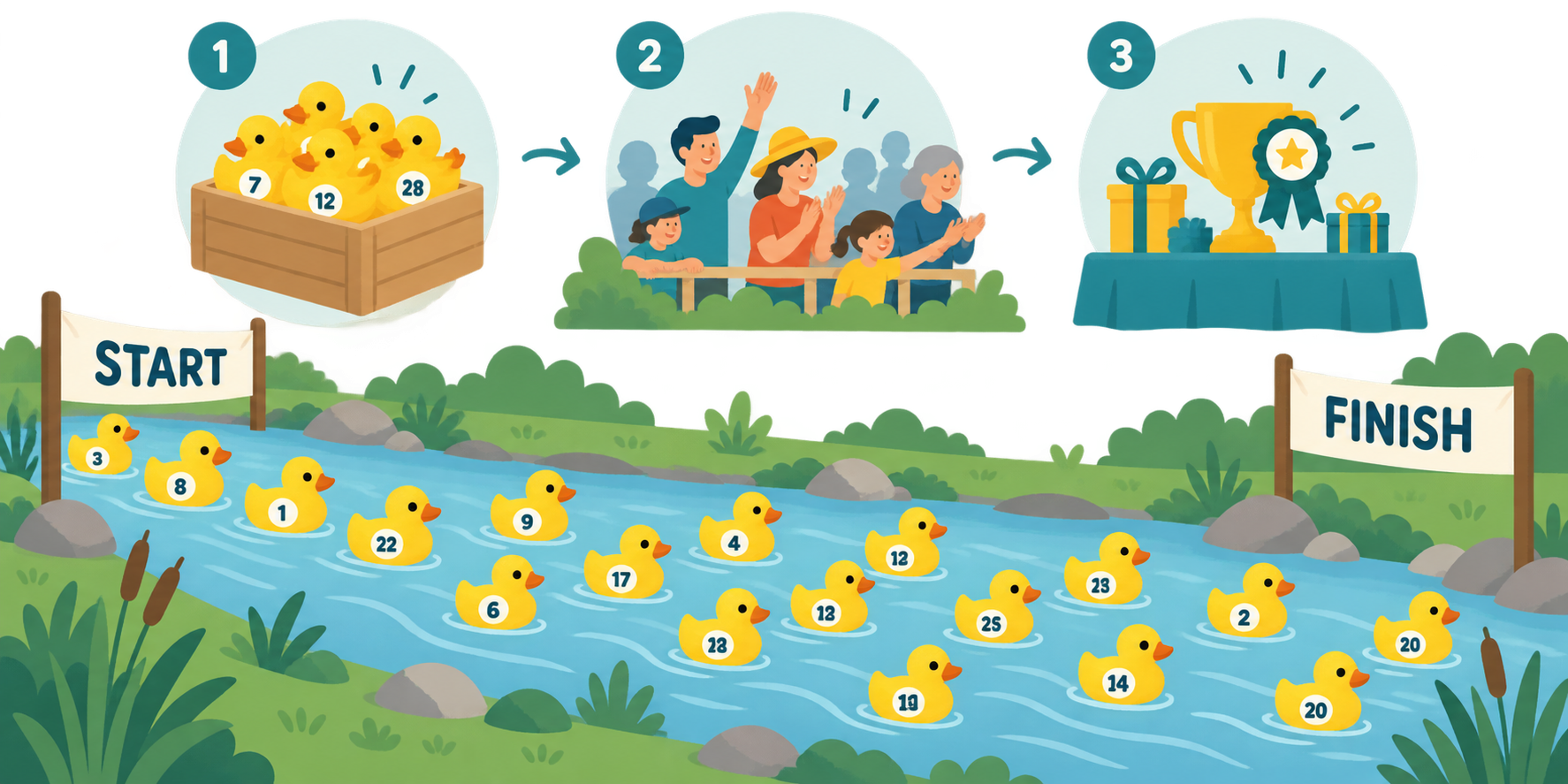
A duck race is a fundraising event in which numbered floating ducks are released together onto a water course, drift downstream or with the current, and are recorded as they cross a finish line. Each duck is linked in advance to a sponsor, ticket buyer, or donor. The first ducks to finish correspond to the winning sponsors, and prizes are awarded against the published rules.
The appeal for organizers is that the mechanic is easy to explain and easy to audit. The race itself is short, but the sponsorship period can run for weeks beforehand.
The typical sequence looks like this:
- Ducks are numbered, and the numbering is recorded against sponsor names in a register.
- Ducks are held upstream of the start line, usually in bins, crates, or a holding pen, in a way that allows a simultaneous release.
- At the start signal, the ducks enter the water together.
- They travel through the course. On natural waterways, the middle section is normally uncontrolled: current, eddies, and obstacles decide the order.
- Finishers are collected at or below the finish line, and their numbers are logged in the order they arrive.
- Winners are matched to the register, and prizes are awarded.
Two format decisions drive everything downstream. The first is whether the course is a natural waterway or a closed loop, such as a channel with a pumped flow. A closed loop is easier to control and easier to recover ducks from, but requires its own equipment and permissions. A natural waterway gives the event its traditional character but introduces weather, flow rate, and debris as real variables.
The second decision is how finishers are recorded. Line judges watching a physical finish line and logging numbers as ducks arrive is the simplest approach. Some organizers add a collection net or boom below the line so that ducks cannot continue downstream unrecorded. Whichever method is chosen, the recording rule should be published in advance, because disputes on the day are almost always about whether a duck was counted before or after a defined point.
Planning checks before ordering ducks
Ordering ducks is usually the largest single line item after permits and insurance, and it is the hardest purchase to reverse. Work through the following checks first.
Confirm the course and the finish rule
Until the start point, finish point, and definition of "finished" are settled, you cannot know how many ducks you need to hold and recover, or how many volunteers to roster. Confirm the course with the waterway authority before ordering anything. If the authority restricts the release window to a specific time slot, that slot determines the race duration and therefore the practical number of ducks.
Confirm permission and insurance
Most rivers, canals, harbors, and public lakes require written permission for an organized event involving floating objects. Ask specifically about release and recovery locations, whether a temporary structure such as a boom or net is allowed, and whether the event needs its own public liability cover. Treat these as separate questions to separate people; permission for an event is not automatically permission for a physical installation in the water.
Confirm the numbering and register plan
Numbering is the integrity backbone of the race. Decide before ordering whether numbers are printed, applied as labels, written on, or issued in blocks to different sales channels. Numbering is also the part most affected by supplier lead time, because it usually happens after the ducks arrive. Ask whether the numbering method has been used on the same duck before, and how it behaves when wet.
Confirm your recovery plan
Every duck released should be accounted for. Decide who collects ducks at the finish, who sweeps the banks downstream, and what the cutoff time for recovery is. This plan influences the duck quantity you can responsibly release, and it is one of the first things a waterway authority will ask about.
Duck types, numbering, and quantity planning
Fundraiser ducks are generally supplied in two broad formats: small vinyl or plastic ducks used for land-based races and shallow water, and larger floating ducks used on open waterways. The right choice depends on the flow of the course, the release mechanism, and how the ducks will be recovered.
Use the following framework to narrow the field with your supplier. The entries are decision criteria, not fixed specifications.
| Criterion | Why it matters | What to ask |
|---|---|---|
| Intended water | A fast river and a shallow channel put very different demands on a duck | Which models does the supplier recommend for a moving river versus a still pool or loop? |
| Buoyancy behavior | A duck that floats high or low, or tilts, drifts differently from the rest | How does the model sit in water, and does it self-right if it tumbles? |
| Numbering surface | Numbers must stay legible after hours in the water and during recovery | Where can numbers be applied, and what application method has worked on this model? |
| Uniformity | Noticeable weight or shape variation can affect drift consistency | Is the model produced to a consistent weight and shape across batches? |
| Recovery and reuse | Many organizations reuse ducks across several years or several events | How should ducks be dried and stored between events? |
| Numbering batches | Blocking numbers by channel simplifies sales administration | Can numbers be supplied or reserved in defined ranges? |
Quantity planning
Quantity should follow from sponsorship demand and course capacity, in that order. Two constraints sit above demand:
- Course capacity. How many ducks can be released simultaneously and still be individually visible at the finish line? Past a certain density, ducks cluster and finishers cannot be read reliably. Ask your line judges to estimate the practical ceiling, and treat it as a hard limit.
- Recovery capacity. How many ducks can your volunteer team collect, count, dry, and store within the event window and the days after? This is usually the binding constraint on larger events.
Once those limits are understood, order to expected sponsorship sales plus a reserve for loss and damage, rather than to a round number. Ducks do go missing, and the recovery sweep will not reach every one. A reserve allows the register to stay complete even when a duck does not come back.
Number the entire population consecutively from one, including the reserve. Mixed or overlapping number ranges are the most common cause of disputes and of duplicate entries in the sponsor register.
Buoyancy and material questions for suppliers
Catalog photographs show shape and color. They do not show how a duck behaves in moving water, so the useful questions are behavioral. Put the following to your supplier in writing and ask for answers specific to the model you are considering, not general marketing language.
- What is the duck made of, and how is it constructed? A single molded body and a two-part body behave differently when they take on water or get pinched.
- Does the material or construction contain an opening, valve, or seam that can admit water over a long race?
- What does the duck weigh when dry, and does it remain upright when placed in moving water?
- Is the model suitable for reuse, and what cleaning or drying process does the supplier recommend between events?
- How is the number applied, and has that method been tested on this model in wet conditions?
- Can you supply a sample before the full order, so numbering and flotation can be checked on the actual course?
A sample run is worth the delay. Test it on the real course at the planned release point, in the same season if possible, and check three things: whether ducks stay together long enough to be judged, whether numbers remain readable after immersion, and whether ducks can be recovered from the banks where they actually collect.
Waterway permissions, safety, and cleanup
The water course is the part of the event the organizer does not control, and it is where most regulatory questions arise. Approach the relevant authority early, and expect the process to involve more than one office.
- Permission. Obtain written authorization for the release and recovery points and for any temporary installation. Clarify whether the event needs to avoid certain dates for wildlife, spawning, or maintenance work.
- Safety. Identify who is responsible for water safety on the day. Volunteers at the water's edge need a briefing on rescue procedure and on what to do if a member of the public enters the water. Where the authority requires trained safety personnel, arrange them before the event is advertised.
- Environmental considerations. Ask whether the ducks, numbering materials, or any markers used are acceptable in the waterway. Some authorities restrict certain materials or require specific handling for anything that could enter the water.
- Cleanup. Plan a downstream sweep after the race, agreed with the authority. Assign a sweep team, a cutoff time, and a reporting method so you can account for every duck released. Build the cleanup into the public timetable rather than treating it as an afterthought.
- Public communication. State the race rules, the finish definition, and the prize claim process in advance and in writing. This reduces day-of disputes and gives the authority a clear picture of how the event will be run.
The cleanup plan is also a fundraising asset: sponsors and authorities respond well to an event that can show a complete recovery record.
FAQ
What is a duck race?
A duck race is a fundraiser in which numbered floating ducks are released together on a water course and the order in which they cross a finish line determines the prize winners. Each duck is linked to a sponsor or ticket buyer through a register kept by the organizer.
How do you play a duck race?
Sponsors adopt a numbered duck, usually by buying a ticket. On race day, all ducks are released simultaneously at a start point agreed with the waterway authority. Line judges record the numbers of the first ducks to cross the finish line, and those numbers are matched to the register to identify winners. The rules defining a finish, the number of prizes, and the claim process should be published before tickets go on sale.
Where can you buy ducks for a duck race?
Fundraiser ducks are sold by event supply and novelty suppliers, and by specialist race organizers who rent or sell complete kits. When comparing sources, ask about the same criteria regardless of supplier: the intended water type, buoyancy behavior, numbering surface and method, consistency across batches, and whether a sample can be supplied before the full order. Also confirm lead time against your ticket sales timetable, because numbering usually happens locally after delivery.
How many ducks should we order?
Order to your expected sponsorship demand, then apply two hard limits: the maximum number that can be released and still judged individually at the finish line, and the maximum your team can collect and store afterwards. The lower of those two figures is your practical race size. Add a reserve for loss and damage, and number the whole population consecutively, including the reserve.
Do we need permission to run a duck race on a river or canal?
Assume yes and confirm it with the body that manages the waterway. Permission normally covers the release and recovery points, any temporary structure, and the date. Insurance and safety provision are separate questions that may involve other requirements. Do not advertise the event until the relevant permissions are confirmed in writing.
What happens to the ducks after the race?
They are collected, counted, dried, and stored for reuse if the model is suitable for it. The organizer is responsible for sweeping the downstream area until the agreed cutoff time and for accounting for every duck released. Ask your supplier for the cleaning and drying method recommended for the specific model.
Next steps
Before placing an order, settle four things in writing: the course and finish definition agreed with the waterway authority, the permission and insurance position, the numbering and sponsor register method, and the recovery plan including a downstream sweep. Those four items determine how many ducks you can responsibly release and how the race will be judged on the day.
With those confirmed, request samples from your chosen supplier, test them at the actual start point, and check the numbering after immersion. Adjust the order based on what that test shows rather than on catalog images, then finalize the race rules for publication.