
A buyer-oriented glossary: define the remote control car toy as a battery-powered vehicle steered from a handheld radio controller, then decode every spec term that appears on quotations and listings—control type and frequency band, body style and terrain rating, age grading, battery and charging, packaging and carton packing, MOQ and customization—with a short note per term on what to confirm with your supplier.
A remote control car toy is a battery-powered model vehicle that a user steers with a handheld radio controller. The car carries its own power source and receiver; the controller sends steering and throttle commands by radio. No track, cable, or app is required for the basic product. Everything else on a quotation—frequency band, body style, age grading, battery type, carton packing, MOQ—describes how that simple idea is built and shipped.
For a sourcing buyer new to the category, the difficulty is not understanding the definition. It is decoding the shorthand. A listing might say "2.4GHz, off-road, 6+, USB rechargeable, color box, MOQ 500" and leave you to work out which of those terms change your order and which are decoration. This article takes each term in the order a buyer actually meets it, explains what it governs, and ends with one short note on what to confirm with your supplier.
- A remote control car toy = battery-powered vehicle + handheld radio controller. The controller is part of the product, not an accessory.
- Frequency band (e.g. 2.4GHz) affects how multiple cars behave in the same room; it is a control term, not a speed term.
- Body style and terrain rating are separate claims: a body shape does not by itself prove where the car can drive.
- Age grading, battery and charging method, and carton packing all appear on the quote and all affect compliance and freight.
- MOQ and customization scope decide whether your packaging and color plan is feasible at the quantity you need.
- Control type and frequency band
- Body style and terrain rating
- Age grading
- Battery and charging
- Packaging and carton packing
- MOQ and customization
- Buying checklist and next step
1. Control type and frequency band
Two terms sit side by side on most listings, and buyers often merge them. Control type describes how the user drives the car: a handheld transmitter with a trigger for throttle and a wheel for steering, or a simpler two-stick layout. Frequency band describes the radio link between that transmitter and the car's receiver.
The band matters most when more than one car runs at the same time. Older narrow-band systems required users to swap crystals so that two cars did not share a channel. A 2.4GHz system manages that pairing electronically, which is why the term appears so often on multi-car products and on listings aimed at family or group use. On a quotation, the band tells you which controller the product uses—it does not tell you how fast the car goes or how far it travels.
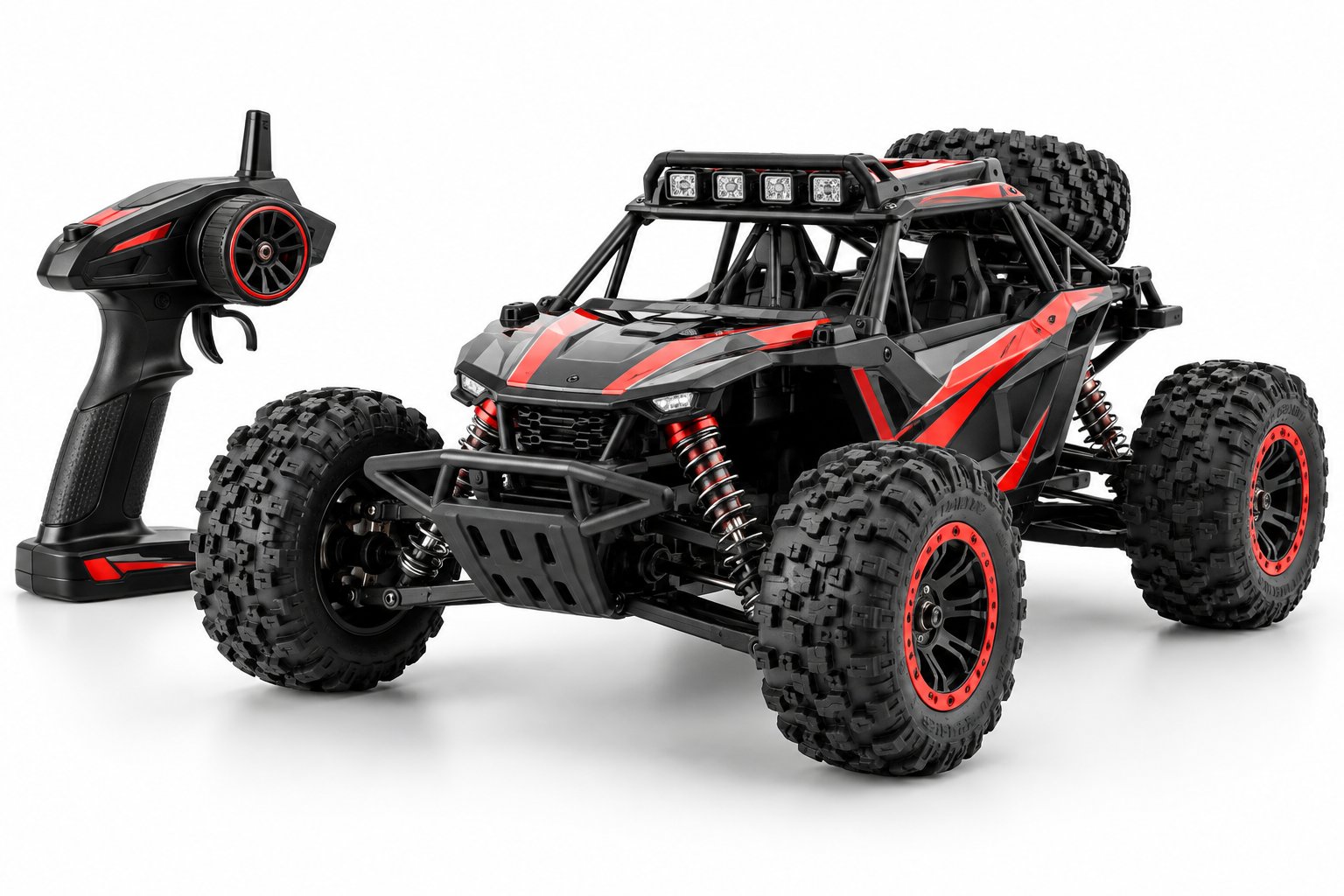
A worked example is useful here. The 2.4GHz remote control off-road car is specified with a handheld 2.4GHz controller, an off-road design for surfaces including gravel and grass, a 6+ age grade, a rechargeable battery with USB charging, MOQ 500 pieces, color box with export carton, EN71 / ASTM F963 compliance, and customizable colors and body styles with OEM/ODM available. Read as a spec sheet, it shows how the terms below line up in practice.
2. Body style and terrain rating
Body style is the shape and look of the car—on-road shell, off-road shell, buggy, truck, and so on. It is a design and tooling term. Terrain rating is a use claim: where the car is built to operate. The two are frequently presented together and can easily be confused.
A car described as off-road is designed for surfaces beyond smooth flooring. The verified example above states suitability for a range of surfaces including gravel and grass. That sentence is the useful part of the listing, because it tells you what the design targets. A raised shell or large wheels is an appearance and design choice; on its own it does not confirm a surface claim. When the surface claim is what you are buying, judge the listing by the sentence about surfaces, not by the picture.
Body style also drives your assortment decision. If you intend to sell two colors or two shell shapes as separate SKUs, the body style list on the quotation should name each variant you expect, not a generic "assorted."
3. Age grading
Age grading is the minimum age stated for the product—for example 6+ years. It is not a marketing label; it drives how the product is tested, how the warning text is written, and often how it is packed.
Two checks follow from it. First, the age grade on the artwork and on the carton must match the age grade in the quotation; a mismatch between the two is a compliance problem, not a typo. Second, the age grade sits beside the safety standards the product is tested to. In the example above, 6+ years appears alongside EN71 / ASTM F963 compliance. Those are separate statements: the age grade says who the product is for, the standards say what it was assessed against. Keep them separate in your own documentation as well.
4. Battery and charging
The battery line on a quote normally answers three things: whether the battery is included, whether it is rechargeable or disposable, and how it is charged. "Rechargeable battery with USB charging" means the car carries a rechargeable pack and charges through a USB connection rather than a dedicated mains charger.
This single term touches freight, retail positioning and after-sales. A product with an included rechargeable battery is a different shipment from one sold without batteries, and USB charging means the buyer's customer supplies the adapter. Both points belong on the packaging and in the product description, not only on the internal spec sheet.
What the spec does not tell you is how long a charge lasts or how long charging takes. Those are performance figures, and if a listing does not state them, treat them as unknown rather than assumed.
5. Packaging and carton packing
Packaging terms on a quotation usually come in two layers, and buyers who read them as one layer misjudge their freight.
| Layer | What it describes | Why the buyer checks it |
|---|---|---|
| Retail packaging | The unit the end customer sees, e.g. a color box | Artwork, age grade and standard marks must match your market's requirements |
| Export carton | The outer shipping carton holding multiple retail units | Determines carton dimensions, unit count per carton, and how the shipment is planned |
The example product is specified as color box with export carton. That is a common configuration, but the quotation should also state how many color boxes go into one export carton. Without that number you cannot work out carton weights or plan a container load.
6. MOQ and customization
MOQ is the minimum order quantity per item or per variant. It is the term that decides whether your plan is realistic: a 500-piece MOQ on a single SKU is one conversation; if that quantity must be split across four colors and two body styles, it becomes a different one.
Customization on a remote control car toy usually refers to colors and body styles, and sometimes to packaging. The example product lists customizable colors and body styles with OEM/ODM available. Read that as scope, then attach quantities to it: ask which combinations are possible at your order size, and whether the MOQ is counted per SKU, per color, or per order.
Customization also has a sequence. Artwork and color decisions need to be settled and approved before production is scheduled, so the approval dates belong in your timeline next to the order date.
Buying checklist
Use this as a single pass over a quotation before you compare suppliers. Each line corresponds to a term above.
- Control: controller layout stated, frequency band stated, and the band's role understood (co-existence, not speed).
- Body and terrain: body styles named as variants; the surface claim written out rather than implied by the picture.
- Age grade: one number, consistent between quotation and artwork.
- Battery: included or not, rechargeable or not, charging method named.
- Packing: retail packaging type and units per export carton both shown.
- Commercial terms: MOQ stated with its counting basis, and customization scope matched to your order quantity.
- Compliance: the standards applicable to your target market listed against the exact model.
Where a line is blank, that is your question list. Where two suppliers answer the same line differently, you have found the point to compare on price.
Next step
The fastest way to test a supplier on these terms is to send your requirement as a short spec of your own: target market, age grade, preferred body style, color plan, packaging type, and order quantity. A supplier who can reply with the units per carton, the MOQ counting basis, and the applicable standards for your market has understood the brief. One who replies with adjectives has not.
Fujian Lequ Wanwan Co., Ltd. supplies remote control car toys to importers and distributors. If you are building an RC range, send your specification and we will respond against these terms line by line.