A practical sourcing guide for preschool programs, retailers, and importers looking to purchase wooden puzzles. It compares manufacturer-direct, wholesale marketplace, and local distributor channels, then details what to verify before ordering: solid wood and non-toxic finishes, age grading, piece counts and storage, MOQ, packaging, and EN71/ASTM compliance documentation.
Preschool directors, early years retailers, and importers search every month for where to buy wooden puzzles, and the buying question behind that search is rarely just a supplier name. It is which channel can deliver solid wood puzzles that pass an inspection, meet the age grading of the classroom, and reorder cleanly at the MOQ a program can actually absorb. This guide covers the three main channel types, what to verify before you place a first order, and how the pieces of a wooden puzzle order fit together from container load to classroom shelf.
Key takeaways
- Manufacturer-direct works best when you need OEM/ODM, repeat production, and product-specific EN71/ASTM documentation; wholesale marketplaces are convenient for small test orders but make compliance traceability harder.
- Verify four product facts before ordering: solid wood with a non-toxic water-based finish, correct age grading, piece count with a storage plan, and MOQ/packaging that matches your warehouse and shelf.
- Ask for compliance documents matched to the exact model, not just a supplier-level statement, and check the carton ratio against how you receive and shelve stock.
- Number and shape puzzles with counting pegs are the workhorses of preschool shelves; a removable-lid cube and a multi-activity learning set round out a mixed program order.
On this page
Three sourcing channels for preschool wooden puzzles
The channel you choose should follow your order size, compliance needs, and how much customization you want. Most preschool programs, toy retailers, and importers mix two of the three below: a manufacturer for core repeat items, a local distributor to bridge a gap, or a wholesale marketplace to test a small quantity of a new design.
Manufacturer direct
Buying straight from a wooden puzzle manufacturer makes sense when you need OEM/ODM work, your own logo on the box or board, or repeat production on the same specification. It also gives you the cleanest paper trail for compliance: a factory that already produces EN71- and ASTM F963-compliant puzzles for export can supply the test documentation matched to the model you are ordering, rather than a generic claim.
The trade-offs are MOQ and lead time. Production runs for wooden puzzles commonly start at 500 sets per model, which is realistic for a program with several classrooms, a regional retailer, or an importer building a mixed container. If you are buying 40 units for one site, manufacturer-direct usually does not fit.
Wholesale marketplaces
Wholesale platforms and B2B marketplaces are useful when you need a small test quantity, want to compare several designs quickly, or need to fill a gap in a mixed order. You often see lower minimums and faster dispatch than a factory run.
What you give up is traceability. Whether the finish is a water-based non-toxic coating, whether the wood is solid or composite, and whether the EN71 certificate on file covers the exact SKU you receive can all be hard to confirm through a marketplace listing. If you buy here, treat the listing as a sample source rather than a compliance source, and confirm the certification documents before any bulk reorder.
Local distributors
A local or regional distributor solves the problem of small replenishment and quick delivery. For a preschool that needs twelve boards next week, a distributor is often the practical answer, because shipping and import paperwork are already handled.
The limit is visibility. Distributors stock after another party tests, so you may not see the original compliance documents, and the product specification can change when they change suppliers. Ask the distributor to name the factory and the model, and request the compliance file if your program or your own customer requires it.
| Channel | Best for | Typical MOQ | Compliance visibility | Customization |
|---|---|---|---|---|
| Manufacturer direct | Repeat orders, OEM/ODM, mixed containers | From 500 sets per model | Test documents matched to the model | Logo, packaging, board design |
| Wholesale marketplace | Small test quantity, design comparison | Lower, varies by listing | Listing-level only; confirm before reorder | Limited |
| Local distributor | Fast, small replenishment | Often by the carton | Depends on what the distributor passes through | Usually none |
What to verify before you order
This is the part that separates a smooth first order from a return shipment. Each item below maps to a document or a sample you should be able to check before committing to a production run.
Solid wood and non-toxic finish
Preschool puzzles get chewed, dropped, and wiped. Confirm the material is solid wood and the finish is a non-toxic, water-based coating rather than a solvent-based lacquer that can leave an odor or a stronger residue. The supplier's product sheet should state the material and finish type, not just "wood."
Age grading and piece count
Age grading drives both safety and classroom fit. A puzzle labelled age 3+ assumes children past the mouthing stage, while an age 2+ design has to assume more exploratory handling. Match the grade to the room you are supplying, and check piece count: a 20-piece counting-board puzzle and a 12-block shape sorter demand different storage and different supervision.
Piece count, storage, and removable parts
Ask how the pieces stay together between sessions. A board with counting pegs holds pieces in place; a cube with a removable lid stores blocks inside but the lid itself is a loose part. If you are supplying classrooms, storage is a real specification, not a detail, and it affects whether the puzzle is practical for self-directed play.
MOQ and packaging
Confirm the MOQ per model and the carton configuration, because it determines your landed unit cost and your receiving labor. A 500-set MOQ split across several models is different from 500 sets of one SKU. Also check the inner packaging: shrink wrap protects against humidity in transit but adds handling time, and export cartons should be labelled so your warehouse can receive without opening every box.
EN71 / ASTM compliance documentation
For preschool products, EN71 (EU) and ASTM F963 (US) are the standards buyers are usually asked about. Ask for the certificate or test report that names the exact model you are ordering, and check that the report is current and issued by a testing body. A supplier-level statement that "all our toys are compliant" is a starting point, not the document your own compliance reviewer will accept.
Three puzzle formats that fit a preschool program
The three formats below cover the core of a preschool wooden puzzle order: a number board for counting, a shape sorter for early matching, and a multi-activity set for mixed-age rooms. Each is built from solid wood with a non-toxic water-based finish, and each is EN71 / ASTM F963 compliant.
| Product | Age | Contents | Size | MOQ | Packing |
|---|---|---|---|---|---|
| Wooden Number Puzzle Board with Counting Pegs | 3+ | 1 board + 20 numbered pieces with counting pegs | Board 30 × 22 × 1.8 cm | 500 sets | Shrink wrap + export carton, 40 sets per carton |
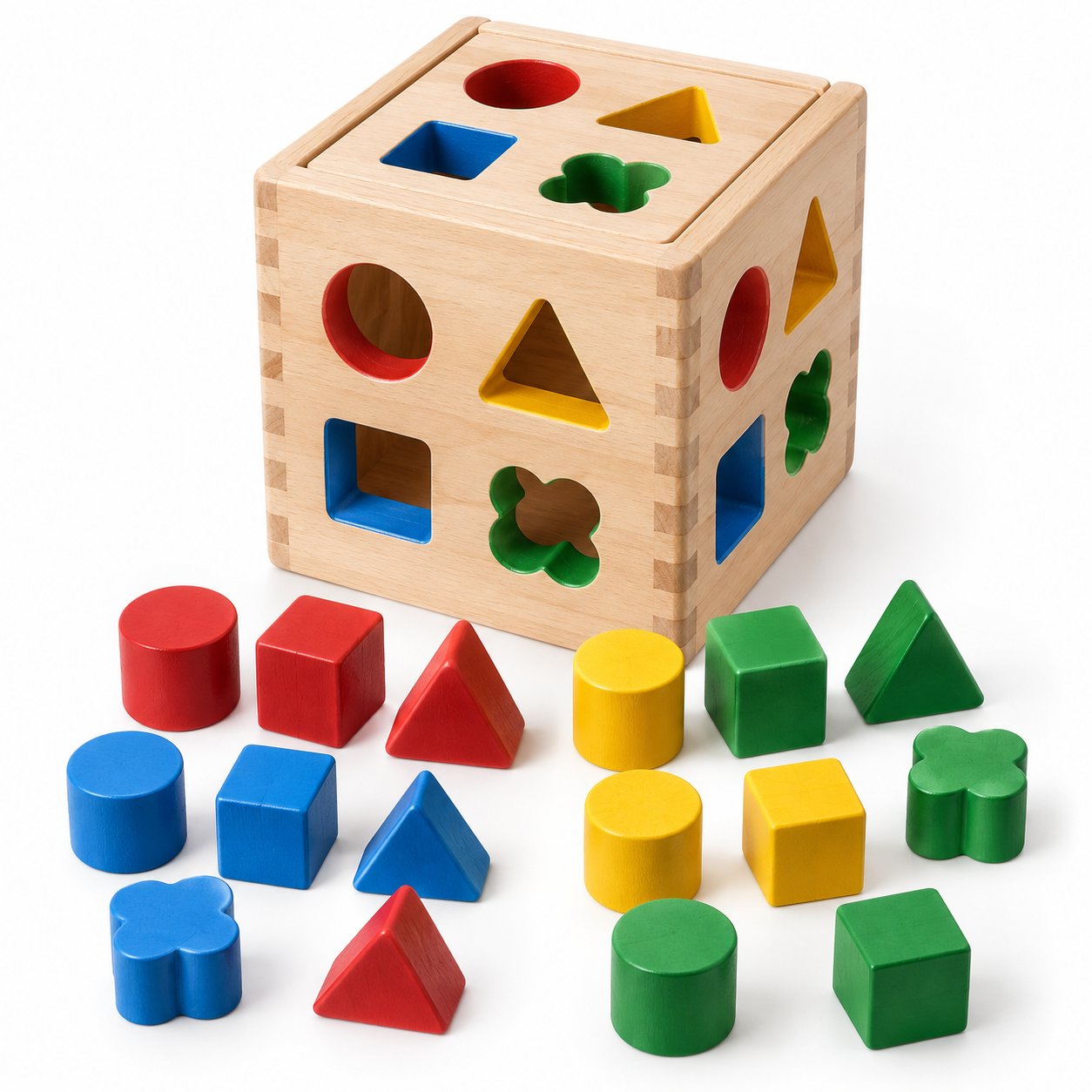
| Wooden Shape Sorter Cube | 2+ | 1 cube + 12 blocks in 4 shapes / 4 colors | Cube 15 × 15 × 15 cm, block thickness 2.5 cm | 500 sets | 24 sets per carton |
| Wooden Montessori Learning Set | 3+ | Shape-sorting box + stacking toys + threading toy | — | 500 sets | — |
Number board: counting on a stable base
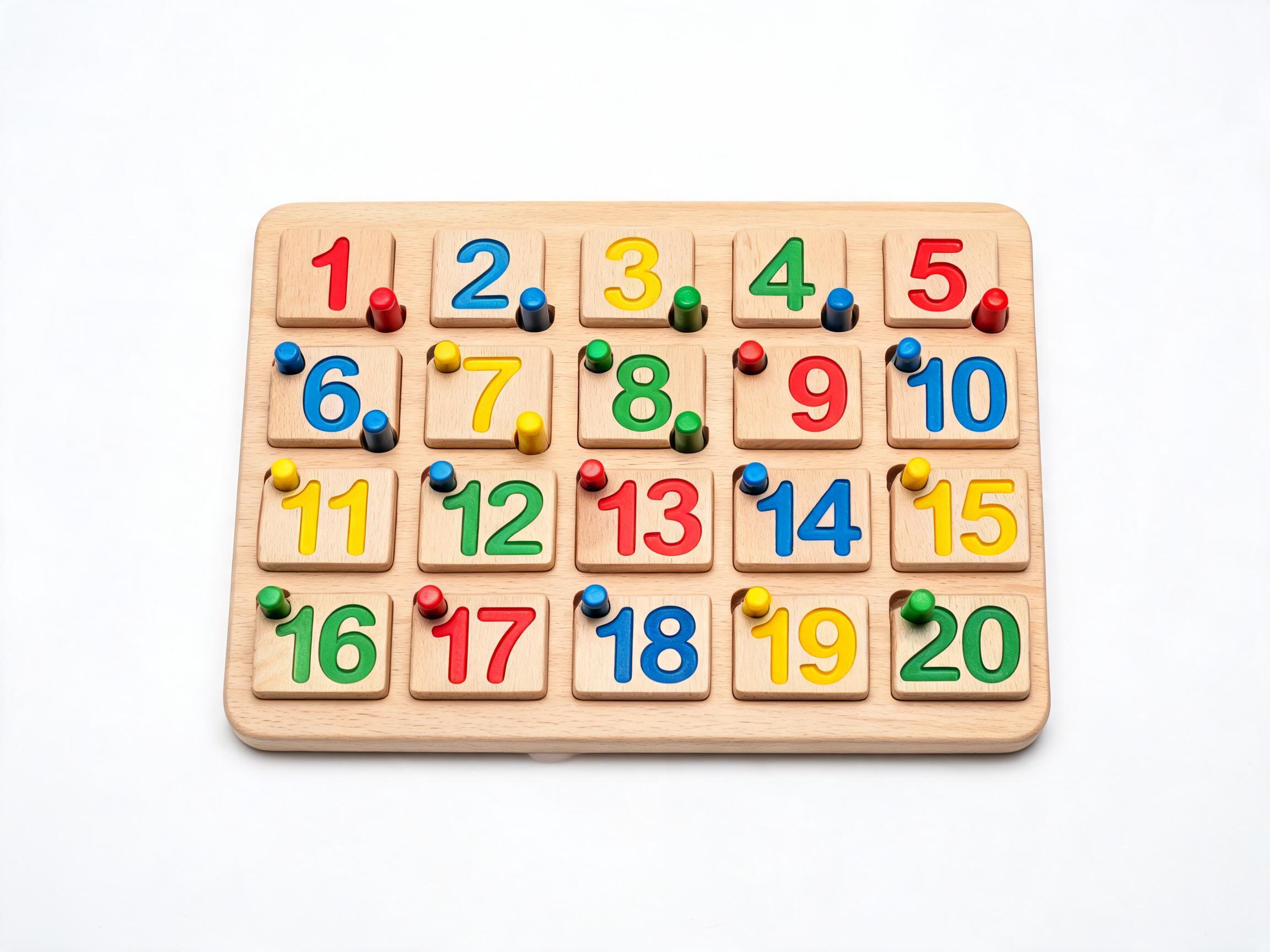
The Wooden Number Puzzle Board with Counting Pegs is a 30 × 22 × 1.8 cm solid wood board with 20 numbered pieces, each held by a counting peg. The pegged design keeps pieces in place while a child counts or sorts, which matters in a room where boards get moved between tables. It is graded age 3+, packed in shrink wrap inside an export carton of 40 sets, at an MOQ of 500 sets. For a preschool buying counting resources, this is the item that pairs directly with early math activities.
Shape sorting cube: early matching
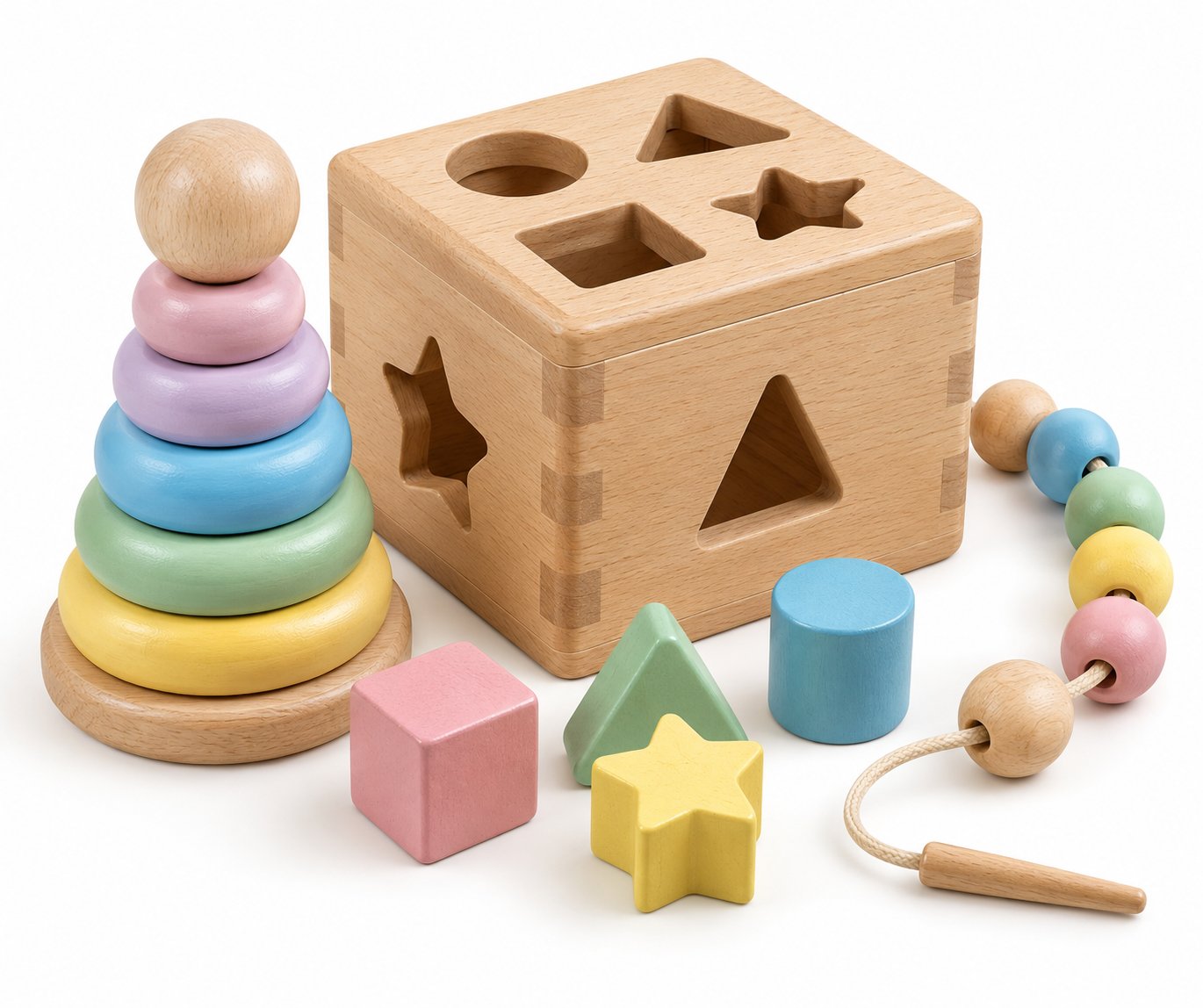
The Wooden Shape Sorter Cube is a 15 × 15 × 15 cm solid wood cube with 12 blocks in 4 shapes and 4 colors, with blocks 2.5 cm thick and a removable lid. The lower 2+ age grade makes it suitable for toddler rooms as well as mixed-age settings. It ships 24 sets per carton. The removable lid is a feature and a storage question at the same time: it keeps the blocks contained between sessions, but it is a separate part to account for in cleaning and inventory.
Montessori learning set: a multi-activity option
The Wooden Montessori Learning Set combines a shape-sorting box, stacking toys, and a threading toy in one age 3+ set using child-safe wood with a non-toxic finish. It suits programs that want a single SKU covering several hand-skill activities, or retailers building a gift or classroom set around one box.
All three models are described as EN71 / ASTM F963 compliant, with OEM/ODM available on the number puzzle board. Confirm the specific certificate for the model and destination market you are ordering before production.
Frequently asked questions
- Is it cheaper to buy wooden puzzles from a manufacturer or a wholesale marketplace?
- Marketplaces often look cheaper on a small trial order because minimums are lower and you are not paying for a production run. At repeat and container volumes, manufacturer-direct pricing and packaging control usually become more competitive, and you get documentation matched to the model. The right comparison is the landed cost per set at your actual annual quantity, not the listing price of one unit.
- What is the typical MOQ for preschool wooden puzzles?
- For the three models above, MOQ is 500 sets per model. That is a common factory-run threshold for wooden puzzles. If you cannot absorb 500 sets of one design, consider whether a mixed order across several models, or a smaller distributor order for a trial, fits your program better.
- What compliance documents should I request?
- Ask for the EN71 or ASTM F963 test report or certificate that names the exact model, and check its validity date and testing body. These are the two standards most commonly requested for preschool products. If you sell into both the EU and the US, you will want both.
- How should preschool puzzles be packaged for shipping?
- At minimum, protect pieces against humidity and movement in transit. The number puzzle board uses shrink wrap plus an export carton of 40 sets, and the shape cube packs 24 sets per carton. Confirm the carton ratio and inner packaging for every model you order, because it changes your receiving, storage, and shelf-ready handling.
- Can I order a custom design or my own logo?
- OEM/ODM is available on the number puzzle board. For a custom board design or branded packaging, expect to confirm artwork, sampling, and the MOQ that applies to your specification. Ask the supplier which models support customization and what the sample timeline is.
Next steps
Before you place a preschool wooden puzzle order, gather three things: your target quantity per model, the destination market so the correct EN71 or ASTM documentation applies, and your packaging expectations. With those in hand, you can compare a manufacturer-direct quote and a distributor quote on equal terms, and check the sample against the age grade of the room you are supplying.
The three models above cover counting, shape matching, and multi-activity play; the number puzzle board, shape sorting cube, and Montessori learning set pages list the specifications you need to start a comparison. Ask for the model-specific compliance file and a sample set before you commit to the first production run.