
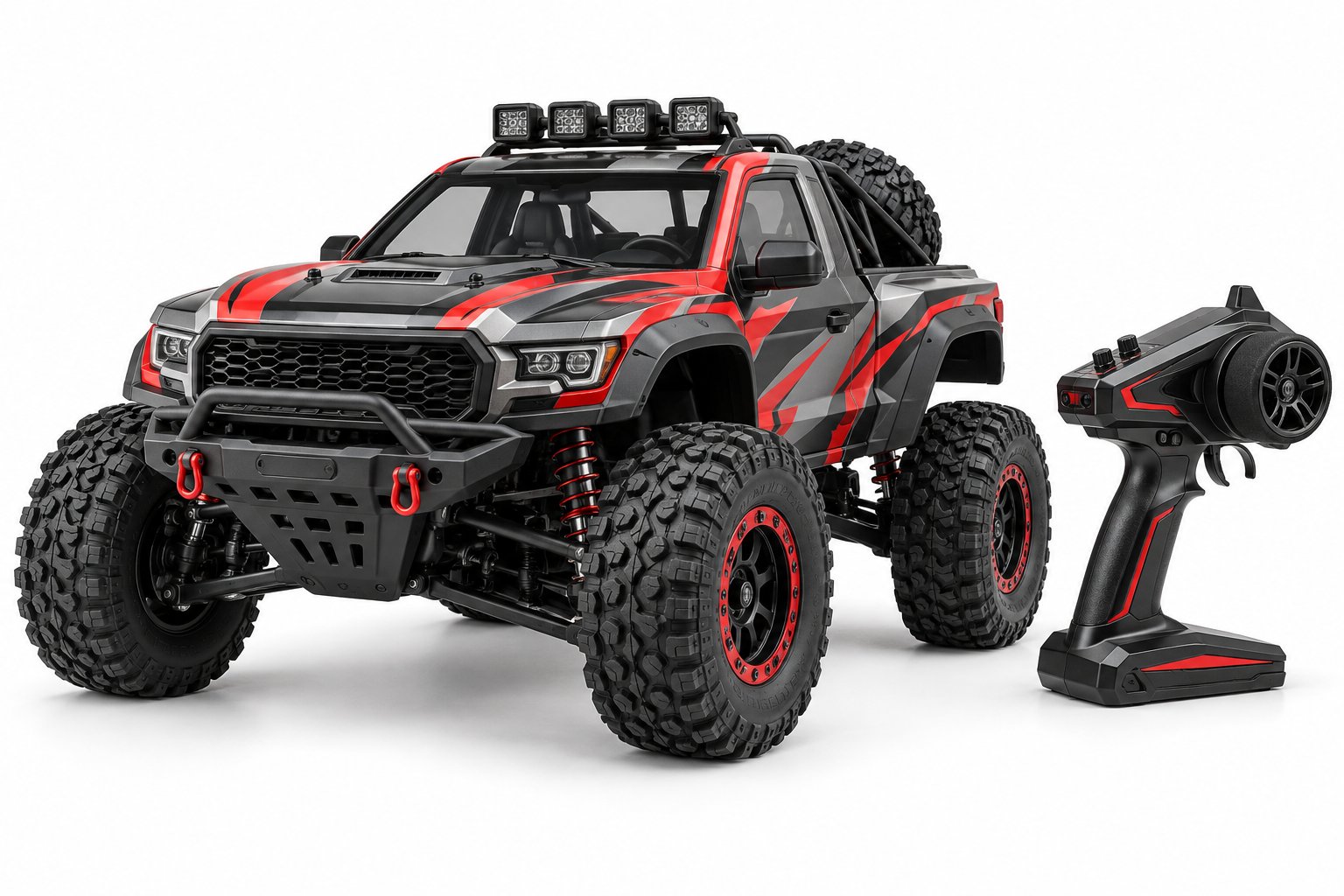
Independent suspension lets each wheel on an RC truck move up and down on its own, so a tyre stays in contact with gravel, grass or packed sand while the other three keep rolling. This article explains how the layout works in toy-grade and hobby RC off-road trucks, how it differs from a solid-axle setup on rough ground, and which specification lines a buyer should check before ordering.
A short answer first: independent suspension is a layout in which each wheel is attached to the chassis by its own arm and spring, so one wheel can rise over a stone while the other three stay planted. On an RC truck it changes how the vehicle behaves on loose ground, and it changes what you should look for on the specification sheet before you place an order.
Most of what search engines return for this question describes passenger cars. The mechanics are related, but the parts, loads and expectations are not. An RC off-road truck is a small, light, toy-grade or hobby-grade vehicle driven over gravel, lawn and packed sand at walking distance from the operator. Judging it by car standards, or reading car suspension data into a toy product spec, leads to the wrong purchasing decision. This article stays inside the RC truck context.
What Independent Suspension Means on an RC Truck
On a full-size vehicle, independent suspension means the two wheels on one axle are not joined by a single rigid beam. Each has its own linkage, and each can follow the ground surface separately. The same description applies at RC scale, with smaller arms, springs and mounts.
If you look closely at a product photo of a 4WD RC off-road truck with independent suspension, you can usually see the spring structure at each corner — the coil or damper sits above an arm that connects one wheel hub to the chassis. Four visible spring units, one per wheel, is the visual signature of the layout.
What this produces on rough ground is straightforward. When one front wheel rolls onto a raised stone, only that corner compresses. The chassis stays roughly level, and the other three tyres remain loaded against the ground. In a solid-axle layout, lifting one wheel tends to lift the opposite wheel with it, because the two are tied to the same beam. That is the core mechanical difference, and it is the reason the layout appears on off-road RC trucks at all.
- Independent suspension = one spring and one arm per wheel; each wheel travels on its own.
- On gravel, grass and packed sand, the benefit is contact: tyres stay on the ground instead of being lifted by the opposite wheel.
- It is a handling and traction layout for uneven terrain, not a performance number you can read off a spec sheet.
- The suspension is only one line on the spec sheet. Drive type, tyre tread, body material, battery and control distance decide the rest.
Independent Versus Solid-Axle Layout on Uneven Ground
Keeping the comparison to principle and handling behaviour, without quoting any performance figures:
| Behaviour | Independent suspension | Solid-axle (linked) layout |
|---|---|---|
| Wheel travel | Each wheel moves on its own | Wheels on the same axle move largely together |
| Response to a single bump | One corner absorbs it; chassis stays closer to level | The lift tends to transfer across the axle |
| Tyre contact on mixed surfaces | Better chance of all four tyres staying loaded | One tyre may lose pressure when the opposite side lifts |
| Chassis attitude in a turn | Less cross-axle coupling; body roll is managed per corner | Motion at one wheel is felt at the other |
| Construction | More parts per corner (arm, spring, mounts) | Fewer, heavier parts shared across the axle |
The trade-off is component count. Four independent corners mean more small parts to assemble and more places where a toy-grade truck can be damaged by a hard impact. That is why the chassis and body material listed for the product matter as much as the suspension wording. An impact-resistant ABS body shell is the stated material on the model below; it can shield the suspension mounts from light knocks, but the product data does not quantify impact resistance, so treat it as a material line to verify — ask the supplier how the shell and the suspension arms are built and whether spare parts are available.
Solid-axle layouts still exist in the RC world, and they are not wrong — they are simpler and use fewer parts. The point here is not that one design is universally better. It is that on loose, uneven surfaces, the independent layout is the one that keeps tyres in contact, and that is what an off-road truck is being bought for.
What the Layout Does for Grip, Control and Durability
Traction on loose surfaces
Grip on gravel and grass depends on contact. A tyre that is hanging in the air contributes nothing. Because each wheel moves separately, an independently suspended truck keeps more of its four tyres pressed against the surface as it rolls over stones and ruts. That is the practical reason the layout is paired with the terrain it is marketed for.
Steering and stability
When one front wheel is lifted by an obstacle, a solid axle tends to push the whole front end around that point. With independent front wheels, the steered wheel on the other side keeps its own contact and its own geometry, so the truck is less likely to be deflected off line. At toy scale this is felt as a more predictable line across bumpy ground rather than a sudden change of direction.
Durability
Independent suspension isolates impacts. A hit on one wheel is absorbed at that corner rather than being passed through a shared axle beam into the opposite side of the chassis. That said, the arms and mounts are small parts, and the honest buying question is not whether the design is strong in theory but whether the surrounding materials hold up in use. Ask the supplier to state the chassis construction and the shell material, and to confirm whether suspension arms, springs and mounting points can be replaced as spare parts. The impact-resistant ABS shell named on the product listing is a starting point for that conversation, not a durability guarantee.
Maintenance and spare parts
Independent suspension has more wear points per corner than a solid axle, so it is fair to ask the supplier three questions before ordering: which suspension components (arms, springs, mounts) are replaceable, whether spare parts are supplied with bulk orders or ordered separately, and what care is recommended after a hard impact on gravel. The product data reviewed here does not answer those questions, so put them in the quotation rather than assuming.
What to Check on the Specification Sheet
Suspension wording alone will not tell you whether a truck suits your market. The following lines are the ones that actually decide the product, and they can be checked before ordering.
Drive configuration
Independent suspension is a chassis layout; four-wheel drive is a drivetrain layout. They are separate specifications, and a buyer should see both stated. A 4WD truck driven through all four wheels benefits from the independent corners only if the drivetrain is genuinely four-wheel drive. Check that the sheet says 4WD explicitly rather than implying it.
Tyres and tread
The tyres do the work the suspension preserves. Deep block tread on soft rubber is the pattern suited to gravel, grass and packed sand; a smooth or shallow tread will not hold the surface regardless of how the springs are arranged. Confirm the tread description in writing and, where possible, request a tyre sample or a material specification; "soft rubber" on a listing is a description to verify, not a measured value.
Body and chassis material
Look for the stated material, such as impact-resistant ABS for the body shell, and ask what the chassis itself is made of — a phrase like "a chassis built for the toy category" gives you nothing to compare. If the shell or chassis material is not listed, ask before committing to an order.
Battery and charging
Battery chemistry, voltage and charging method affect how the product is presented to consumers and, in some markets, what documentation accompanies it. A 7.4 V rechargeable pack with USB charging is a clear, checkable combination. Confirm the voltage and the charging method in writing.
Control distance
Up to 40 m is the kind of figure that belongs on a retail box. If your channel needs a different range or a different radio format, that is a point to raise with the supplier rather than assume.
Age grading and compliance
An age grading of 6+ and conformity with EN71 and ASTM F963 are the lines a toy importer needs first, because they determine whether the product can be sold in the target market. Check that the compliance statement covers the exact model you are ordering.
Order terms
Packing quantity and minimum order quantity set the commercial frame: 16 pieces per carton and an MOQ of 500 pieces. These figures tell you how a trial order and a repeat order will be structured.
Applying the Checklist to an Actual Model
Fujian Lequ Wanwan Co., Ltd. is a B2B toy manufacturer and exporter working with OEM and ODM customisation. One of its published models is a 4WD RC Off-Road Truck with Independent Suspension for Gravel, and it is a useful example of how the specifications fit together.
- Drivetrain
- Four-wheel drive with independent suspension at each wheel
- Terrain
- Soft rubber tyres with deep block tread, suited to gravel, grass and packed sand
- Body
- Impact-resistant ABS shell
- Power
- 7.4 V rechargeable battery, USB charging
- Control distance
- Up to 40 m
- Dimensions
- 32 x 20 x 14 cm
- Age grading
- 6+
- Compliance
- EN71 / ASTM F963
- Order terms
- MOQ 500 pieces; 16 pieces per carton
- Customisation
- OEM/ODM available
Read together, these lines answer the buyer's real question. The suspension is a four-corner independent layout; the drivetrain is 4WD; the tread is matched to the loose surfaces named on the listing; the shell material is stated; the battery and charging method are specified; and the compliance and order terms are explicit. That is what a specification sheet should do — let you compare without guessing.
The Buying Decision in One Paragraph
Independent suspension matters on an RC off-road truck because it keeps each tyre doing its own job over uneven ground. It is not a standalone selling point, though. Pair it with four-wheel drive, tread suited to the surface, a stated body material, a specified battery and charger, and compliance documents that cover the model you are ordering. When those lines are all explicit, you can compare suppliers on facts instead of adjectives.
If you are sourcing an off-road RC truck for gravel, grass or packed sand, you can send your specification — terrain, age grading, market compliance, packing quantity — to the manufacturer and ask for a quotation and sample terms against it. OEM and ODM work through Fujian Lequ Wanwan Co., Ltd. follows the same route.