
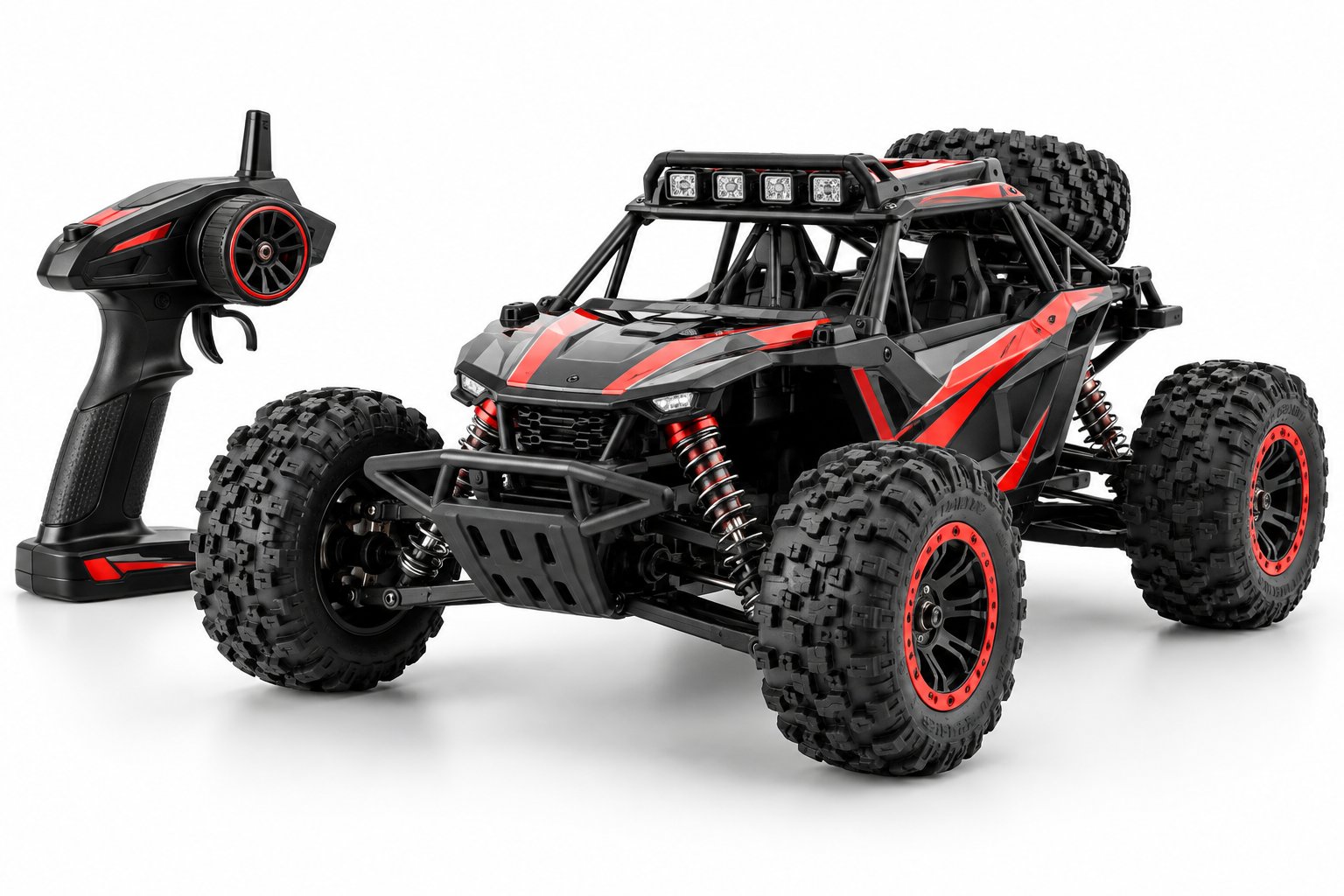
If you are sourcing RC cars for retail or distribution, the term 2.4GHz appears on nearly every specification sheet. This article explains what a 2.4GHz remote control car is in plain language, what the frequency actually does, and which details buyers should verify before placing an order. It also outlines the compliance, packaging, and customization questions that matter for North American and European programs.
Buyer's Guide
When a specification sheet says "2.4GHz remote control car," it is describing the radio frequency the controller uses to talk to the vehicle. For buyers, the important question is not what the number means in physics, but whether the radio system suits the retail or distribution program you are planning.
Key takeaways
- 2.4GHz is a radio frequency band, not a measure of speed, battery life, or toy quality.
- It allows multiple cars to run in the same space without the long antennas and frequency crystals used by older systems.
- Check the spec sheet for three things: the controller band, whether the wording confirms multi-car play, and how range is described.
- Compliance, packaging, and MOQ often matter more than the frequency label when you are placing a container order.
In this article
What 2.4GHz actually describes
Radio-controlled toys communicate on a radio band. Older RC cars commonly used lower bands such as 27MHz or 49MHz. Those systems worked, but they had practical limits: the controller used a long telescopic antenna, each frequency could only serve one car at a time, and running two cars on the same channel caused interference.
The 2.4GHz band is a different, higher-frequency radio band. It is the same general part of the radio spectrum used by Wi-Fi, cordless phones, and many wireless game controllers. For an RC car, the practical result is a shorter controller antenna, a cleaner signal between the handheld unit and the vehicle, and the ability for several cars to operate in the same area at once.
What 2.4GHz does not tell you: how fast the car goes, how long the battery lasts, how far it can drive before signal loss, or how durable it is. Those are separate specifications. A supplier listing a 2.4GHz controller is telling you about the radio link, not the whole performance package.
What to verify on a supplier spec sheet
Because "2.4GHz" is a category label, not a full technical description, buyers should look for the supporting details. The table below shows the items worth checking and why they matter for a purchase decision.
| Spec sheet item | Why it matters to a buyer |
|---|---|
| Controller band stated as 2.4GHz | Confirms the radio system category. It should be consistent across the product listing, packaging, and manual. |
| Multi-car play wording | Tells you whether several units can run together in one space, which affects retail appeal and demo events. |
| Range description | If a range figure is given, ask how it was measured. If no figure is given, treat the claim as unverified. |
| Battery and charging method | Rechargeable battery with USB charging is easier to support in retail channels than disposable battery formats. |
| Age grading | Age 6+ is a common entry point for this category and affects packaging warnings and market positioning. |
If a listing makes a range claim, ask the factory what conditions it reflects. Signal range is affected by terrain, obstacles, and interference, so a single number without test conditions is not a reliable purchasing criterion.
Why multi-car play matters for retail programs
For a distributor or retailer, the practical benefit of a 2.4GHz system is that children can run more than one car in the same room or driveway without the channel conflicts that older frequency systems had. That matters in two common situations:
- Family and group play: siblings or friends can each operate a car without one controller blocking another.
- Retail demonstrations: in-store demo tables can run several units at once, which is useful when a buyer wants to show the product to a retail partner.
However, "2.4GHz" alone does not guarantee this. The manufacturer has to design the radio system to support multiple units. That is why the spec sheet wording matters. Look for a clear statement that multiple cars can operate together, rather than assuming it from the frequency label.
How this applies to an off-road model
Take a concrete example: the 2.4GHz Remote Control Off-Road Car for Gravel and Grass. Its specification combines a handheld 2.4GHz controller with an off-road design intended for gravel and grass, an age grading of 6+, and a rechargeable battery with USB charging. Those are the facts a buyer can plan around.
The off-road design is relevant to the frequency discussion because terrain affects signal behavior. A car used on gravel and grass is often operated outdoors, where the radio link has to cope with distance and obstacles. The 2.4GHz controller is part of that setup, but the actual usable distance still depends on the environment and on how the manufacturer has implemented the radio system. Buyers should test a sample in the conditions they expect end users to use.
For retail and promotional programs, this model can be customized in colors and body styles. It is compliant with EN71 and ASTM F963, which are the standards most relevant to toy safety in Europe and North America. MOQ is 500 pcs, and it ships in a color box plus export carton. OEM/ODM is available for buyers who need private label or modified specifications.
Procurement and compliance checklist
Frequency is only one line on a purchase order. The checklist below covers the areas where B2B buyers usually need confirmation before committing to a program.
- Target market standards: For Europe, EN71; for the United States, ASTM F963. Confirm the certificate covers the exact model and batch you are ordering.
- Age grading and warnings: Age 6+ affects packaging labels and retail shelf placement. Check that the retail box matches your market's language and warning requirements.
- Packaging format: Color box plus export carton is a standard combination. Confirm carton dimensions, units per carton, and whether the color box artwork can be tailored to your brand.
- Customization scope: Colors and body styles can be customized for retail and promotional programs. Clarify lead times for custom colorways and whether tooling changes are required.
- MOQ and order planning: MOQ is 500 pcs. Plan your first order to validate sell-through before scaling.
- Sample evaluation: Test the controller and car in the actual play environment, including how the 2.4GHz system behaves when several units are powered on together.
For buyers sourcing from a supplier that exports to North America and Europe, it also helps to confirm that the factory has in-house engineering and QC. That reduces the risk of specification drift between the sample you approve and the production batch you receive.
FAQ for buyers
Does 2.4GHz mean the car is faster than a 27MHz model?
No. Frequency describes the radio band, not the motor or speed. Speed depends on the motor, gearing, battery, and vehicle weight. Treat the 2.4GHz label as a radio specification only.
Can two 2.4GHz cars run at the same time?
They can if the manufacturer has designed the system for multi-car play. The 2.4GHz band supports this better than older single-channel systems, but the actual capability is a product design decision. Ask the supplier to confirm it in writing.
What range should I expect from a 2.4GHz remote control car?
Range depends on the transmitter power, receiver sensitivity, antenna design, and the environment. If a supplier quotes a range, ask for the test conditions. If no range figure is stated, do not assume one.
Is 2.4GHz allowed in all markets?
The 2.4GHz band is widely used for short-range consumer devices, but compliance is a separate matter from frequency. Toy safety standards such as EN71 and ASTM F963 cover the product as a toy. Confirm the certificate applies to the model and batch you are importing.
Can I customize the car for my retail brand?
Yes, within the supplier's OEM/ODM scope. For this model, colors and body styles can be customized for retail and promotional programs. Exact terms depend on order volume and artwork requirements.


