
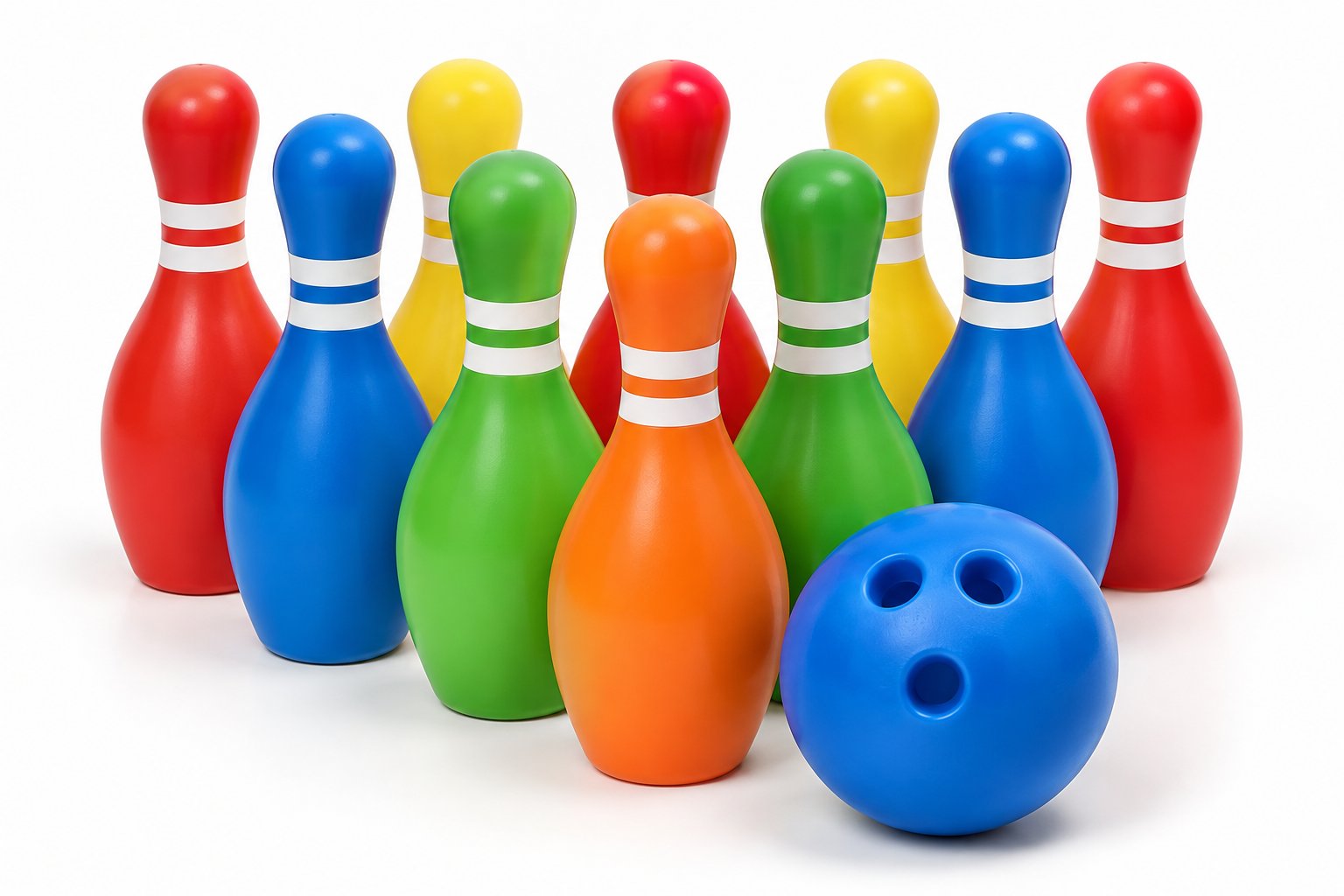
A channel-by-channel guide for buyers sourcing kids' and garden bowling pins and sets. Compare factory direct, wholesale distributors, and local retail on pin count, size (child-safe vs full-size), material, MOQ, and certification, with a checklist of what to verify before ordering.
Sourcing Guide
If you are buying kids' or garden bowling pins for a school, a playground, or a retail shelf, the right channel depends less on price per unit and more on what you need the product to be: the pin count, the size relative to the children using it, the material, the minimum order, and the certification you must show. This guide compares factory direct, wholesale distributors, and local retail against those points, so you can choose a channel and know what to verify before you commit.
Key takeaways
- Factory direct suits buyers who need a defined specification (pin count, height, material, certification) and can meet a stated minimum order.
- Wholesale distributors suit buyers who want smaller lots or faster replenishment from existing stock, usually with less control over specification.
- Local retail suits one-off purchases and trial use, but rarely gives you the documentation a school procurement or retail compliance file needs.
- Whatever the channel, check the same five things: pin count, child-safe sizing vs full-size pins, material, MOQ, and certification.
First, separate garden pins from regulation pins
The phrase "bowling pins" covers two different products. Regulation ten-pin bowling uses full-size pins on a lane. Garden and kids' bowling sets use smaller, lighter pins for outdoor play, and those are what schools, playgrounds, and family retailers typically buy. The sizes and materials differ enough that a quotation for one is not a substitute for the other.
For reference, one product in this category — the Kids Garden Bowling Set with 10 Pins for Outdoor Play from Fujian Lequ Wanwan Co., Ltd. — lists 10 pins plus 1 ball, a 28 cm pin height, and a 16 cm ball diameter with moulded finger holes, for age 5+. Those figures give you a concrete benchmark: a garden set at this scale is a different object from a regulation pin, and the channel you use should be able to confirm dimensions in this range rather than send you a generic "bowling pin" quote.
Channel comparison at a glance
| What you check | Factory direct | Wholesale distributor | Local retail |
|---|---|---|---|
| Pin count | Specified in the product definition; confirm per set | Stated on the carton or listing; varies by brand | Read the retail pack |
| Child-safe vs full-size | You can specify garden scale and age grading | Whatever the distributor stocks | Whatever is on the shelf |
| Material | Named in the specification (e.g. PE plastic) | Usually named, sometimes abbreviated | Often on the pack, sometimes not |
| MOQ | A stated minimum, e.g. 500 sets for this set | Case or pallet quantities | One unit |
| Certification | EN71 / ASTM F963 stated for the product | Ask which standard and for which item | Typically not available at point of sale |
| Best fit | Schools, playgrounds, retailers with a defined spec | Buyers needing smaller lots or mixed stock | Trial use, single classrooms, small gifts |
The MOQ and certification entries in the factory-direct column reflect the listed terms for the product above. Distributor and retail terms vary by seller; confirm them directly.
Factory direct: when specification matters more than lot size
Buying from a manufacturer makes sense when you already know what the product must be. A school district may need a documented age grade and a named material. A retailer may need a consistent carton count and a certification file. A playground operator may need a pin height that suits the age group using the space. These are specification questions, and a factory direct order is the channel where you can put them into the purchase definition.
The trade-off is the minimum order. The garden set referenced here has a minimum of 500 sets, packed 20 sets per carton. If your requirement is smaller than that, factory direct is not the practical route unless you are consolidating with other purchases. The other trade-off is that you carry the work of checking the specification yourself — the factory will make what is specified, so the specification has to be right.
What to check on a factory-direct order
- Pin count and what is included: 10 pins plus 1 ball is the listed configuration. Confirm whether the ball, the mesh carry bag, and the export carton are part of the set you are buying.
- Pin height and ball diameter: 28 cm pins and a 16 cm ball are garden scale. Check that this suits the age group and the space; a taller pin is not automatically better for young children.
- Material: the listed material is weather-resistant PE plastic, which is relevant if the set will live outdoors.
- Age grading: the listed age is 5+. Match this to your audience and your own compliance requirements.
- Certification: EN71 and ASTM F963 are listed for this product. Ask for the certificate that applies to the item and the market you are selling into, and check that the scope names the product.
- OEM/ODM: available if you need your own branding or a modified specification. Clarify what can change and what stays fixed before quoting.
Wholesale distributors: flexibility in lot size, less control in specification
Distributors are useful when you need a smaller quantity than a factory minimum, or when you need stock quickly from what is already in a warehouse. For a retailer testing a new line, or a school topping up an existing set, that flexibility can matter more than specification control.
The limitation is that you are choosing from what the distributor stocks. Pin count, pin height, material, and certification are set by the brand the distributor carries, and the documentation you receive depends on what that distributor can pass on. If your buyer — a school board, a retail compliance team — requires a named standard such as EN71 or ASTM F963, confirm that the distributor can supply the matching certificate for the exact item before you order. A distributor's general assurance that "our toys are certified" is not the same as a certificate naming the product.
Also check the packing. A distributor may sell by the case, and the case count may not match the 20-sets-per-carton packing used at factory level. If you are comparing landed cost, compare like with like: cost per set, not cost per case.
Local retail: fine for trial, weak for procurement
Local retail is the simplest channel and the right one for a single classroom, a small playground trial, or a quick replacement. You can see the product, read the pack, and take it away the same day.
It is a poor fit for institutional or retail procurement because the information you need usually stops at the shelf. You may not get the pin height, the material specification, or a certificate you can file. If you need several identical sets, retail stock may not be consistent between purchases. Use retail to evaluate the format — do children engage with a 28 cm pin and a 16 cm ball? — and move to a wholesale or factory channel once you need repeatable specification and documentation.
A short checklist you can send to any channel
Whichever channel you approach, the same five questions separate a usable quote from a vague one:
- Pin count: how many pins per set, and is a ball included?
- Size: pin height and ball diameter, and is the set graded for the age group you serve?
- Material: what plastic, and is it suitable for outdoor use if the set will be left outside?
- MOQ and packing: minimum order quantity, sets per carton, and what the carton contains.
- Certification: which standard applies to this item, and can you receive the certificate for your market?
If a channel cannot answer these five, that is useful information in itself: it tells you the channel is not set up for institutional or retail supply, whatever the unit price suggests.
Putting the channels together
A practical sequence for many buyers is to use retail or a small distributor order to confirm the format works for the audience, then move to factory direct once you need a defined specification, a certificate, and consistent packing. The garden set above — 10 pins plus 1 ball, 28 cm pins, 16 cm ball, weather-resistant PE plastic, age 5+, MOQ 500 sets, 20 sets per carton, EN71/ASTM F963 — is an example of the level of detail a factory-direct specification should contain. If your requirement matches that shape, the next step is to confirm the certificate scope and the OEM/ODM options for your market.
View the Kids Garden Bowling Set
FAQ
Is a garden bowling set the same as a regulation bowling pin?
No. Garden sets use smaller, lighter pins for outdoor play. The set referenced here uses 28 cm pins and a 16 cm ball, which is a different product from a full-size lane pin.
Can I order fewer than the factory minimum?
The listed minimum for this set is 500 sets. For smaller quantities, a wholesale distributor or local retail is the practical channel, with the specification and documentation limits described above.
What certification should I ask for?
Ask for the certificate that applies to the exact item and the market you sell into. This product lists EN71 and ASTM F963; confirm the certificate scope names the product before you rely on it.


