
Sealing a wooden toy for sale is a finishing decision the buyer writes into the purchase order and accepts on a pre-production sample, not something a retail buyer repeats after delivery. This article sets out what a sealed surface must cover, how to compare water-based and solvent-based systems, how to write the coating requirement on the PO, what to inspect on the sample, what to ask for in saliva and heavy-metal migration reports, and how to plan recoating and touch-up over the product life.
Buyer guide · finishing specification
Sealing for sale is a factory finishing decision: the buyer names the coating system on the purchase order and accepts it on a pre-production sample. Retail buyers do not re-seal a finished wooden toy after delivery, and any instruction to do so should be treated as a red flag in the supply chain rather than a service task.
That framing matters because it moves sealing from a vague quality expectation into a clause you can inspect. A sealed wooden toy is not simply “treated wood”; it is a defined substrate, a defined colour system, a defined sealer, a defined coat sequence, a defined cure stage before packing, and a report package that names the article as shipped. Each of those items can be written down, sampled and checked.
What a properly sealed toy surface has to mean in practice
A sealer has one job on a toy: close the wood surface so that the article resists saliva, moisture from hands and handling, and normal classroom or nursery contact, while holding the colour and print in place. On a shape sorter, that means far more than a coat across the top face of the cube.
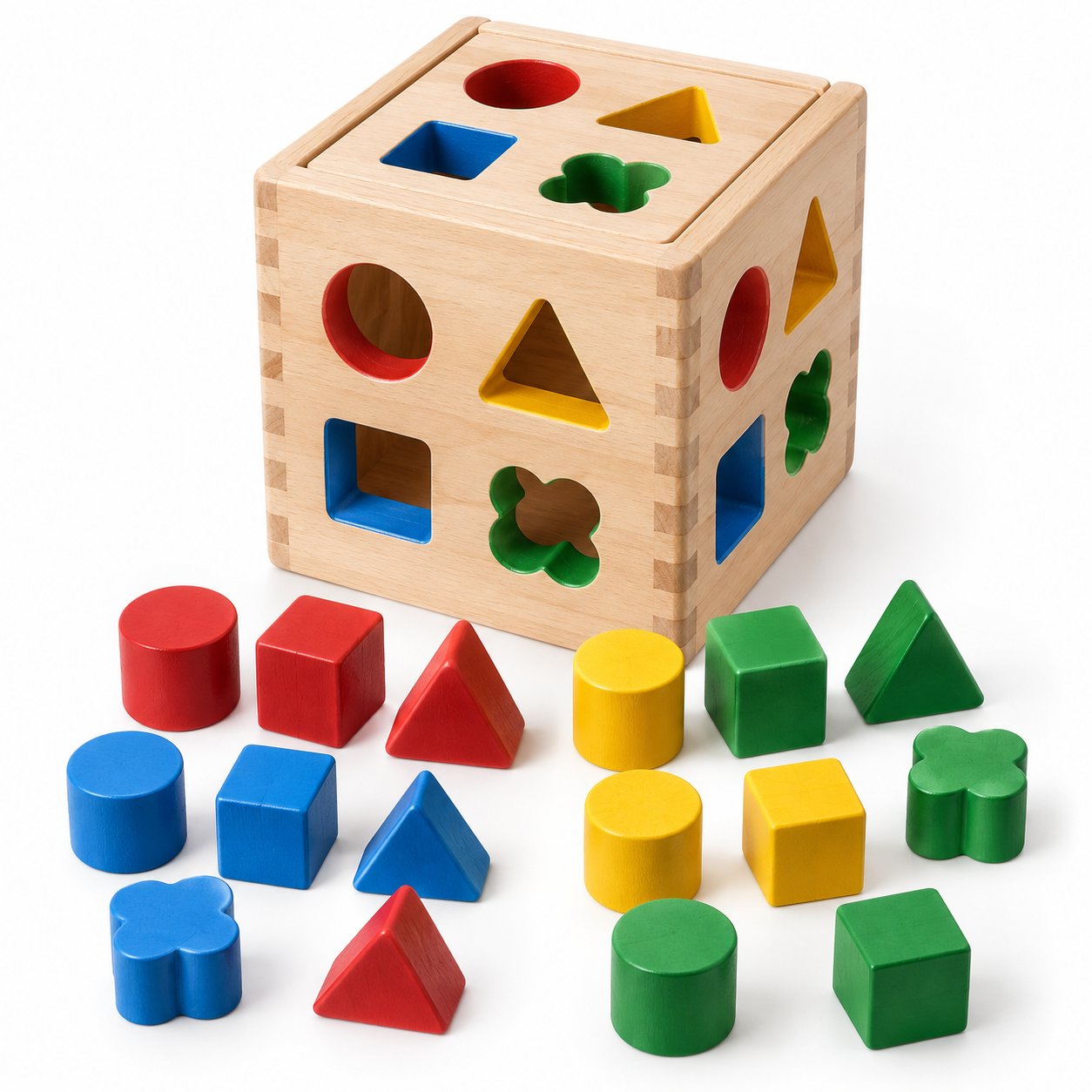
Take the Wooden Shape Sorter Cube with 12 Blocks for Toddlers as the concrete case. The set has twelve blocks in four shapes and four colours, a cube body of 15 x 15 x 15 cm, and block thickness of 2.5 cm, finished in a non-toxic water-based finish and listed as EN71 and ASTM F963 compliant. In sealing terms, that product presents dozens of separate surfaces:
- The flat faces and the four long edges of each of the twelve blocks, where the end grain of the cut timber is exposed.
- The rounded or bevelled corners where a thin film is easiest to rub through.
- The shape openings in the cube walls, including the inside faces of each cut-out, which are sanded and sealed separately from the outside face.
- The interior of the cube body, which is reachable by small hands through the openings.
- Any printed area, logo or colour-block detail applied over the wood.
A properly sealed surface therefore means a continuous film over sanded wood and over printed or painted areas, sealed end grain and cut-outs, sealed edges and interior holes, and no tackiness anywhere the hand or mouth can reach. Gaps usually appear where sanding stopped too coarse, where end grain absorbed more finish than the face, or where a cut-out was masked during spraying and never re-coated.
Practical test of coverage: run a fingertip along the inside rim of a shape opening and across the end grain of a block. These are the two places where film continuity fails first, and they are the two places a buyer should look before approving a sample.
Water-based and solvent-based sealer systems
Both families are used on wooden toys. The choice affects feel, compatibility with the colour system, workshop conditions, how long the parts must rest before packing, and how the item behaves in a classroom. The table below sets out the comparison on the criteria that usually decide an order.
| Criterion | Water-based sealer system | Solvent-based sealer system |
|---|---|---|
| Finish feel | Typically a softer, more open feel; wood grain remains legible under the film. | Generally a harder, tighter film with a more pronounced sheen. |
| Compatibility with water-based colour | Designed to sit over water-based colour and print as part of one system; compatibility should be confirmed as a matched pair. | Requires checking that the solvent carrier does not lift or soften the colour layer beneath. |
| Workshop and odour | Lower odour in the finishing area; ventilation still required. | Stronger solvent odour; needs extraction and controlled storage of opened containers. |
| Handling before packing | Parts must be fully cured, not merely touch-dry, before they are stacked or wrapped. | Cure stage must be confirmed with the finisher; solvent release continues after the surface feels dry. |
| Classroom suitability | Well suited where odour on opening a carton is a concern for preschool and classroom programmes. | Acceptable where the supply chain confirms full cure and the packed carton has no residual odour on opening. |
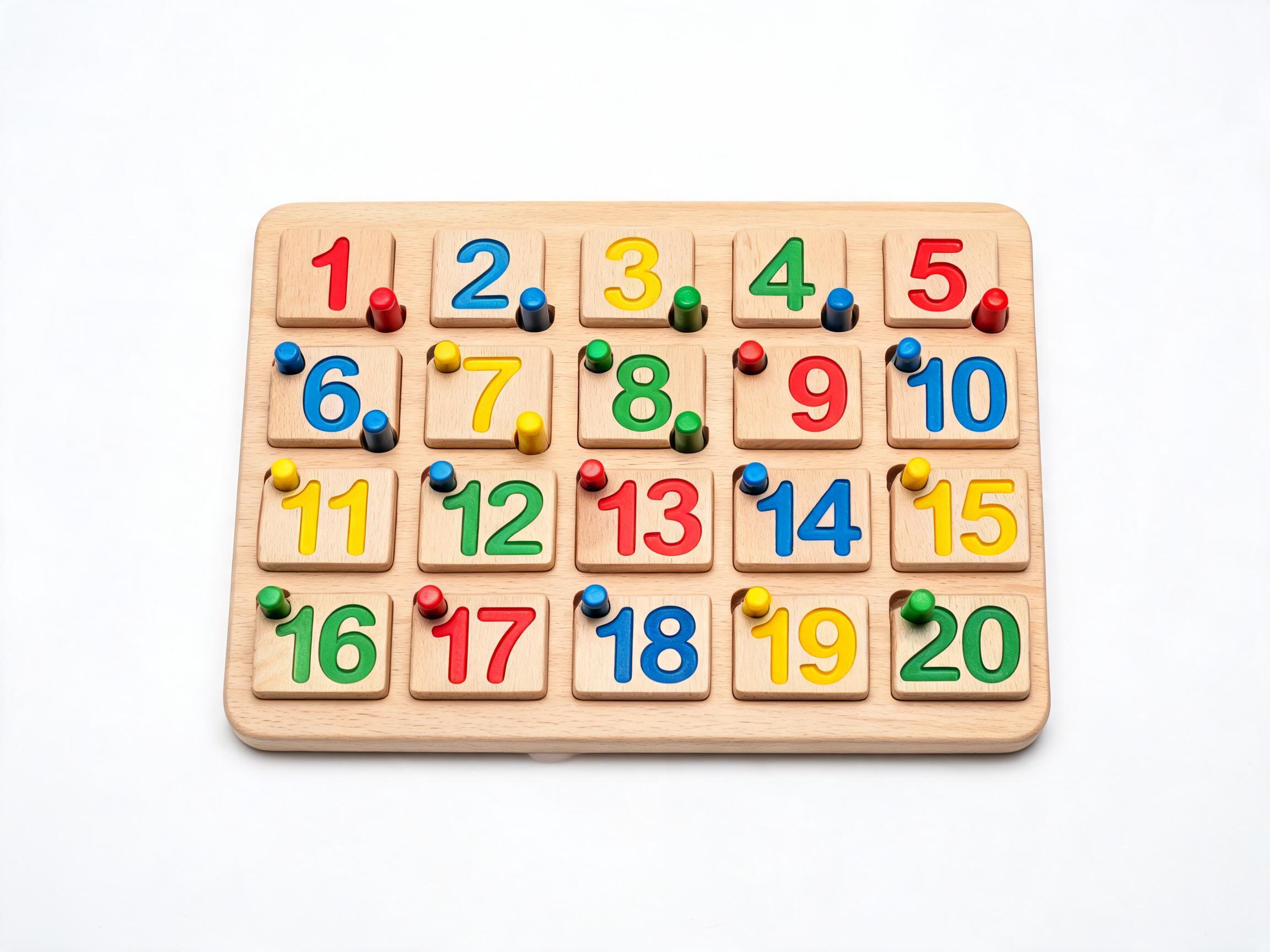
Both the shape sorter cube and the Wooden Number Puzzle Board with Counting Pegs for Preschool are finished with a non-toxic water-based coating. The puzzle board carries twenty numbered pieces with counting pegs on a board of 30 x 22 x 1.8 cm, packed 40 sets per export carton, and is listed against the same EN71 and ASTM F963 frameworks. For a buyer, the point of the table is not to declare one system better; it is to make clear what you are choosing when you write the clause.
Writing the coating requirement on the purchase order
The coating requirement does not need to be long, but it does need to be unambiguous. A short specification block on the PO, agreed before production, removes most of the arguments that arise at inspection. Use this structure:
Substrate and preparation: solid wood, sanded to an agreed grit sequence, with dust removed before finishing; end grain and cut-outs prepared to the same standard as face surfaces.
Colour system: named colour system, with the exact shades referenced; printed or applied graphics listed separately.
Sealer type: water-based or solvent-based, named as a system, with the sealer matched to the colour layer beneath it.
Coat sequence and film build: number of coats, order of coats relative to printing, and the film build to be agreed on the approved sample.
Cure before packing: parts held until fully cured, with cure stage confirmed before wrapping and cartoning.
Packaging after cure: colour box, shrink wrap or export carton applied only after cure, with no stacking of uncured parts.
The film build clause is the one buyers most often leave vague. Rather than citing a number, agree that the approved sample defines the target, and that production is matched to it. That keeps the specification tied to something both sides have physically inspected.
What to inspect on a pre-production sample
Approve the sample against a numbered list, and record the observations in writing. The points below are inspection items, not pass or fail thresholds; the acceptable condition is whatever both parties sign off on the sample.
- Film continuity at end grain and inside cut-outs, checked by eye and by touch.
- Dry rub observation on a concealed or low-visibility area.
- Damp cloth rub observation on the same area, noting any colour transfer.
- Tackiness check on flat faces, corners and around pegs.
- Colour fastness around the counting pegs and any painted or printed areas.
- Edge and corner coverage, particularly on thin sections such as the 2.5 cm blocks.
- Odour when a packed carton is opened, assessed on a carton that has been closed for a realistic period.
- Surface appearance under raking light, looking for sanding marks, sink-in or dry spray.
- Print or logo adhesion, checked where graphics sit on a sealed surface.
Item seven is often skipped and is the one that most directly affects a classroom buyer, because the first impression of the product is the smell of the carton.
Saliva and heavy-metal migration reports
Ask for the report package at quotation stage, not after the order is placed. The central rule is that the report must name the finished article as shipped. A statement about the coating material in its container does not cover the applied film on a sanded, coloured toy.
When you request a test report, check that it identifies the laboratory, the test method, the date, and the exact colour and finish system that was sampled. If the article ships in four colours, the report should make clear which colours were tested. Ask specifically for saliva and heavy-metal migration coverage on the finished surface, since these are the routes that matter for toys used by young children.
- Material-level statements are not enough. A supplier’s declaration about a sealer as supplied says nothing about the film as cured on your article.
- Distinguish a compliance declaration from a report. A letter confirming that a product is listed against EN71 and ASTM F963 is useful for a tender file, but it is not the same document as a migration report naming your finish system.
- Match the report to the order. If you change colour, sealer or print supplier, the original report no longer describes what you are buying.
Both models discussed here are listed as EN71 and ASTM F963 compliant. Treat that as the framework the products are listed against and ask for the supporting documentation that applies to your specific order configuration.
Recoating and touch-up over the product life
Who recoats depends on who owns the product. Retail buyers do not re-seal finished goods; the sealed finish is expected to last the life of the item in normal use. Institutional buyers — preschools, classroom programmes and rental or lending libraries — may need touch-up after heavy use, because repeated handling in a group setting wears any film.
The condition signals that suggest touch-up are dull patches where the film has worn thin, raised grain where moisture has lifted the surface, and whitening at edges and corners. Where these appear, a light sand of the affected area followed by a thin recoat is the usual approach, with the item held out of use until the new coat is fully cured.
The point that catches buyers out: recoating with a different product leaves the original test coverage behind. The migration report you accepted covered the factory finish, and a different touch-up material is a different system. Specify the touch-up material when the order is placed, so the classroom has a compatible product on hand and the documentation still describes what is on the toy.
Buyer questions
Can an oil finish replace a sealer?
An oil finish and a sealer are different systems, and they should not be treated as interchangeable on an order. If you want an oiled look, raise it as a separate specification, accept it on a sample, and confirm the report package covers that finish system rather than the standard one.
Does sealing change the colour?
Any film changes how colour reads, and water-based and solvent-based systems can shift the appearance differently. Approve the colour on the sealed sample, not on an unsealed or part-finished piece, and keep that approved sample as the reference for production.
Does the sealer go on before or after printing?
It depends on the system, and it belongs in the coat sequence clause. On a matched water-based system, the sequence typically places a sealer over the colour or print layer so the graphic is protected; the exact order should be agreed and visible on the sample.
Does each colour need its own report?
Ask the laboratory or supplier to confirm which colours the report covers. Where a report names only one shade, additional colours may need their own coverage; do not assume the whole colour range is included.
How many touch-up units should a classroom order carry?
There is no universal figure, and it depends on handling intensity and the length of the programme. A practical approach is to agree a small touch-up kit with the supplier at order stage, sized to the number of sets in use, and to specify the matching touch-up material at the same time.
Our pricing is quoted against the specification, so the coating system, the film build agreed on the sample, the report package and the packing all change the quotation. The shape sorter cube and the number puzzle board are both available at a 500-set MOQ with OEM and ODM options.
Send your target market and the finish requirement you need — sealer type, colour system, report package and touch-up plan — and we will quote against that specification rather than against a generic listing.


