A buyer-facing guide to shuttlecock construction: feather versus synthetic skirts, cork versus plastic bases, how materials affect flight and durability, and what to confirm with a supplier before ordering school badminton sets.
Materials Explainer
Every shuttlecock is built from two parts: a base and a skirt. What those two parts are made of decides how the shuttle flies, how long it survives a school lesson, and what you can reasonably order at a given budget.
Key takeaways
- A shuttlecock has a base (cork or plastic) and a skirt (feather or synthetic).
- Feather skirts fly closest to tournament behaviour but cost more and break faster.
- Nylon and other synthetic skirts flex instead of cracking, which suits school and recreation use.
- Material choice is a cost-and-durability trade-off, not a quality ranking.
- Confirm the exact shuttle spec with your supplier before ordering, because the material is usually not stated on a set's outer carton.
On this page
The two parts of a shuttlecock
A shuttlecock is not one material. It is an assembly, and each half behaves differently in play.
The base is the rounded block that meets the racket strings. It carries the weight and gives the shuttle its punch off the string bed. The skirt is the cone of overlapping pieces above it. The skirt creates drag, and that drag is what makes a shuttle slow down sharply and fall nose-first instead of sailing like a ball.
Buyers often ask "what is a shuttlecock made of" expecting a single answer. In practice, the answer is a pair: base material plus skirt material. Feather and cork is one combination, synthetic skirt and plastic base is another, and mixed builds exist in between.
Skirt materials: feather versus synthetic
Feather skirts
Feather skirts are made from natural bird feathers, trimmed and arranged in an overlapping ring so the flight is consistent. Feathers come in grades, and grading is the main reason two feather shuttles at the same nominal specification can perform differently. Feather gives a crisp, predictable trajectory and the familiar tumbling fall that experienced players expect.
The drawback is fragility. A feather is a thin natural sheet, and a mis-hit or a clash of rackets can crease or snap it. Once one or two feathers deform, the shuttle starts to wobble and drift. Feather shuttles are normally treated as consumables in competitive play rather than long-life equipment.
Nylon and other synthetic skirts
Synthetic skirts are moulded from nylon or a similar polymer. Instead of cracking, the moulded ribs flex and spring back, so a deformed skirt often recovers its shape between rallies. They are also unaffected by humidity, which matters in tropical and coastal markets where stored feather shuttles can soften.
The trade-off is feel. A synthetic shuttle generally flies slightly differently from a feather one, and players who are used to feather will notice it. For school lessons, club warm-ups, family sets and rental programmes, that difference rarely matters, while the longer service life does.
Base materials: cork versus plastic
The base determines how the shuttle responds at the moment of impact.
- Cork base. Traditional and still the reference point for tournament play. Cork is light, absorbs impact well and gives a clean, controlled rebound. It is paired almost exclusively with feather skirts, because the two are matched in weight and behaviour.
- Plastic or synthetic base. Moulded polymer bases are the usual partner for synthetic skirts. They are more tolerant of rough handling, damp courts and repeated mis-hits, and they hold up better when a set is passed between dozens of students in a single session.
Note that the base is not always a single material. Some shuttles combine a cork core with a synthetic skin, or weight the base with a denser insert. The construction details sit with the manufacturer; the skirt and base type are what a buyer normally needs to specify.
Material comparison for buyers
| Build | Flight feel | Durability in group use | Typical fit |
|---|---|---|---|
| Feather skirt + cork base | Closest to tournament behaviour; crisp and predictable | Lower; feathers deform from mis-hits | Competitive play, coaching, advanced training |
| Feather skirt + composite base | Feather-like, slightly firmer | Moderate; base outlasts the skirt | Club practice on a controlled budget |
| Synthetic skirt + plastic base | Consistent but noticeably different from feather | Higher; skirts flex back and resist humidity | Schools, recreation, rental sets, family use |
Read the table as a cost-and-durability trade-off. A school ordering sets for PE lessons is not buying the same shuttle as a tournament organiser, and neither build is "better" in isolation. If your buyers replace shuttles every term, the synthetic route usually reduces that churn; if your customers are experienced players, feather is the expectation.
What to confirm with a supplier before ordering
A shuttlecock's material is frequently not printed on the set's gift box or export carton. Suppliers can also change the shuttle inside a set without changing the set's article number. Before you confirm a purchase order, ask for the following in writing.
- Skirt material and grade — natural feather, or synthetic. If feather, ask how the supplier grades it, since grade drives both flight and price.
- Base material — cork, composite or moulded plastic, and whether any insert is used.
- Consistency across the order — whether the shuttle in the bulk order matches the sample you approved, and how the supplier controls that.
- Spare shuttles — whether replacements can be supplied separately, in their own pack, for buyers who resell sets.
- Packaging and quantity — how many shuttles per set, and how the set is packed for export.
- Compliance documents — which test reports apply to the set and its contents.
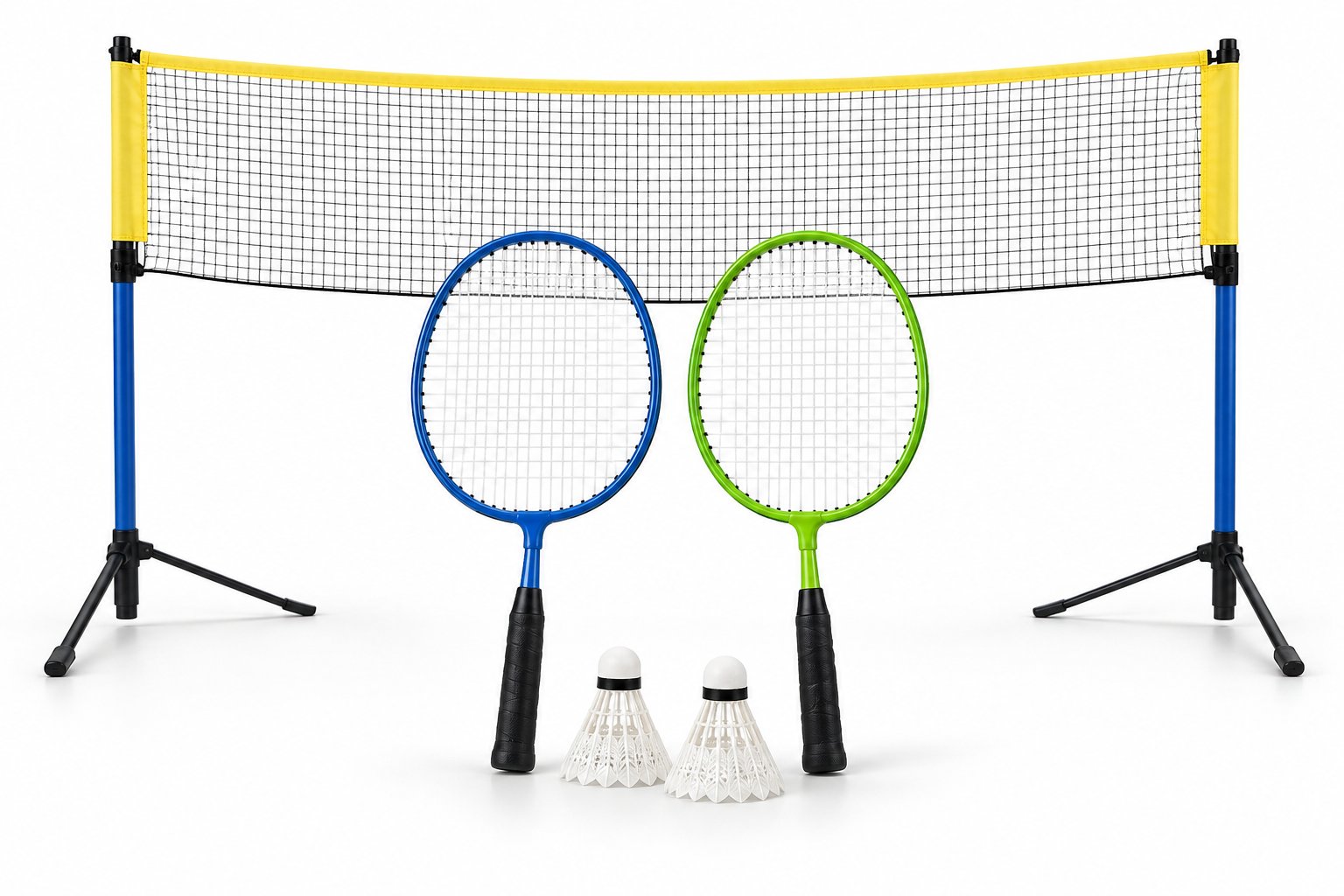
For reference, a school-oriented set such as the Junior Badminton Set with Net for School Sports Lessons ships with two rackets, two shuttlecocks, one 300 x 60 cm nylon net and four pegs, with 53 cm rackets in a lightweight composite frame. The set is packed in a carry bag and an export carton of 16 sets, with EN71 and ASTM F963 certification across the range and OEM/ODM available at a MOQ of 500 sets. The shuttlecock material inside that set should be confirmed directly with the supplier, since the specification is not fixed in the published product data.
FAQ
How long does a shuttlecock last?
There is no universal figure, because lifespan depends on the material, the level of play and how many people share the shuttle. Feather shuttles can be damaged within a single hard rally, while synthetic shuttles typically survive many sessions of school-level play before the skirt loses its shape. The practical way to plan is to estimate shuttles per student per term and compare that with the replacement cost of each build, rather than to rely on a quoted number of hours.
How do I choose a shuttlecock for a school or kids' set?
Start from who is playing. For children aged six and up, beginners and mixed-ability classes, a synthetic skirt with a moulded base is the usual choice: it tolerates mis-hits and humid storage, and it keeps a class supplied without constant replacement. Choose feather only if the players are experienced and the programme expects tournament-style flight. Then confirm the exact material, grade and packing with your supplier, because the set description alone rarely specifies it.
Does the shuttlecock material affect the racket or the net?
Only indirectly. A heavier or denser shuttle puts slightly more stress on the string bed, and a shuttle that is repeatedly mis-hit will be struck by the frame more often. The racket and net specifications in a set are chosen independently, so treat shuttle, racket and net as separate line items when you compare quotations.
Can a supplier mix shuttle types in one order?
That depends on the supplier and the order volume. Ask before you finalise the enquiry, and state the split you need, since mixed configurations may affect the packing list and the carton count.
Fujian Lequ Wanwan Co., Ltd. is a B2B toy manufacturer and exporter founded in 2013, with EN71 and ASTM F963 certification across its export range. If you are sourcing school badminton sets and need the shuttlecock specification confirmed in writing before you place an order, send your requirements and target market to the supplier for a quotation.