
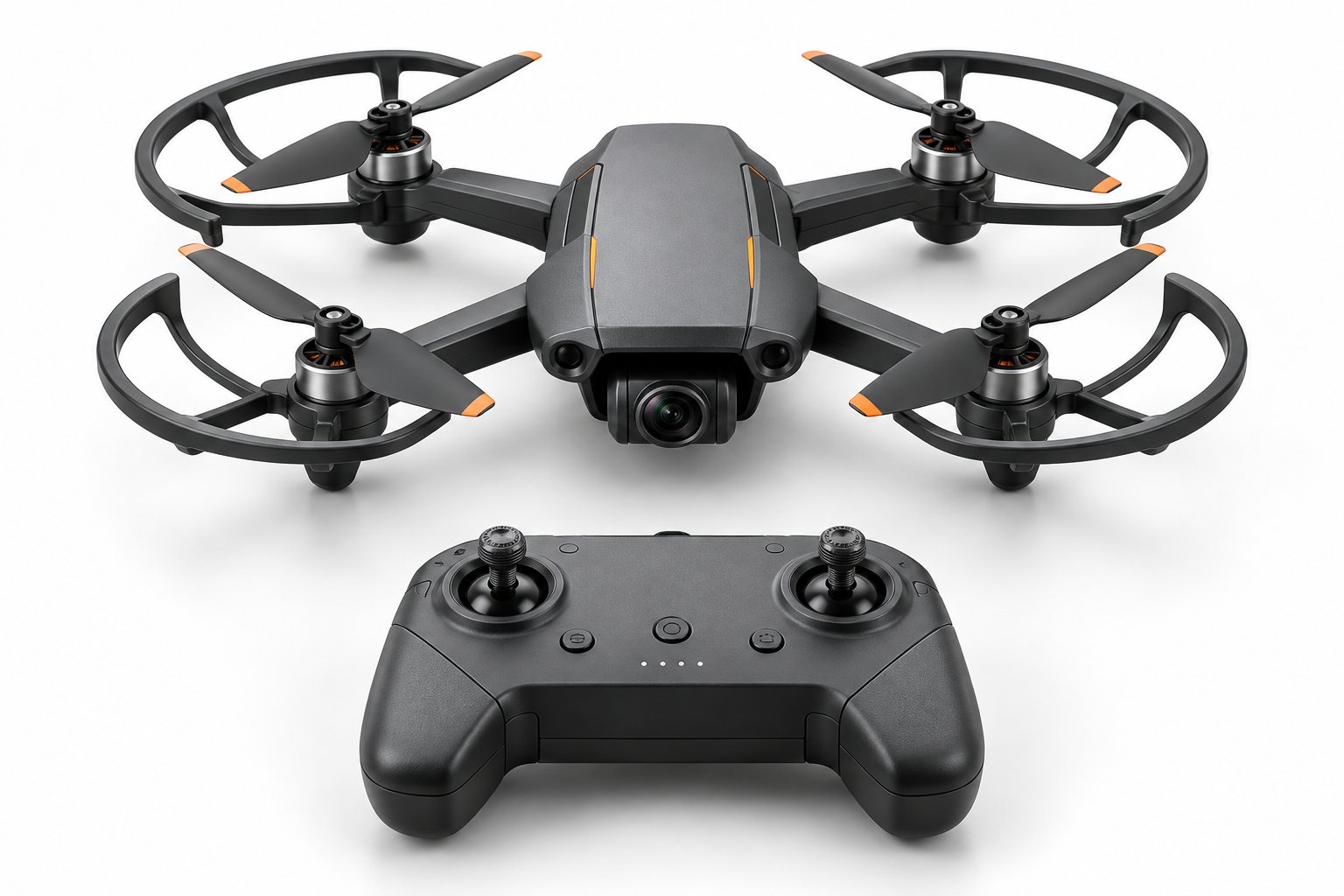
An RC drone is a radio-controlled multirotor aircraft. For buyers new to the category, this article defines the term and explains which toy-grade specifications actually matter when comparing entry-level models for retail or gift programs.
An RC drone is a radio-controlled multirotor aircraft: a small unmanned flying vehicle with four or more rotors, steered by a handheld transmitter rather than by onboard autonomy or a smartphone app alone. The category covers everything from palm-sized toy models sold in gift aisles to hobby-grade quadcopters with GPS and brushless motors. This article explains what separates the two ends of that range, focusing on the spec-sheet terms buyers actually see on toy-grade packaging and product listings.
Key Takeaways
- An RC drone is a radio-controlled multirotor; control comes from a dedicated transmitter, not a phone.
- Toy-grade and hobby-grade models differ mainly in camera resolution, flight assistance features, control range, flight time, and battery/charging setup.
- For retail and gift programs, the spec terms that matter most are the ones that shape the out-of-box experience: altitude hold, headless mode, propeller guards, and USB charging.
- Use a real product spec sheet as a benchmark. Our mini RC drone with camera is a useful example of toy-grade specifications.
RC Drone: A Plain Definition
A radio-controlled drone consists of a multirotor airframe, motors and propellers, a flight controller, a battery, and a radio receiver that communicates with a handheld transmitter. The transmitter sends commands for throttle, yaw, pitch, and roll; the flight controller translates those commands into different motor speeds to keep the craft stable and move it in the intended direction.
That last point matters for buyers: the flight controller, not the transmitter alone, determines how forgiving the drone is to fly. Toy-grade models typically include simplified flight-assist features (altitude hold, headless mode) that reduce the skill needed to get airborne. Hobby-grade models assume more pilot input and often add GPS, return-to-home, and brushless motors for longer life and higher performance.
The term “RC drone” is often used interchangeably with “quadcopter,” although a quadcopter is simply a drone with four rotors. Most toy-grade RC drones are quadcopters.
Toy-Grade vs Hobby-Grade: The Spec Terms That Actually Differ
When you compare spec sheets across entry-level models, the same handful of terms appear again and again. Here is what each one means and how toy-grade and hobby-grade approaches typically differ.
Camera Resolution and Recording
Toy-grade drones usually list a resolution such as 720p and may or may not include recording capability. A 720p camera captures stills or video at a modest resolution suitable for casual use; it is not intended to match action-camera footage. Some toy models record to a microSD card, while others transmit only to a phone. Hobby-grade drones often offer higher resolutions, gimbal stabilization, and adjustable camera angles.
For a retail or gift program, the presence of recording (microSD slot) is often a clearer differentiator than the resolution number itself, because it changes how the product is used and perceived.
Altitude Hold
Altitude hold is a flight-assist feature that maintains the drone’s current height when the throttle stick is released. On a toy-grade model, this makes the drone easier for a beginner to control and reduces the chance of unintended climbs or drops. Hobby-grade drones may also have altitude hold, but they typically pair it with GPS-based position hold and return-to-home functions.
On a spec sheet, altitude hold is a simple yes/no feature. For gift buyers, it is a strong signal that the model is beginner-friendly.
Headless Mode
Headless mode keeps control orientation fixed relative to the pilot, regardless of which way the drone is facing. Without headless mode, forward on the stick moves the drone in the direction its nose is pointing; with headless mode, forward always moves the drone away from the pilot. This simplifies orientation for new users and is common on toy-grade models.
Hobby-grade drones often rely on GPS and compass instead, or assume the pilot can manage orientation visually. For toy-grade products, headless mode is a practical feature to highlight on packaging.
Propeller Guards
Propeller guards are protective frames around each propeller. On toy-grade drones, they reduce the risk of damage from minor collisions and make the product safer for indoor or mixed indoor/outdoor use. Guards are typically made from a flexible plastic such as PP.
Hobby-grade drones often omit guards to save weight and reduce drag. For a toy program aimed at beginners or younger users, guards are a meaningful safety and durability feature.
Control Range
Control range is the maximum distance at which the transmitter can reliably send commands to the drone. Toy-grade models typically list a range suitable for backyard or park flying—for example, up to 50 m on our mini RC drone. Hobby-grade drones may offer longer ranges, often with more sophisticated radio links.
On a spec sheet, a longer range is not automatically better for a toy: beginners rarely fly far, and a long range can imply capabilities the product does not have. For retail positioning, a stated range that matches typical use is more honest and more useful.
Flight Time
Flight time is the approximate duration the drone can fly on a fully charged battery. Toy-grade models commonly list flight times in the range of several minutes—about 8 minutes for our mini RC drone—while hobby-grade drones may fly longer, often with larger batteries and brushless motors.
For buyers, flight time should be read together with battery and charging method. A short flight time paired with easy USB charging and a spare battery can be more practical for a gift product than a longer flight time that requires a proprietary charger.
Battery and Charging
Toy-grade drones typically use a small rechargeable battery—3.7 V is common—charged via USB. USB charging lowers the barrier for end users (no separate charger needed) and simplifies packaging. Hobby-grade drones often use higher-voltage batteries with dedicated balance chargers.
On a spec sheet, the charging method matters as much as the battery chemistry. USB charging is a convenience feature that suits gift and retail channels.
Toy-Grade Spec Sheet: A Worked Example
To see how these terms come together, consider the mini RC drone with camera from Lequ Wanwan. Its published specifications include:
| Specification | Detail |
|---|---|
| Flight configuration | Four-axis (quadcopter) |
| Camera | 720p with microSD recording |
| Altitude hold | Yes |
| One-key take-off and landing | Yes |
| Headless mode | Yes, keeps control orientation fixed |
| Propeller guards | On all four arms |
| Control range | Up to 50 m |
| Flight time | About 8 minutes |
| Battery | 3.7 V rechargeable, USB charging |
| Materials | ABS frame with PP propeller guards |
| Age recommendation | 8+ years |
| MOQ | 500 pieces |
| Compliance | EN71 / ASTM F963 |
All specifications above are as published by the manufacturer. Buyers should confirm current specifications and compliance documentation directly with the supplier.
What This Means for Your Order
If you are sourcing RC drones for a retail or gift program, the spec terms above translate into practical considerations:
- Target user: Altitude hold, headless mode, and propeller guards are beginner-friendly features. If your audience is new to drones, these features reduce frustration and returns.
- Channel fit: USB charging and a stated flight time of about 8 minutes suit gift and impulse-purchase channels where users expect simple setup. A proprietary charger adds complexity that may not match the price point.
- Camera expectations: 720p recording is adequate for casual photos and video. If your program requires higher resolution, you are moving toward hobby-grade specifications and should expect different pricing and features.
- Control range: A range up to 50 m is appropriate for backyard and park use. It is not a performance claim for long-distance flight; set expectations accordingly in your marketing.
- Compliance and age grading: The example product is EN71 / ASTM F963 compliant and rated for ages 8+. Confirm that the compliance documentation matches the exact model and packaging you plan to import.
- MOQ: The example product has a MOQ of 500 pieces. MOQ affects your ability to test the market and should be discussed early in sourcing.
It is also worth asking suppliers how they verify flight time and control range, and whether spare propellers or batteries are available as accessories. These details affect after-sales support and repurchase rates.
Next Step: Compare a Real Spec Sheet
Use the worked example above as a template for your own comparison. When evaluating toy-grade RC drones, line up the specs that matter for your channel—camera and recording, altitude hold, headless mode, propeller guards, control range, flight time, and battery/charging—and check whether the supplier can provide compliance documentation for the exact model.
If you are sourcing for a retail or gift program, you can view the mini RC drone with camera for full specifications and request a quotation. Lequ Wanwan is a toy manufacturer and exporter based in Fujian, China, and can discuss MOQ, compliance, and packaging details for your order.


