A practical guide for buyers on what really determines a small drone's wind performance—weight-to-power balance, propeller guards, and altitude hold—plus a checklist to verify with suppliers before ordering.
Buying Guide
Best Drone for Windy Conditions: Key Features to Check
Wind is the single most common reason small drones behave unpredictably outdoors. For buyers sourcing consumer or toy-grade quadcopters, the question is not which model has the highest advertised wind resistance—it is which design features actually help a small aircraft hold its position when gusts hit, and what the limits of that class of product really are.
This guide explains the specifications that matter, using the Mini RC Drone with Camera as a reference point for a well-equipped toy-class quadcopter. It also sets out the questions to put to a supplier before you commit to an order.
Key takeaways
- For small drones, wind performance comes from the relationship between body weight and motor/thrust capability—not from a single headline number.
- Propeller guards protect blades during unplanned contact, which becomes more likely in gusty air.
- Altitude hold and stable flight-assist features reduce the workload on the operator when the aircraft is pushed around.
- Toy-class drones have real limits: short range (≤50m on the referenced model), short flight time (about 8 minutes, subject to actual product), and no GPS. Be honest about these boundaries before you buy.
- Always confirm the specific model's actual specifications with the supplier—published figures vary by configuration and batch.
On this page
Weight-to-power balance
A drone stays stable in wind when its propulsion system can produce enough thrust to counter the force of the gust, and when the flight controller can make rapid corrections. Two airframes of the same size can behave very differently: a heavier body with underpowered motors will struggle to climb out of a downdraft, while a very light body with strong motors may react quickly but get pushed around more easily.
In practice, buyers should look for a design where the motor and propeller size are matched to the all-up weight. There is no universal ratio to quote for toy drones, but suppliers can tell you the motor type and the intended thrust-to-weight margin. If a supplier cannot explain how the propulsion was sized, that is a warning sign.
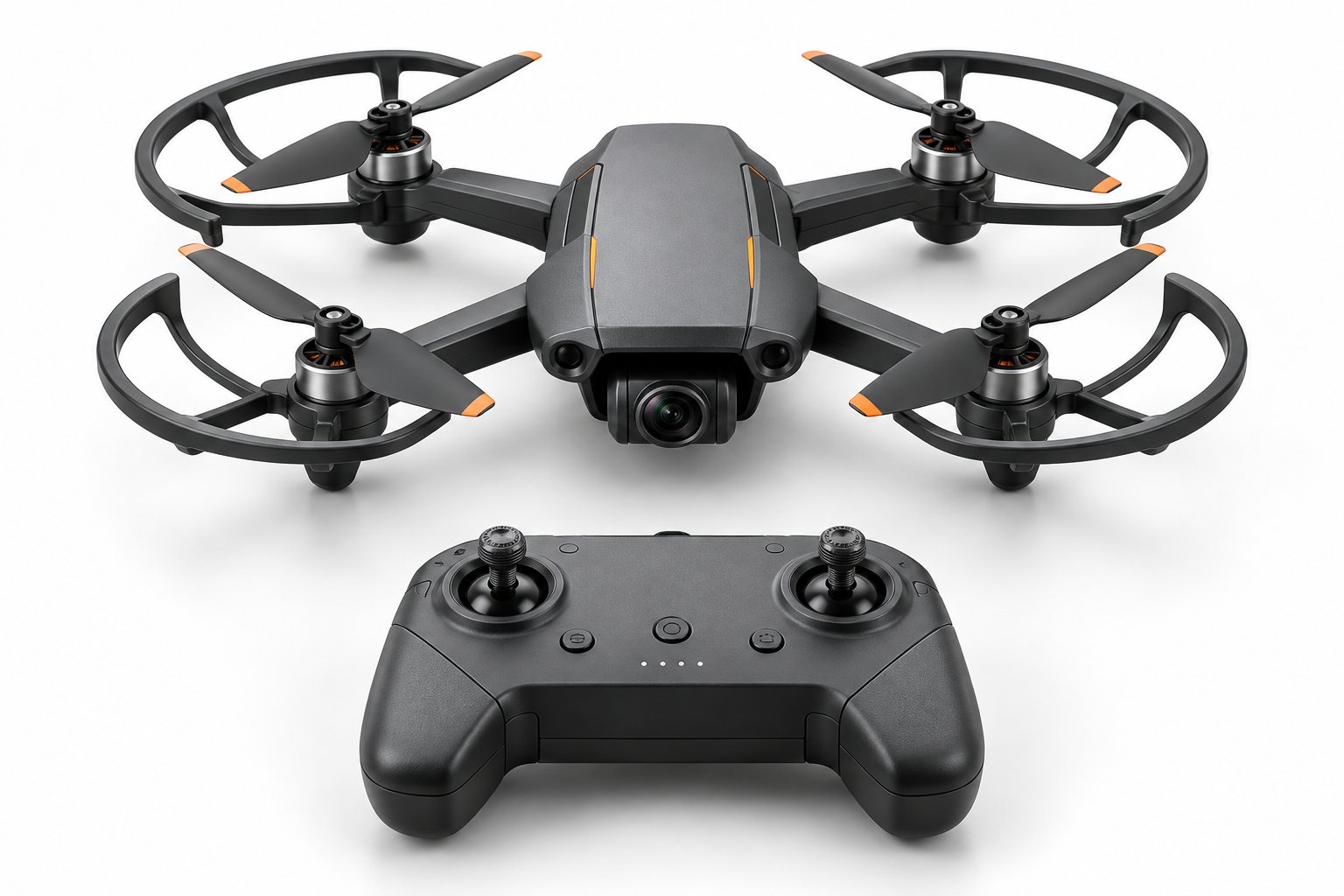
The referenced Mini RC Drone with Camera is a four-axis quadcopter with a 720p camera and a 3.7V USB-charged battery. Its compact frame and four-motor layout are typical of the class. For wind, the key question is not the camera resolution but whether the motors can hold altitude when a breeze hits—something only the supplier's own testing or a sample flight can confirm.
Propeller guards and structural protection
In gusty conditions, the aircraft is more likely to drift into walls, trees, or the ground during takeoff and landing. Full propeller guards on all four arms reduce the chance of blade damage and make the drone more forgiving for less experienced pilots. They also protect people nearby if the drone is blown off course.
The Mini RC Drone with Camera has full blade guards on all four arms. That is a meaningful feature for outdoor use, but it does not make the drone windproof. Guards add a small amount of weight and drag, so the propulsion system must be sized accordingly. When comparing models, check whether guards are included as standard or only on certain SKUs.
Altitude hold and flight-assist features
Altitude hold uses a barometric sensor to maintain a consistent height without the operator constantly adjusting the throttle. In light wind, this reduces the mental load and makes smoother video possible. The Mini RC Drone with Camera includes altitude hold, along with one-key takeoff/landing and headless mode. Headless mode can simplify orientation when the drone is far away or when the pilot is distracted by wind corrections.
These features help, but they are aids, not autopilots. They do not measure wind speed or automatically compensate for gusts. Buyers should treat them as workload reducers for the pilot, not as a guarantee of stable flight in strong wind.
Honest boundaries of toy-class drones
It is important to be clear about what a small, low-cost quadcopter can and cannot do. The referenced model has a control distance of ≤50m and a flight time of about 8 minutes (subject to actual product). These are typical figures for the class. In windy conditions, both range and flight time can be effectively shorter because the drone must work harder to hold position.
Toy-class drones also lack GPS, which means they cannot hold a fixed position automatically or return to home if the signal is lost. For windy outdoor use, this is a significant limitation: if the drone is blown out of range, recovery may not be possible. Buyers should communicate these limits clearly to end users.
The Mini RC Drone with Camera is intended for ages 8 and above and carries EN71 and ASTM F963 certifications. Those certifications cover toy safety, not wind performance. Do not confuse them with a weather-resistance rating.
Supplier checklist
Before placing an order, ask your supplier to confirm the following for the specific model and configuration you are buying. Where a figure is not available, ask what testing or documentation they can provide.
| Item | What to confirm | Why it matters |
|---|---|---|
| Motor and propeller specification | Motor type, propeller size, and thrust-to-weight margin | Determines the drone's ability to counter wind gusts |
| All-up weight | Weight with battery installed | Lighter drones are more affected by wind, but heavier ones need more thrust |
| Propeller guards | Included on all arms? Standard or optional? | Protects blades and people during unplanned contact |
| Altitude hold | Barometric sensor present? How is it calibrated? | Reduces pilot workload in light wind |
| Control range | Confirmed maximum distance (≤50m for the referenced model) | Wind reduces effective range; users need to know the limit |
| Flight time | Typical flight time (about 8 minutes for the referenced model, subject to actual product) | Wind increases power draw and shortens flight time |
| Certifications | EN71 and ASTM F963 for the specific SKU | Toy safety compliance for target markets |
| MOQ and lead time | MOQ 500 pcs for the referenced model; confirm lead time | Planning and inventory |
The Mini RC Drone with Camera is available with MOQ 500 pcs. Specifications are as listed for the referenced model; confirm final details with the supplier before ordering.
FAQ
Can a toy drone fly in strong wind?
No. Toy-class drones are not designed for strong wind. They may handle very light breezes, but gusts can push them off course or out of range. Always check the supplier's recommended conditions and test a sample before committing to volume orders.
Does a higher camera resolution mean better wind performance?
No. Camera resolution (720p on the referenced model) affects video quality, not flight stability. Wind performance depends on weight-to-power balance, propeller guards, and flight-assist features.
What is the most important feature for windy conditions?
There is no single feature. The combination of adequate thrust, protective guards, and altitude hold matters most. Buyers should evaluate the whole system and confirm specifications with the supplier.
How can I verify a supplier's wind claims?
Ask for the specific test conditions (wind speed, duration, payload) and request a sample for your own evaluation. Be cautious of any supplier that quotes a wind resistance figure without explaining how it was measured.