CE marking on toys is a self-declared conformity mark for the EU market, not a government-issued certificate. This explainer covers what the mark actually addresses, how the EN71 parts divide mechanical, flammability, and chemical risks, where ASTM F963 fits for US-bound goods, and gives importers a verification checklist covering test report scope, the Declaration of Conformity, the certificate holder, and production consistency before a plush toy order is confirmed.
Compliance & Buyer Verification
A CE mark on a toy shipment tells you the manufacturer or importer has declared the product meets the applicable EU toy rules. It does not tell you what was tested, who holds the paperwork, or whether the units in your container match the sample. Those are the things you have to verify yourself.
Key takeaways
- CE marking is a self-declared conformity mark for the EU market — the manufacturer (or the importer placing the goods on the EU market) takes responsibility for the declaration.
- EN71 is split into parts: mechanical and physical properties, flammability, and chemical safety. Each part covers a different risk, and a report can cover one without the others.
- For the US market, ASTM F963 is the comparable toy safety standard. A CE mark alone does not substitute for it.
- Verify four things before ordering: the scope of the test report, the Declaration of Conformity, the holder of the certificate, and production consistency between the tested sample and the shipped batch.
On this page
What CE marking on toys actually covers
"CE" stands for Conformité Européenne. On toys sold in the EU, the mark indicates the product is declared compliant with the EU Toy Safety Directive and the harmonised standards that support it. The mark is applied by the manufacturer or, where the manufacturer is outside the EU, by the importer who places the goods on the market. That is the central point for buyers: CE marking is not issued by a government body or a central authority. It is a declaration backed by technical documentation, and the party signing it carries the legal responsibility.
Because it is self-declared, the mark itself carries no information about how thorough the underlying testing was. Two shipments can both carry CE marks while being supported by very different levels of evidence. This is why the answer to "what is CE marking on products" is only half the story — the other half is what documentation stands behind the mark, and whether that documentation applies to the exact item in your order.
EN71 is not one test — it is a set of parts
EN71 is the European standard for toy safety. It is organised into parts, and each part addresses a different category of risk. A common mistake among first-time importers is to read "EN71 certified" as a single blanket statement. In practice, a test report will list which parts were applied, and that list is what you need to read.
| Standard part | Risk area | What a report typically records |
|---|---|---|
| EN71-1 | Mechanical and physical properties | Sharp edges and points, small parts, attachment strength of components, seam and joint integrity relevant to the age group. |
| EN71-2 | Flammability | Burning rate and flame spread behaviour of the toy materials tested. |
| EN71-3 | Chemical safety (migration of certain elements) | Migration limits for specified elements from toy materials and coatings. |
A report covering only EN71-1 leaves flammability and chemical migration unaddressed by that document. That is not automatically a problem for every product — the applicable requirements depend on the toy, its materials, and its intended age group — but it does mean a report's headline "EN71 tested" claim is not enough on its own.
For goods headed to the United States, the relevant toy safety standard is ASTM F963, which is separate from the CE framework. If you are buying for both markets, ask for the documents that correspond to each destination rather than assuming one covers the other.
The Declaration of Conformity is the document that matters
Behind the CE mark sits the Declaration of Conformity (DoC). This is the formal document in which the responsible party lists the product, the directives and standards applied, and signs off on compliance. For a buyer, the DoC is more informative than the CE symbol printed on a hangtag or carton, because it names the standards relied upon.
Read it for three things: the product identity (does the description match what you are ordering, including size and age grading), the standards listed (do they correspond to the tests you expected), and the identity of the signing party (is it the manufacturer, or an importer or agent, and does that match who you are contracting with). A DoC that names a different product, or a generic description that could apply to anything, is a signal to ask more questions before committing to a production run.
Note on certificates vs. reports: A test report is the record of what a laboratory tested on a specific sample. A certificate or DoC is the conformity statement built on top of that testing. Buyers need both, and they need to confirm the two refer to the same product and standard.
Buyer verification checklist
Run these checks against the supplier before placing a bulk order. Each one answers a different question, and skipping any of them leaves a gap you may only discover at customs or in a customer complaint.
- Confirm the test report scope. Ask which EN71 parts were applied, what sample was tested, and the report date. A report on an earlier version of a product does not automatically carry over to a redesign.
- Read the Declaration of Conformity. Check that the product description, materials, and age grading match your purchase order, and that the signatory is the party you are dealing with.
- Identify the certificate holder. Establish who legally holds the documentation. If it is a trading company rather than the factory, clarify how that affects responsibility for the production batch.
- Check age grading and small parts. For toys intended for young children, confirm the tested age range aligns with your labelling. Components that detach under tension are one of the most frequently cited failure modes in physical testing.
- Verify material and component consistency. Confirm the tested sample used the same materials and construction as production — filling type, surface fabric, and how eyes and nose are attached all fall under this.
- Review production consistency controls. Ask how the factory keeps the shipped batch aligned with the tested sample, and whether any incoming-material changes would trigger re-testing.
- Decide on third-party verification. For higher-risk or higher-volume orders, a pre-shipment inspection or an independent test on a pulled sample closes the gap between "the sample passed" and "the batch conforms."
Applying this to a plush toy order
Plush toys concentrate several of these verification points into one product. The materials are soft, so flammability and chemical migration matter; the eyes and nose are small components, so attachment strength falls under physical testing; and the filling is a material that has to match whatever was originally tested.
Take a product like our plush teddy bear comfort toy as a concrete example of how a spec sheet intersects the checklist. It is stated as EN71 and ASTM F963 compliant, which tells you the supplier positions it for both the EU and US markets — but you still confirm the EN71 parts covered and request the DoC and supporting report. It has embroidered eyes and nose with no plastic parts, which removes one small-parts consideration from the physical testing conversation while leaving seam integrity and overall construction in scope. Double-stitched seams, a short-pile plush surface, and hypoallergenic polyester fibre filling are the material and construction details you would match against the tested sample to confirm production consistency. At 30 cm seated height and a MOQ of 1,000 pieces, it is also a case where the economics of an independent pre-shipment test are easy to justify.
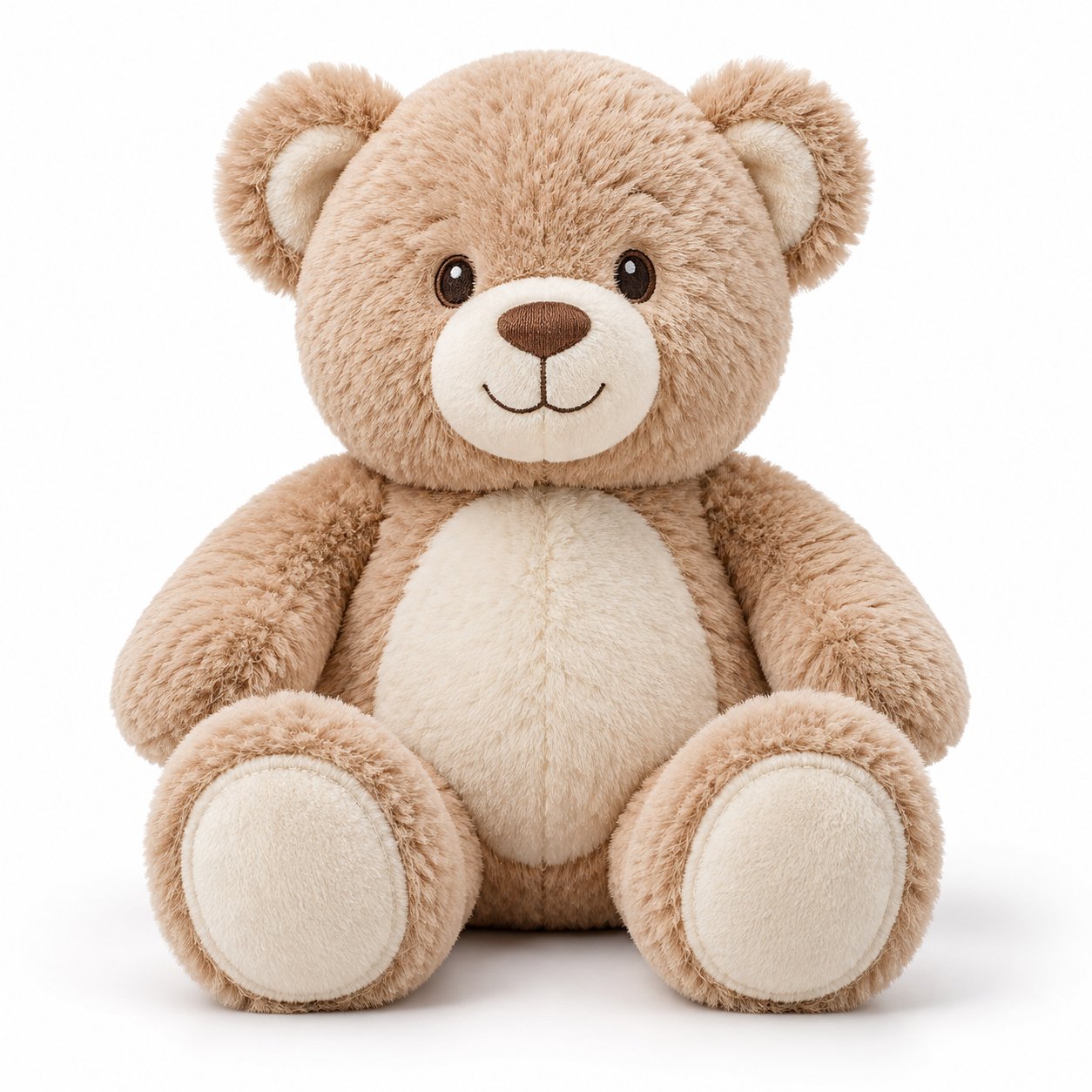
None of these product details by themselves prove that a particular production run conforms. They are the facts you line up against the test report and DoC — the points where a mismatch would be visible to you before the order ships.
FAQ
Does a CE mark guarantee a toy is safe?
No. It is a declaration of conformity with applicable EU rules, backed by technical documentation the responsible party maintains. Its reliability depends on the accuracy of that documentation and the consistency of production. That is why buyers verify rather than assume.
Is EN71 the same as CE marking?
No. EN71 is a standard used to demonstrate conformity; CE marking is the market-access mark applied when the applicable requirements are met. The test report under EN71 is part of the evidence that supports the CE declaration.
Can one test report cover a whole product range?
Only to the extent that the tested sample genuinely represents the other variants in materials, construction, and size. If a variant changes the filling, surface fabric, or component attachment, ask whether the original report still applies or whether additional testing is needed.
What should I ask for before paying a deposit?
At minimum: the EN71 test report with its scope and date, the Declaration of Conformity naming the product and standards, and clarity on who holds the documentation. For large orders, add a pre-shipment inspection plan.
Before you place the order
If you are sourcing plush toys for the EU or US market, send us your target market, age grading, and quantity, and we can walk through the documentation we can supply for the specific product you are considering. Have the compliance documents to hand — the questions above go faster when both sides are looking at the same paperwork.