A factory-side breakdown of how a beach ball is actually produced — panel cutting, printing, seam welding, inflation testing and export packing — plus the checks B2B buyers should run before placing a bulk order for an outdoor sports toy set.
Buyers searching "how to make a beach ball" usually find craft tutorials: cut plastic, tape the seams, inflate. That is not how a beach ball arrives in an export carton. A sellable beach ball is a welded, printed, pressure-tested product, and the way it is made determines whether a container load survives the trip. This is the factory view.
Why the Manufacturing Method Matters to a Buyer
A beach ball is a low-unit-price item, which is exactly why process control matters more than buyers expect. Small defects that a consumer tolerates on a single retail purchase become a claim, a return or a dead listing when they appear across a full order. The production sequence below is what separates a factory-made beach ball from a hand-assembled craft object, and each step maps to something you can ask a supplier to confirm.
Step 1: Material Selection and Panel Cutting
Factory beach balls are built from flexible, weather-resistant plastic film formed into curved panels. Panels are die-cut to a template so that every ball in a run has matching seam lengths — a mismatched panel set produces a ball that leans or wrinkles when inflated.
For an outdoor toy set sold into North America or Europe, the material choice also links to compliance. Our Outdoor Sports Set with Beach Ball and Ring Toss for Group Play uses weather-resistant plastic and fabric components and is produced to EN71 and ASTM F963 requirements. Those standards govern the finished toy, so material selection is a compliance decision as much as a durability one.
Step 2: Printing and Color Registration
Panels are printed before assembly, while the film is still flat. This is the practical reason factory printing looks cleaner than any post-assembly decoration: the artwork is applied to a flat surface, so registration stays consistent across all panels of the ball.
For OEM and ODM programs, artwork is approved at this stage. A panel layout that works on a flat sheet can still look misaligned when the panels curve into a sphere, so buyers should expect to review a printed panel sample rather than only a flat digital proof.
Step 3: Seam Welding and Assembly
The panels are joined along their curved edges to form the sphere. In volume production this is a heat-based welding process rather than stitching or adhesive, which is why mass-produced beach balls hold air in a way taped DIY versions do not.
This is the highest-risk step in the line. Seam quality determines whether the ball holds inflation and where it will fail first. A factory with an internal QC laboratory can inspect incoming material, run small-parts testing and check finished goods before packing — that sequence is what catches a weak seam before it reaches a carton.
Step 4: Valve Insertion and Inflation Testing
The inflation valve is inserted and the ball is inflated for inspection. Testing at this stage looks for two things: that the ball holds air, and that it inflates into a round shape rather than an egg. Balls are typically checked inflated and then deflated for shipping, since a flat-packed ball occupies far less container space.
Key takeaways for buyers
- Panel cutting and flat-sheet printing happen before assembly — ask to see a printed panel, not only digital artwork.
- Seam welding is the critical quality step; it determines air retention and the ball's round shape.
- Age grading, material and small-parts control feed directly into EN71 / ASTM F963 compliance.
- Bulk orders ship deflated in export cartons, so pack configuration is part of the quotation.
Step 5: Packing and Export Cartons
Beach balls are deflated and packed with the rest of the set. For a multi-component product like a set with a ball, disc and ring toss, packing is a real engineering task: the carton must hold the full set without crushing components or wasting container volume.
We export in color box packaging. If you are comparing quotations, pack format — polybag, color box, or set-with-display — changes both unit cost and the number of sets per carton, so it should be specified before pricing rather than after.
Factory Capacity Behind a Beach Ball Order
Unit price is only half of a sourcing decision; the other half is whether the factory can repeat the same quality at volume. Current production facts for this line:
| Item | Detail |
|---|---|
| Production lines | 6 |
| Monthly capacity | 1.2 million pieces |
| Workforce | 180 staff |
| Quality system | ISO 9001; internal QC lab (incoming inspection, small-parts testing, finished goods inspection) |
| Compliance | EN71 / ASTM F963 for the outdoor sports toy set |
| MOQ | 500 sets |
| Customization | OEM / ODM available |
| Age grading | 3 years and up |
| Markets served | North America, Europe |
DIY Instructions vs. Factory Production: What Actually Differs
Most "how to make a beach ball" content online describes a craft project: cut panels from a beach towel or vinyl sheet, join them with tape or glue, and inflate. That is a legitimate hobby activity, but it is not a sourcing reference. The differences that matter commercially are:
- Joining method. Adhesive and tape are not heat-welded seams; a taped ball leaks at the joins under repeated use.
- Consistency. A hand-made ball is one unit. A factory run is thousands of balls that must match in size, shape, print and inflation.
- Compliance. A craft ball has no age grading, no small-parts assessment and no EN71 or ASTM F963 documentation. A retail toy needs all three.
- Packing. Craft output is one ball. Export output is a deflated set in a color box inside a carton sized for container efficiency.
Checks to Run Before You Place an Order
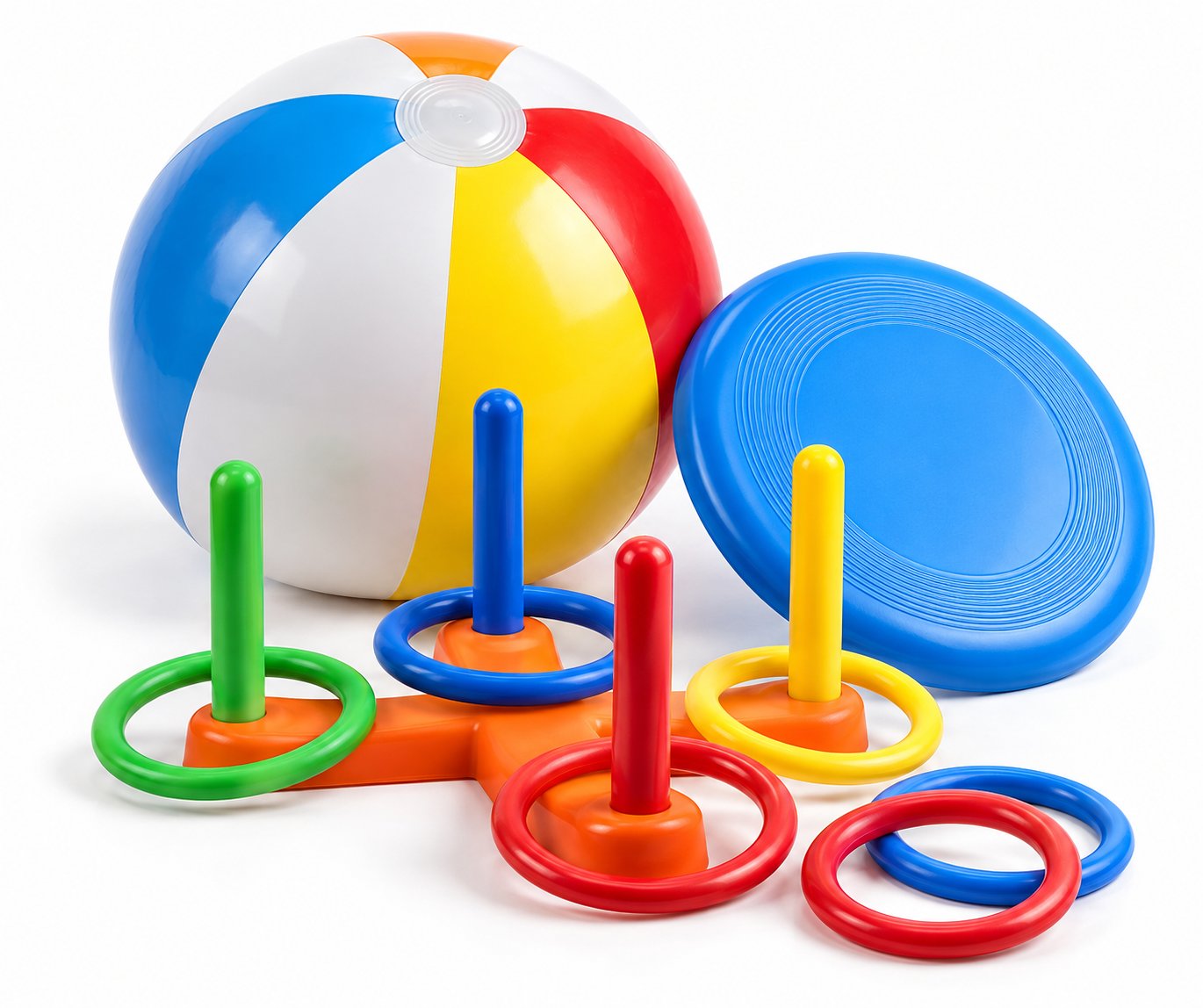
- Ask which components ship in the set. The outdoor sports set includes a beach ball, a flying disc and a ring toss game — confirm the exact contents and quantities per set in your quotation.
- Confirm the compliance scope. Ask for the EN71 / ASTM F963 documentation that applies to the set you are ordering, not a general statement.
- Verify the pack format and carton count. Color box export packaging is standard here; confirm sets per carton and carton dimensions before finalizing freight estimates.
- Check age grading against your market. The set is graded for 3 years and up. If your channel sells to a different age group, raise it before sampling.
- Request a printed panel or pre-production sample if your artwork is complex, so registration and shape can be checked on a real ball.
- Align on customization early. OEM and ODM are available; logo placement, colors and packaging artwork all take review cycles, so start them before booking production capacity.
FAQ
Are beach balls inflated when they ship?
For bulk export, balls are deflated so the set packs flat in an export carton. Inflation happens at the retail or end-user stage.
What is the minimum order quantity?
MOQ for this outdoor sports toy set is 500 sets.
Can the ball and packaging be customized?
Yes — OEM and ODM are available for this product line. The practical limit is review time: custom print and packaging artwork need approval before production is scheduled.
Which markets does this product ship to?
We serve buyers in North America and Europe, and the set is produced to EN71 and ASTM F963 requirements.
Next Step
If you are sourcing a beach ball as part of a group-play set rather than as a standalone toy, the product to look at is the Outdoor Sports Set with Beach Ball and Ring Toss for Group Play — a beach ball, flying disc and ring toss game in one weather-resistant set, graded for 3 years and up, with color box export packing, OEM/ODM options and an MOQ of 500 sets.
Send your target market, artwork status and pack format, and we can confirm quotation and lead time against current production capacity.
Process steps above describe standard factory production for this product category. For your specific order — packaging, artwork and documentation scope — confirm details with us before placing production capacity.