
Flight time on a toy-class quadcopter is decided by battery capacity, aircraft weight, wind, flight mode, and how much you hover versus fly aggressively. Registration is a separate question: regulators set weight thresholds that vary by market, and many lightweight toy-class drones fall below them. This explainer covers what actually shortens a battery, how to get the most from each charge, and a buyer checklist for checking registration rules in your destination market.
Buyer Basics · Toy-Class Quadcopters
Two questions come up before almost every first drone purchase: how long does a drone battery last on a single charge, and how much does it cost to register a drone where I live? The honest answer to the first is a list of factors rather than one number, and the honest answer to the second is “it depends on the local weight threshold” — which is why the rules are worth checking before you buy, not after.
What this guide covers
What actually decides flight time
Advertising statements about runtime describe a best case measured under favorable conditions: a freshly charged pack, mild air, gentle stick inputs, and often a mix of hovering and slow forward flight. Real sessions are shorter. Four variables explain most of the gap.
- Battery capacity. A larger capacity stores more energy, so it can support a longer flight — all else being equal.
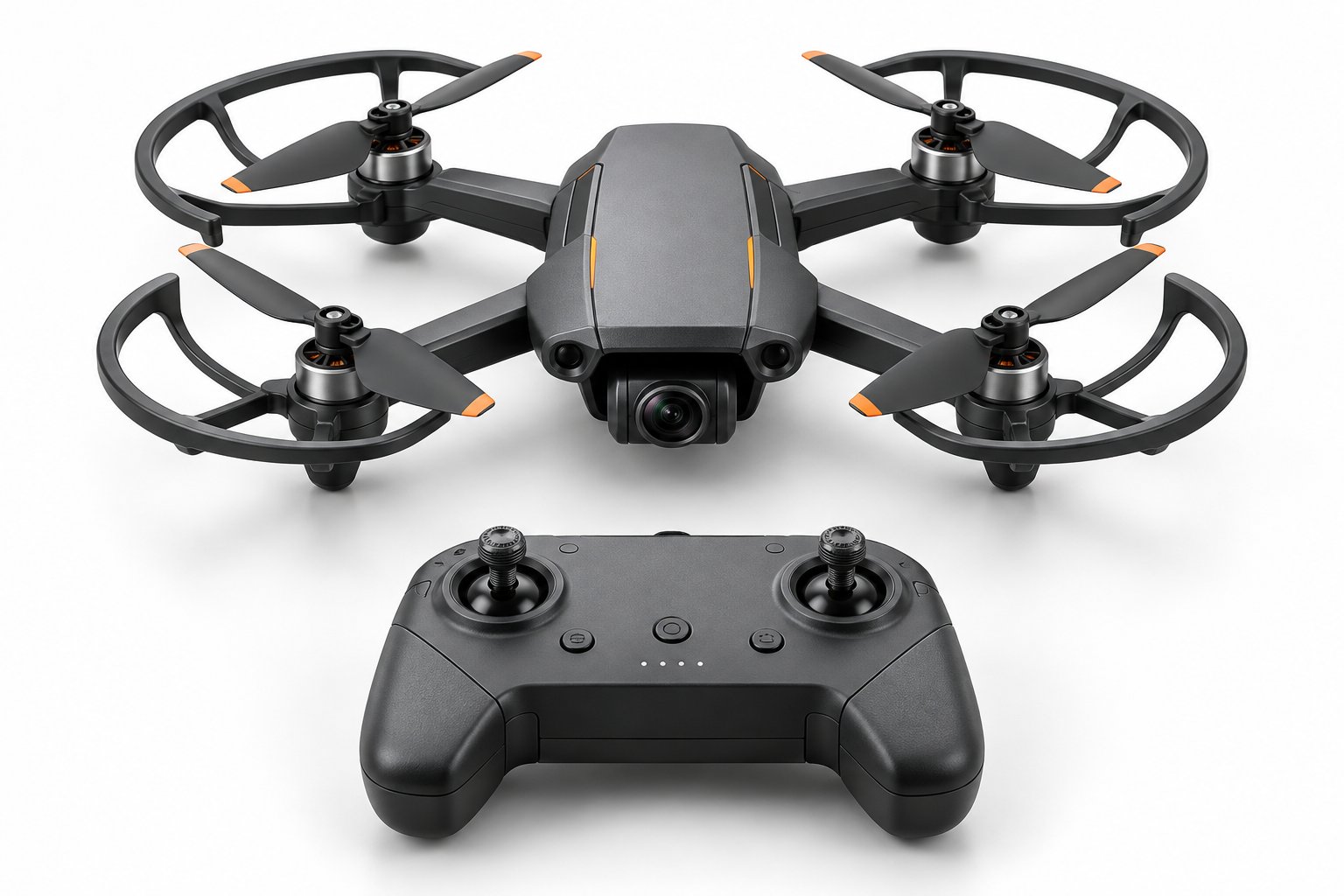
- All-up weight. Everything the motors lift — frame, motors, propellers, guards, camera module, and the battery itself — costs energy to keep airborne.
- Flight conditions. Wind is the single biggest external drain. Fighting a headwind means the motors work harder to hold position or make progress.
- Flight mode and style. A calm hover in a low-power mode draws far less current than continuous sport flying, fast climbs, and hard direction changes.
These interact. A heavier drone with a bigger battery is not automatically a longer-flying drone, because the extra mass has to be carried by the very energy that pack provides.
Battery capacity and weight: a trade-off, not a spec winner
In toy-class quadcopters the honest relationship is a seesaw. Adding capacity adds mass; adding mass raises the power needed to fly. Manufacturers choose a point on that curve to balance runtime, agility, and cost. That is why two drones of similar size can behave very differently, and why comparing capacity numbers alone tells you very little.
For buyers, the practical takeaway is that the battery is a consumable, not a lifetime component. Lithium-based packs lose usable capacity as they age, and that lost capacity shows up directly as shorter flights. This is normal chemistry, not a defect, and it is why spare or replacement packs are a sensible part of any first purchase.
Wind, flight mode, and hover versus sport flying
| Variable | Effect on flight time | What the buyer can do |
|---|---|---|
| Wind and gusts | Shortens runtime; the drone spends energy holding position instead of moving efficiently. | Fly early morning or evening; choose sheltered areas; avoid days with strong gusts. |
| Flight mode | Low-power or beginner modes stretch runtime; high-rate modes consume faster. | Match the mode to the task — smooth footage or relaxed cruising, not every flight. |
| Hover vs. sport flying | Long steady hovers are gentler on the pack than repeated hard acceleration. | Plan smooth flight paths instead of constant sharp corrections. |
| Payload (camera, guards) | Every added component increases weight and current draw. | Remove optional add-ons when you do not need them. |
| Battery age and care | Gradual capacity loss over the pack's life reduces each charge. | Follow the maker's storage and charging instructions; keep spare packs. |
Getting the most out of each charge
- Charge fully, and cool down before flying. Let the pack return to ambient temperature after charging and after landing.
- Start with a calm cruise. Begin each flight gently; the first minute sets the tone for the whole session.
- Land with margin. Do not plan to use the final portion of a charge; keep a buffer so you are never surprised by a low-battery cutoff.
- Store at partial charge. Long-term storage at full charge is hard on lithium packs — store as the manufacturer advises.
- Keep spare packs ready. Swapping a pack is usually faster and cheaper than trying to extend one overlong flight.
Registration: a weight-threshold framework
Registration is a different question from flight time, and it is set by regulators, not by the drone's price or features. The common structure worldwide is a weight threshold: below it, registration and often remote identification are not required; above it, the pilot must register the aircraft. The threshold itself varies by market — some authorities draw the line at 250 g, others use a different figure, and the counting method (bare weight vs. takeoff weight with battery and accessories) can differ too.
What this means for toy-class drones: lightweight models frequently fall below the threshold in many markets, so no registration is needed. But “often” is not “always.” A few points to keep straight:
- Check the rule for each destination market, not just the country you buy in. Cross-border buyers should verify the importing country's rule too.
- Check the weight definition. Whether the threshold applies to the bare airframe or the takeoff weight changes the answer for a given model.
- A fee, where one applies, is typically modest, but exact amounts and validity periods are set by each authority and change over time — confirm the current figure with the local aviation authority.
- Rules also cover how and where you fly (altitude limits, no-fly zones, visual line of sight), which apply regardless of registration status.
Practical shortcut
Before ordering, look up the destination market's aviation authority and search its small-drone or toy-drone page. Confirm the weight threshold, the counting method, the fee (if any), and whether the rule is enforced by the seller, the importer, or the end user.
First-time buyer checklist
- Confirm the drone's listed weight and whether it is bare or takeoff weight.
- Check the destination market's registration threshold and current fee.
- Ask whether the model ships with propeller guards, spare propellers, and a spare battery.
- Confirm the battery type, charging method, and any storage instructions.
- Decide whether you need extra packs — nearly always yes for real sessions.
- Verify controller compatibility and whether a phone or tablet is required.
- Ask the supplier for the user manual in your language and for spare-parts availability.
FAQ
How long does a drone battery last per flight?
There is no single number. Runtime depends on capacity, all-up weight, wind, flight mode, and how smoothly you fly. Treat manufacturer figures as a best case and expect shorter sessions in real conditions.
Does a toy drone need registration?
In many markets, lightweight toy-class drones fall below the registration threshold, so no registration is required. Thresholds and weight-counting methods vary, so verify the rule for your destination market before purchase.
How much does it cost to register a drone?
Where a fee applies, it is usually modest and set by the local aviation authority. The exact amount, validity period, and whether a fee applies at all depend on the market and the drone's weight — confirm with the authority.
Does a spare battery double my flight time?
No — it gives you a second session of similar length. Swapping packs between flights is the standard way to fly longer in total, and it also lets you land with a safe margin on each pack.
Next steps
If you are sourcing toy-class quadcopters for a retail program, ask suppliers for the weight (bare and takeoff), battery type and capacity, spare-parts availability, and user manual in your target language. Supply these details alongside the destination market's registration rule, and you will have everything needed to answer both buyer questions — runtime and registration — before the order ships.