
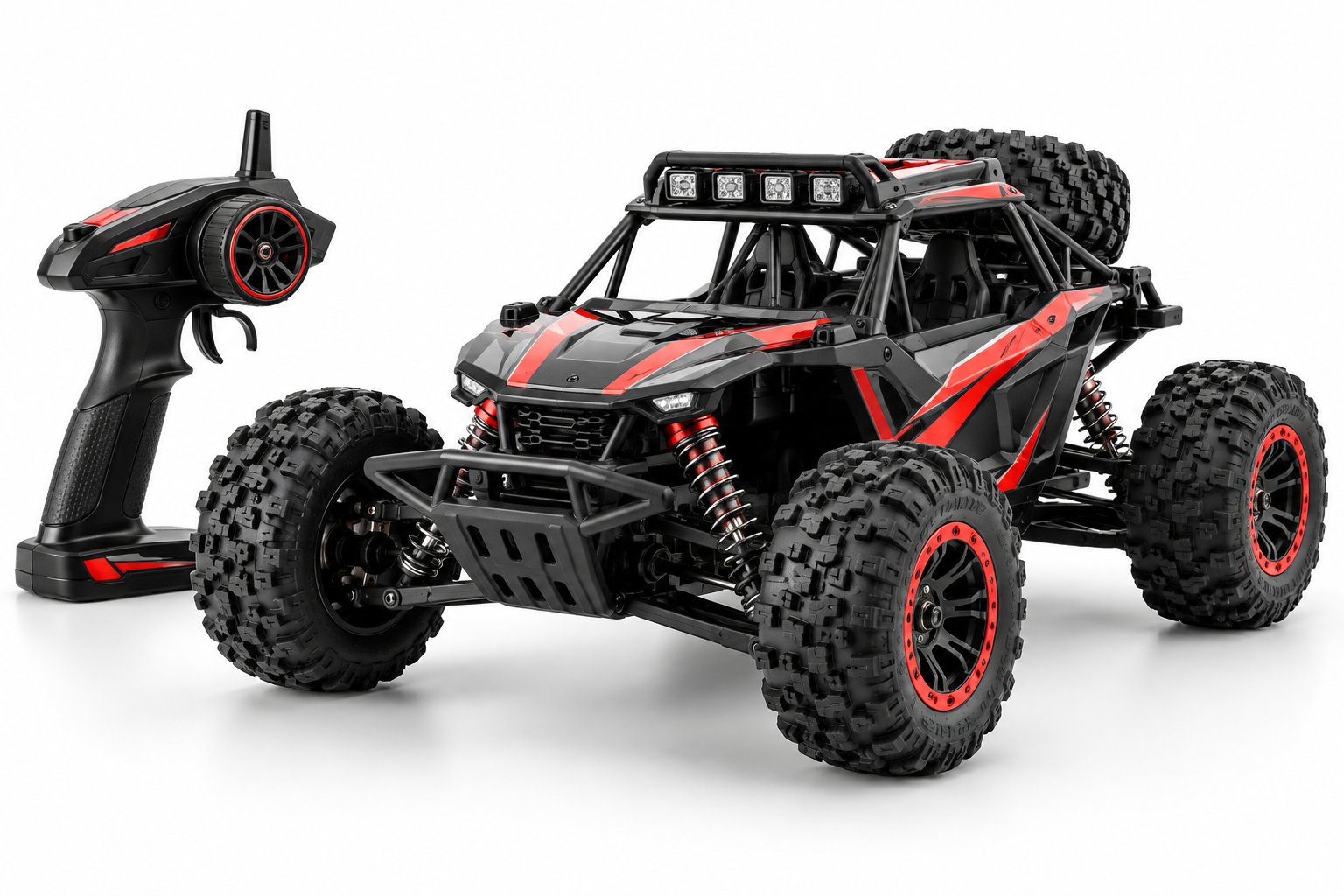
Charging an RC car battery typically takes 45 minutes to 4 hours, depending on battery capacity, charger output, and chemistry. This guide explains the calculation, why USB rechargeable RC cars charge slower, and the specifications importers should verify—including charge current, connector type, and safety certification.
Buyers sourcing RC cars for retail or distribution often ask one question first: how long does an RC car battery take to charge? The answer determines how a product sits in the market—a toy that charges in 45 minutes plays differently from one that needs a 4-hour top-up.
This article explains the variables that control charging time, how to estimate it from a product spec sheet, and which details on a supplier's datasheet deserve scrutiny before you place an order.
What this article covers
How to Estimate Charging Time from Battery and Charger Specs
Charging time is not a fixed number. It comes from a simple relationship: how much energy the battery holds, divided by how fast the charger can deliver it, adjusted for charging losses.
A widely used approximation is:
Charging time (hours) ≈ Battery capacity (mAh) ÷ Charger output current (mA) × 1.2 to 1.5
The 1.2–1.5 multiplier accounts for the fact that chargers are not 100% efficient and that the final stage of charging a lithium or NiMH pack current tapers. It is a planning estimate, not a guarantee. A charger rated at 500 mA charging a 1200 mAh pack will take roughly 3 to 3.5 hours, not 2.4 hours.
- Charging time scales with battery capacity. A 2000 mAh pack takes about twice as long as a 1000 mAh pack on the same charger.
- A higher-output charger shortens charge time but must match the battery's rated charge current; overcurrent charging degrades cells and creates safety risk.
- Do not quote a single charge time for a product family. Quote it for each SKU's battery capacity and supplied charger.
Battery Chemistry and Charger Type: The Real Drivers
Two RC car batteries can share the same capacity label and still charge at very different speeds. The chemistry and the charger design matter as much as the numbers on the label.
| Battery type | Typical capacity range | Typical charge time (with supplied charger) | Notes for spec sheets |
|---|---|---|---|
| NiMH (nickel-metal hydride) | 700–3000 mAh | 2–6 hours | Often charged at 0.1C–0.3C; slower but tolerant of simple chargers |
| Li-ion (lithium-ion) | 500–2000 mAh | 1–3 hours | Requires CC/CV charging; charge current should be stated |
| LiPo (lithium polymer) | 1000–5000+ mAh | 0.75–2 hours | Higher charge rates possible (1C typical) but require proper balance charging |
Ranges are indicative. Actual time depends on charger output, discharge depth, and ambient temperature. Confirm against the specific product's manual or test report.
For a buyer, the practical difference is this: a NiMH toy-grade pack charged from a wall adapter behaves very differently from a LiPo pack charged from a hobby-grade balance charger. Both can be called "RC car batteries," but they belong in different product categories and often different price tiers.
Charger output is the variable manufacturers control
The same 1200 mAh battery can be charged in roughly 1.5 hours at 1000 mA or 3 hours at 500 mA. So when a supplier quotes a charge time, ask what charge current the supplied charger delivers—not just what the battery capacity is.
Why USB Rechargeable RC Cars Charge Slower
The usb rechargeable rc car category has grown quickly because it removes the need for a separate wall adapter: the charging cable plugs into a phone charger, power bank, or laptop port. That convenience has a cost in charge time.
Standard USB ports deliver 5V at 0.5A to 2.4A, but the RC car's internal charging circuit—not the USB source—sets the actual charge current. Many USB-charged toy RC cars limit charge current to 300–500 mA to keep the charging circuit small, cool, and inexpensive. That limit, not the USB port, usually determines the charge time.
- Small toy-grade packs (300–800 mAh): typically 1–3 hours over USB.
- Mid-size packs (800–1500 mAh): typically 2–4 hours over USB.
- Larger packs or fast-charge circuits: can be shorter, but the product should specify the input current and any fast-charge protocol.
If a supplier claims a 30-minute USB charge for a 1500 mAh pack, ask for the charge current and the test conditions. The arithmetic does not support that claim at standard USB current limits unless the pack is partially charged or the capacity figure is optimistic.
What Buyers Should Verify on the Spec Sheet
Charging time is a derived number. To verify it, you need the inputs. The checklist below covers the specifications that let you check a supplier's claim independently.
| Item to verify | Why it matters | What good documentation shows |
|---|---|---|
| Battery chemistry and nominal voltage | Determines charging method and safety requirements | e.g., "Li-ion 3.7V" or "NiMH 4.8V," not just "rechargeable" |
| Battery capacity (mAh or Wh) | Directly sets charge time at a given current | A stated capacity with test condition (e.g., 0.2C discharge) |
| Charger input and output | Determines actual charge current and compatibility | Input voltage/current, output voltage/current |
| Connector type | Affects replacement parts and after-sales support | Named connector standard (e.g., USB-C, JST, barrel jack) |
| Charge time (claimed) | Marketing figure customers will compare | A stated time tied to a specific charger and battery, not a range |
| Safety features | Overcharge, over-discharge, and thermal protection affect returns and liability | Protection ICs or BMS described; relevant test reports available |
| Certification documents | Required for many destination markets | Certificates matching the exact model and battery, available on request |
Red flags in battery and charging claims
- Capacity without units or test conditions. "Long-lasting battery" is not a specification.
- Charge time shorter than the arithmetic allows. If 1500 mAh ÷ 500 mA × 1.3 = 3.9 hours, a 1-hour claim needs explanation.
- No charger output rating. Without it, charge time cannot be checked.
- Certificates that name a different model or battery. A certificate applies to the tested object, not automatically to every SKU in a catalog.
Implications for Importers and Distributors
Charge time is not only a technical detail. It shapes how a product is positioned and supported.
- Product listing accuracy: Marketplaces and retail listings often require a stated charge time. If the figure is wrong, returns and negative reviews follow. Base the listing on the supplier's documented charge current and capacity.
- Accessory strategy: Faster chargers and spare batteries are natural add-on items. If the product uses a standard connector, sourcing compatible accessories is easier.
- After-sales support: Customers lose chargers. Knowing the exact connector and electrical rating lets you supply replacements instead of replacing whole units.
- Compliance planning: Battery-containing products face shipping and market-entry rules that vary by destination. Confirm which certifications and documents the supplier can provide for the specific model before committing to a market.
When comparing suppliers, ask for the battery and charger specifications in writing, not verbally. A supplier who can provide a consistent spec sheet—capacity, chemistry, charge current, connector, and safety features—is easier to audit and easier to support after the sale.
A ready reference for the toy-grade, USB-charged segment: Lequ Toys' 2.4GHz remote control off-road car uses a USB-rechargeable battery pack, a typical configuration for this price tier. Review its listed battery and charging details as a benchmark for the spec sheet you request from any supplier.
FAQ
Most toy-grade RC cars with 500–1500 mAh packs and a supplied USB or wall charger take roughly 1 to 4 hours. Larger hobby-grade packs can take longer or shorter depending on the charger. The exact figure depends on capacity and charge current.
The charging circuit inside the car sets the current it draws, so a higher-wattage phone charger does not necessarily charge the car faster. Use the cable and charger specified by the manufacturer, and check the input rating on the product.
At the same charge current, yes—capacity and time scale together. If the charger output also increases, the times can be similar. Always compare both numbers.
Ask for battery chemistry, capacity, charger input/output, connector type, claimed charge time with its conditions, safety features, and the certification documents applicable to that exact model. Request these in writing.
Because the charge current differs. A car with a 1000 mA charging circuit will charge a 1000 mAh pack in roughly half the time of one limited to 500 mA, assuming similar efficiency.
Next Steps
If you are sourcing RC cars or replacement battery packs, start with the specification rather than the marketing copy. Request the battery and charger data for each model you are considering, check the charge-time arithmetic, and confirm which certificates apply to that exact product.
Send us your target market, product type, and the charging performance you need. We can help you compare specifications across models and identify which configurations match your channel and compliance requirements.