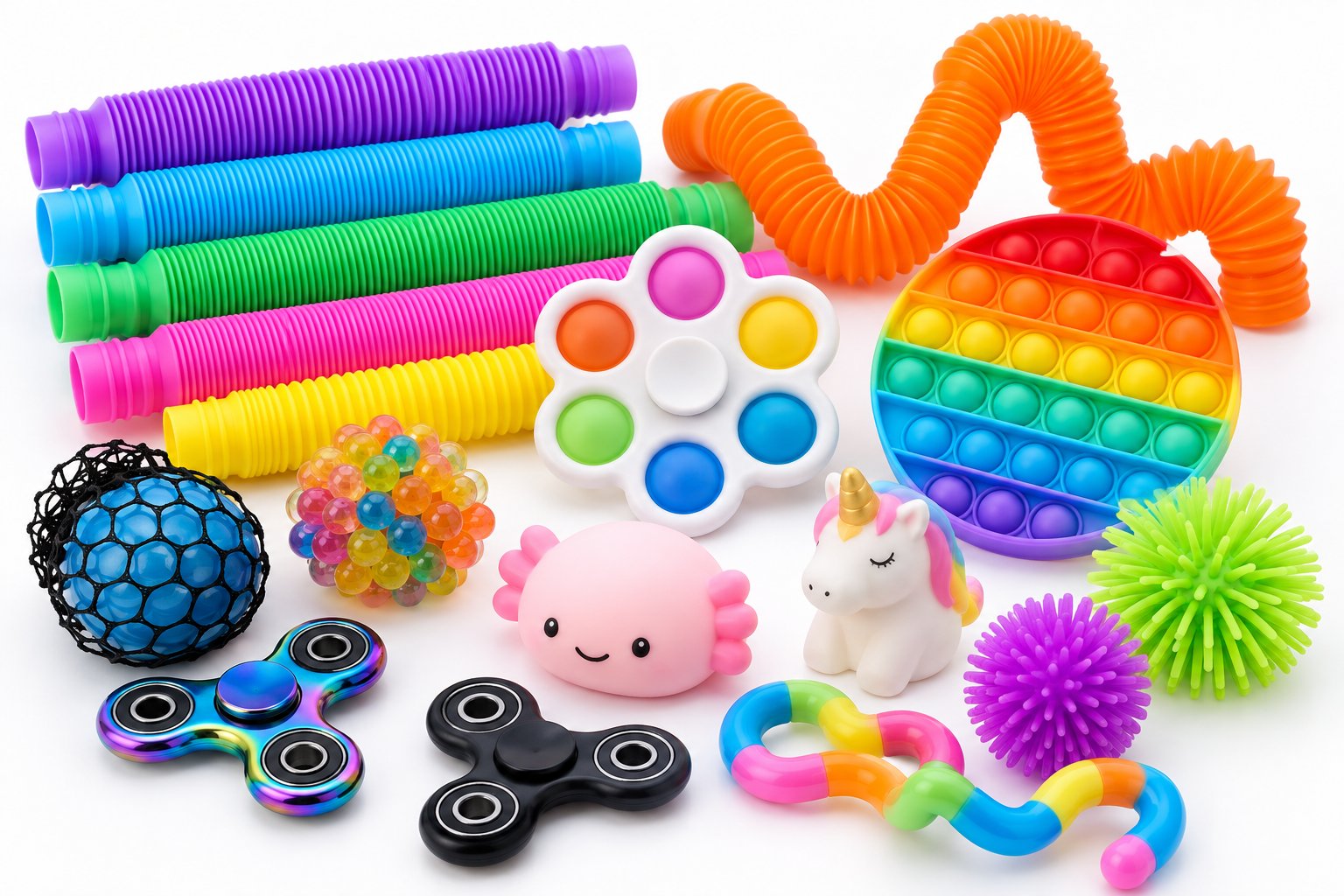
Fidget toy pricing is not a single number a supplier can quote off the top of their head. This article breaks down the real cost drivers behind wholesale fidget and sensory toys, from material grade and mechanism complexity to safety testing, packaging, and order quantity, and lists the checkpoints buyers should confirm before requesting a quotation.
Wholesale Pricing Guide
Buyers searching for the cost of fidget toys usually want one thing: a number they can put into a landed-cost sheet before they contact a factory. There is no single figure that answers that question, because a fidget toy unit price is the sum of a handful of decisions and raw material inputs. What a buyer can do is understand which decisions move the number, and which ones to lock down with a supplier before a quotation is issued. That is what this breakdown covers.
The short answer
A fidget toy unit price is driven mainly by five things: the material and its grade, the complexity of the mechanism, the safety testing the product must pass for your market, the packaging you specify, and the production quantity you order. Change any one of them and the quoted price changes. Ask a supplier to quantify each of these before you compare quotes from two factories, because two prices that look far apart are often quoting different products.
What this article covers
Material and Material Grade Set the Floor
The body material is the first and usually the largest single input into a fidget toy unit price. Common constructions fall into a few families, and each behaves differently on cost, feel, and compliance.
- Rigid injection-molded plastic bodies, typically ABS or a comparable engineering plastic, sit at the lower end of material cost and support high-volume production runs.
- Soft or flexible bodies, including silicone and TPR, cost more per unit of weight and usually require different tooling and cycle times.
- Metal-bodied fidgets and metal components such as bearings, springs, and click plates push the material line up further, and they introduce additional finishing steps.
- Wood, bamboo, and composite bodies sit in a separate cost band again, because they involve cutting, sanding, and surface treatment rather than a simple molding cycle.
Grade matters as much as material family. Two suppliers can both say "ABS" and mean very different things: virgin resin versus regrind content, food-contact grades, recycled grades, or grades selected specifically to pass a drop or impact test. If a quotation is significantly below others for what looks like the same product, the material grade is the first place to look. Ask the supplier to state the material specification in writing rather than accepting a generic material name.
Mechanism and Assembly Complexity Drive Labor and Reject Rates
A simple push-pop or spinner is a single molded part or a small number of parts with minimal assembly. A fidget with a bearing, a rotating dial, a click mechanism, or a multi-piece sensory structure has more components, more assembly steps, and more opportunities for a unit to fail inspection. That shows up in the price in two ways: more component cost and higher labor and quality-control cost per finished piece.
Complexity also affects how predictable the ordering process is. Products with tight mechanical tolerances usually need a sample approval stage before mass production, and tooling and sampling are legitimate cost items that a buyer should expect to see handled separately from the per-unit price. A supplier with structured production lines can usually give a clearer picture of which parts of the cost are fixed and which scale with volume.
Safety Testing and Market Compliance Are Not Optional Costs
For North American and European retail channels, fidget toys are children's or general consumer products and are subject to toy safety requirements. Testing is a real line item, and it varies with the target market, the age grading of the product, and the materials used.
Suppliers that export to these markets normally hold management system and product safety credentials. Fujian Lequ Wanwan, a B2B toy manufacturer and exporter serving North American and European buyers, holds EN71 and ASTM F963 toy safety certifications and an ISO 9001:2015 quality management system certification, and operates six production lines with 180 staff for OEM and ODM programs. Buyers should still confirm which certification applies to the specific item being quoted, since a system-level certificate and a product-level test report are not the same document.
Why this changes your price
A product intended for a market that requires additional testing, or a product with an age grade that triggers stricter requirements, carries more testing cost per model. If your quote does not state which tests are included, you cannot compare it against a quote that does, and you may be absorbing a compliance gap later at your own cost.
Packaging Follows the Retail Channel
Packaging is often the most underestimated driver in a fidget toy quotation, because it is chosen by the buyer rather than the factory. The same toy can ship in several very different formats:
- Bulk polybag packing for importers who repack locally, which carries the lowest packaging cost.
- Plain or printed hang-tag and header cards for pegboard retail.
- Blister or clamshell packs, which add a thermoformed component and a sealing step.
- Printed cartons or gift boxes with brand artwork, which add printing plates, color control, and often a minimum print run per design.
Custom artwork also affects the schedule, not only the price. Multi-color printing and any packaging that must match a brand's existing shelf system normally require a proofing step before production. Buyers should specify the exact packaging format, printed color count, and any barcoding or labeling requirements in the request for quotation, because these are the details suppliers need to price the job accurately.
Order Quantity, Tooling, and Per-Unit Economics
Fidget toys are typically molded or assembled in runs, and the unit price falls as quantity rises. The reason is straightforward: fixed costs are spread over more pieces. These fixed costs include mold or tooling amortization, machine setup, artwork and printing preparation, and the first-article inspection and sample approval steps.
| Order scenario | What dominates the unit cost | Buyer consideration |
|---|---|---|
| Small trial order | Tooling setup, sampling, and per-run fixed costs spread across few units | Expect a higher unit price; use the trial to validate quality, not to benchmark long-run pricing |
| Repeat production order | Material and labor, with fixed costs already absorbed | Ask what quantity band the quoted price applies to |
| Annual or consolidated program | Material purchasing leverage and line scheduling efficiency | Ask whether pricing holds across multiple shipments or releases |
The practical point for buyers is that a unit price without a stated quantity band is not a comparable figure. When you line up quotes, make sure each supplier is pricing the same model, the same material specification, the same testing scope, the same packaging, and the same quantity band. Otherwise you are comparing different products, not different prices.
What to Confirm with a Supplier Before Requesting a Quotation
A well-prepared inquiry gets a faster and more accurate answer. These are the points worth settling first.
- Target market and age grading. This determines which safety standard applies and therefore which tests the product must pass.
- Material specification. Ask for the material family and grade in writing, not a generic description.
- Product function and mechanism. Share a reference sample, photo, or drawing so the supplier can assess assembly complexity rather than guess.
- Packaging format. State polybag, header card, blister, or printed box, plus artwork status and barcode requirements.
- Quantity and shipment plan. Give a realistic annual or first-order volume, and say whether it ships in one release or several.
- Customization scope. Clarify whether you need OEM production from an existing design or full ODM development, since the two carry different development work.
- Compliance documents. Confirm which certifications and test reports the supplier can provide for that specific item.
Suppliers that run OEM and ODM programs for export markets can usually tell you quickly which of these points affects the price and which do not, and can flag anything that needs a sample stage before a firm quotation is possible.
Questions Buyers Ask Most
Why do two suppliers quote very different prices for what looks like the same fidget toy?
Usually because the quotes describe different products. Differences in material grade, mechanism, testing scope, packaging, and quantity band account for most of the gap. Ask each supplier to itemize what is included before drawing conclusions.
Does ordering a sample cost more than ordering in bulk?
Sample and trial quantities carry a higher unit price because fixed costs are spread over very few pieces. That is normal. The purpose of a sample is to confirm material, function, and finish, not to establish your long-run price.
Is safety testing included in the unit price?
It depends on the supplier and the market. Confirm in writing which tests are covered, which entity holds the report, and whether the report applies to the specific model you are buying.
Does custom packaging raise the price significantly?
Printed and thermoformed packaging adds materials, a printing step, and often a minimum print run per design. Polybag packing costs the least. The right choice depends on your retail channel rather than on price alone.
Next step. If you are sourcing wholesale fidget toys or sensory toys for a North American or European program, send your target market, quantity band, packaging format, and customization requirements in one message. A supplier working from those inputs can give you a quotation that reflects your actual specification instead of a placeholder figure.