Buyers sourcing junior badminton sets for schools, retail, or distribution need to understand what drives cost beyond a quoted unit price. This article explains the main price factors in children's badminton rackets and complete sets—frame material, grip, racket length, included shuttlecocks and net, and packaging—and how to compare quotes on specification completeness, MOQ, carton packing, and certification.
Sourcing Guide for B2B Buyers
When you ask suppliers “how much do badminton rackets cost?” for a kids' set, the answer rarely comes as a single number. Junior badminton sets vary widely in what is included, how the rackets are built, and how the product is packed for export. For schools, retailers, and distributors, the quoted unit price is only one part of the cost picture—and often not the most important one. This article breaks down the factors that actually move the price of children's badminton rackets and complete sets, and explains how to compare quotes on specification, MOQ, carton packing, and certification.
Key takeaways
- Price drivers include frame material, grip quality, racket length, included shuttlecocks and net, and packaging.
- A complete set (rackets, shuttlecocks, net, carry bag) costs more than rackets alone, but simplifies procurement.
- Compare quotes on specification completeness, MOQ, carton packing, and certification—not just unit price.
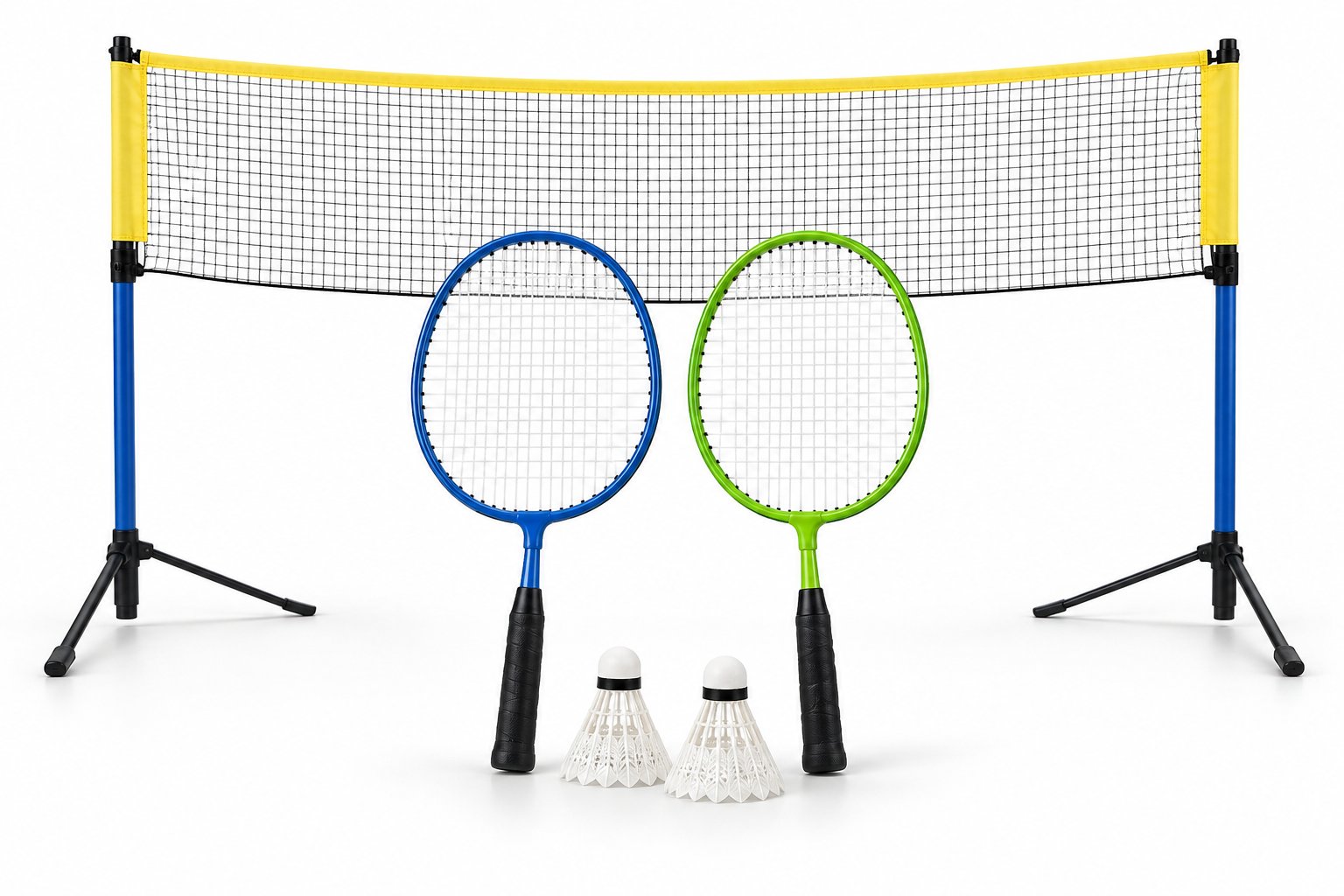
- For reference, a junior set like the Junior Badminton Set with Net for School Sports Lessons has a 53 cm racket, 300 x 60 cm net, two shuttlecocks, carry bag, and MOQ 500 sets.
What goes into the price of a kids' badminton set?
Children's badminton sets are not a single commodity. The price reflects a combination of components and manufacturing choices. Here are the main factors that suppliers consider when quoting:
Frame material
Rackets for children are typically made from lightweight materials such as aluminum, composite, or plastic. Composite frames (like those in the Junior Badminton Set with Net) offer a balance of weight and durability, but they generally cost more than basic plastic or low-grade aluminum. The material affects not only the unit cost but also the racket's feel and longevity—important for school programs where equipment sees frequent use.
Grip
The grip material and construction influence both comfort and cost. Soft grips (e.g., EVA foam or synthetic rubber) are more expensive than plain plastic handles but provide better handling for small hands. For institutional buyers, a comfortable grip can reduce drop-outs and improve the playing experience, which may justify the higher price.
Racket length
Junior rackets come in various lengths to suit different age groups. A shorter racket (e.g., 53 cm) uses less material and may be less expensive to produce than a longer one. However, length also affects playability: a racket that is too long or too short can hinder skill development. Buyers should match racket length to the target age group (e.g., 6+ years) and consider whether a single length or a range of sizes is needed.
Included shuttlecocks and net
A set that includes shuttlecocks and a net is more complete but also carries a higher price than rackets alone. The quality and quantity of shuttlecocks matter: two shuttlecocks are common for basic sets, while more or higher-grade shuttlecocks add cost. The net's size, material, and assembly method (e.g., tool-free setup with ground pegs) also affect price. For schools, a complete set reduces the need to source components separately, which can save on logistics and administrative overhead.
Packaging
Packaging is often overlooked but can be a significant cost factor. A carry bag adds convenience and perceived value but increases unit cost. Export carton configuration (e.g., 16 sets per carton) affects shipping efficiency and handling costs. Custom packaging (e.g., printed bags or boxes) may require higher MOQs and additional lead time.
How to compare quotes beyond the unit price
When evaluating quotes for kids' badminton sets, looking only at the unit price can be misleading. A lower quote may exclude essential components, use lower-grade materials, or skimp on certification. Here’s what to compare:
| Factor | What to check | Why it matters |
|---|---|---|
| Specification completeness | Are racket length, frame material, grip type, number of shuttlecocks, net size, and bag included clearly stated? | Ensures you are comparing like-for-like and avoids hidden extras. |
| MOQ | What is the minimum order quantity? Does it align with your budget and storage capacity? | Higher MOQs may offer lower unit prices but require larger upfront investment. |
| Carton packing | How many sets per carton? What are the carton dimensions and weight? | Affects shipping costs, handling, and storage efficiency. |
| Certification | Does the product meet relevant safety standards (e.g., EN71, ASTM F963)? | Certification is often mandatory for retail and school channels; lack of it can block sales. |
| OEM/ODM options | Can the supplier customize branding, colors, or packaging? | Customization may add cost but can strengthen your brand and market fit. |
Example: specification of a junior badminton set
To illustrate how specifications translate into a quote, consider the Junior Badminton Set with Net for School Sports Lessons from Fujian Lequ Wanwan Co., Ltd. This set is designed for children aged 6+ and includes:
- Two short-handle rackets sized for children, with a length of 53 cm
- Lightweight composite frames with soft grip
- Two shuttlecocks
- Net size 300 x 60 cm, assembles without tools using 4 ground pegs and poles
- Carry bag packaging, 16 sets per export carton
- Age 6+ years
- MOQ 500 sets
- EN71 / ASTM F963 compliant
- OEM/ODM available
This example shows the level of detail you should expect in a quote. A supplier who provides such specifications upfront is easier to compare and less likely to surprise you with hidden costs later.
Questions to ask when requesting a quote
To get accurate and comparable quotes, ask suppliers the following questions:
- What is the exact racket length and frame material?
- How many shuttlecocks are included, and what type?
- What are the net dimensions and assembly requirements?
- Is a carry bag included? What are its specifications?
- How many sets per export carton, and what are the carton dimensions/weight?
- What is the MOQ for standard and customized versions?
- Which safety certifications apply (e.g., EN71, ASTM F963)? Can you provide test reports?
- What is the lead time for samples and bulk orders?
- What are the payment terms and Incoterms?
Certification and compliance: a cost worth paying
For B2B buyers, especially those supplying schools or retail chains, product safety certification is non-negotiable. EN71 (Europe) and ASTM F963 (North America) are common requirements for toys and children's sporting goods. Certified products may carry a higher unit price due to testing and compliance costs, but they open doors to regulated markets and reduce liability risks. Always verify that the certification covers the specific product and batch you are ordering, and request copies of test reports for your records.
Conclusion: focus on total value, not just unit price
The cost of kids' badminton sets is driven by material choices, included components, packaging, and compliance. When comparing quotes, evaluate the full package—specification completeness, MOQ, carton packing, and certification—to ensure you are getting the right product for your market at a fair price. A supplier who is transparent about these factors is more likely to be a reliable long-term partner.
Ready to source junior badminton sets for your school program or retail chain? View the Junior Badminton Set with Net for full specifications and request a quote tailored to your needs.