A practical guide for importers and distributors on what drives the cost of building blocks, from material and piece count to safety testing and packaging. Learn how to compare STEM building blocks sets and negotiate better prices on educational toys wholesale orders.
Sourcing & Cost Guide
“How much do building blocks cost?” is usually the first question a buyer sends us—and the hardest to answer with a single number. Two wholesale lots of 200-piece sets can differ by more than 100% in unit price, and the gap is rarely about the plastic itself. It comes from resin grade, piece count, tolerances, safety testing, magnets or electronics, packaging, and order volume.
This guide breaks down the real cost drivers behind building blocks and STEM building blocks sets, so you can compare quotations on equal terms and know which line items to question before you place a wholesale order.
Key Takeaways
- Unit cost is driven by material type, piece count, and mold complexity—not by brand markup alone.
- Safety testing and compliance documentation can add a meaningful percentage to landed cost; ask which standards apply to your market.
- Packaging and branding often account for a larger share of cost than buyers expect, especially for retail-ready sets.
- Order volume and mold amortization determine whether a custom piece is economical.
- Always request a cost breakdown by component so you can compare suppliers fairly.
What this guide covers
Material: The First Cost Divider
Building blocks are most commonly made from ABS, PP, or PE. ABS dominates the category because it holds tight tolerances, resists impact, and takes color well—but it is also the most expensive of the three. Recycled or bio-based resins can change the price again, and availability varies by region.
For a buyer, the key question is not simply “ABS or not.” Ask for the resin grade and supplier, whether virgin or recycled content is used, and whether the supplier can provide material safety documentation. A lower quote may reflect a lower-grade resin that affects clutch power (how firmly bricks grip) or color consistency across a production run.
Magnetic building blocks introduce another layer: neodymium magnets, ultrasonic welding, and additional drop and small-parts testing. These sets sit in a different price bracket entirely.
Piece Count and Mold Complexity
A 100-piece set and a 500-piece set do not scale linearly in cost. More pieces mean more mold cycles, more sorting, more quality checks, and more packaging labor. The table below shows how the main variables typically shift unit cost.
| Factor | Lower Cost | Higher Cost |
|---|---|---|
| Piece count | 50–150 pieces | 300+ pieces |
| Mold complexity | Standard bricks, simple shapes | Specialty parts, moving elements, figures |
| Material | PP or PE | ABS, recycled ABS, magnetic components |
| Tolerance | Loose fit acceptable | Tight clutch power required |
| Color | Single or few colors | Multi-color, custom Pantone matching |
The table is directional. Actual pricing depends on your specifications and order quantity.
Mold complexity deserves special attention. A standard 2x4 brick uses a simple mold with a long service life. A specialty piece—say, a curved slide or a functional gear—requires a more expensive mold and slower cycle times. If your set includes proprietary shapes, expect the supplier to factor in tooling amortization.
Why STEM Building Blocks Sets Cost More
STEM building blocks set pricing reflects additional design and component costs:
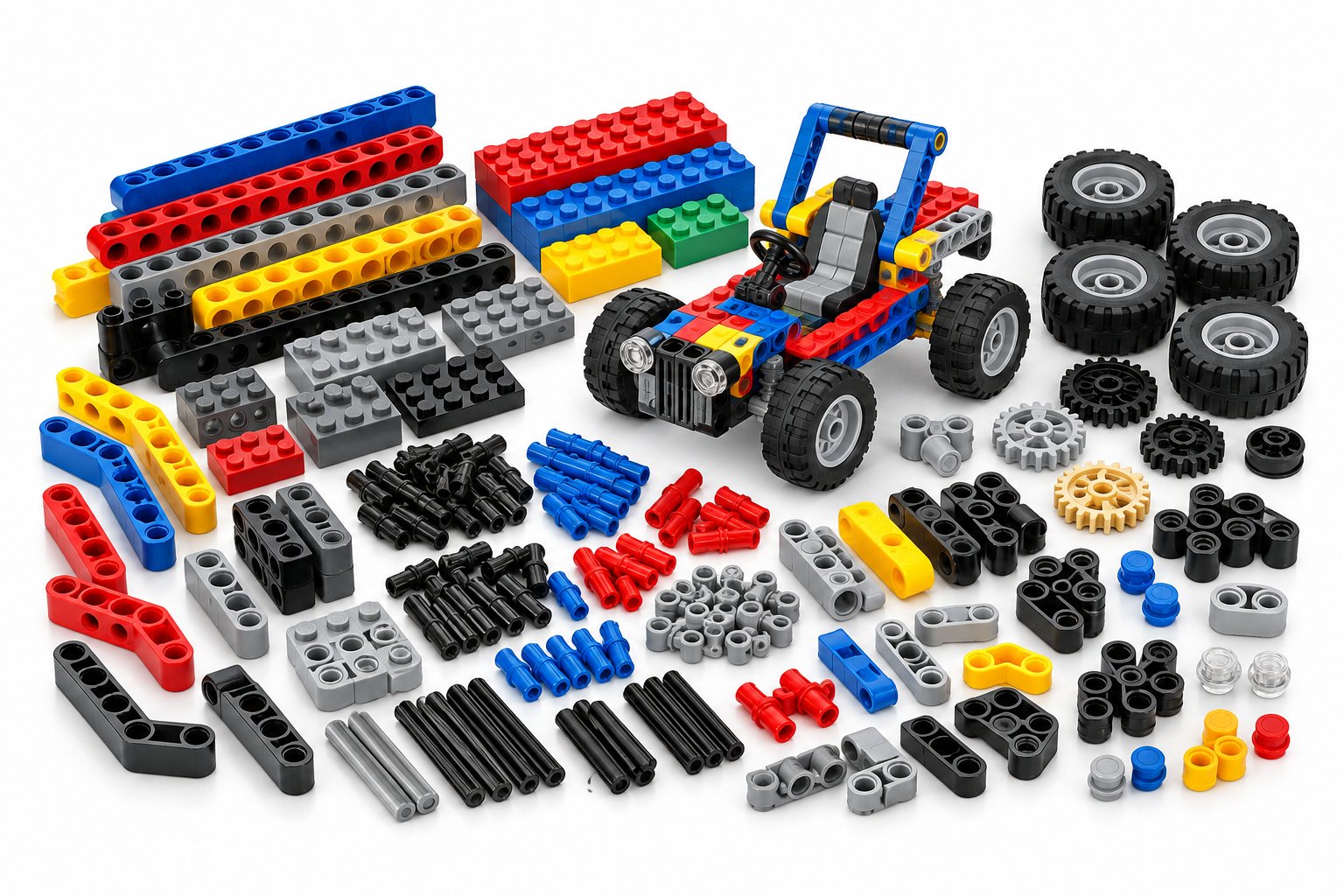
- Functional parts: gears, axles, pulleys, and motors add components that must be sourced or produced separately.
- Precision requirements: moving parts demand tighter tolerances, which slows production and increases scrap rates.
- Instructional content: printed manuals or activity cards add design, translation, and printing costs.
- Testing scope: sets with electronics or small moving parts may require additional safety assessment.
If you are sourcing educational toys wholesale, compare a basic building block set with a STEM set side by side. The STEM set may cost 30–60% more per unit, but it also supports a higher retail price and different customer segment. The right choice depends on your market positioning, not on cost alone.
Safety Testing and Compliance
Compliance is a cost line that many first-time buyers underestimate. Depending on your destination market, building blocks may need to meet toy safety standards such as EN 71 (EU), ASTM F963 (US), or ISO 8124 (international). Testing is typically performed per product, per color, and sometimes per material batch.
Cost factors include:
- Number of test reports required
- Whether the supplier already holds valid reports for the same materials and construction
- Whether small parts, magnets, or electronics trigger additional requirements
Ask the supplier which standards their existing reports cover, and whether those reports apply to your exact configuration. Do not assume a report for one set covers a different set with different components. If the supplier cannot provide applicable reports, budget for third-party testing in your cost calculation.
Packaging and Branding
Packaging can account for a significant share of the unit cost, especially for retail-ready sets. A plain polybag with a hang tag costs far less than a full-color printed box with inserts, a window, and multilingual labeling.
Common packaging options and their cost impact:
| Packaging Type | Typical Cost Impact | Best For |
|---|---|---|
| Polybag + header card | Lowest | Budget retail, promotional items |
| Printed color box | Moderate to high | Retail shelves, brand building |
| Storage tub or bucket | High | STEM sets, educational channels |
| Custom branded packaging | Highest | Premium brands, private label |
Custom printing, additional languages, and compliance markings all add setup and per-unit costs. If you are testing a new market, consider starting with standard packaging and upgrading once volumes justify the investment.
Order Volume and Tooling
Unit price generally drops as order quantity increases, but the relationship is not unlimited. Suppliers quote based on mold setup time, material purchasing, and production scheduling. Small orders may carry a setup surcharge; large orders may qualify for tiered pricing.
For custom shapes or branded pieces, tooling cost is a one-time investment. Ask whether the tooling is amortized into the unit price or billed separately, and who owns the mold. This affects your long-term cost if you switch suppliers or reorder.
Typical volume tiers for building blocks:
- Sample or trial order: highest unit cost, often with setup fees
- Small wholesale order: moderate unit cost, standard packaging
- Container-level order: lowest unit cost, best for established products
Logistics, Duties, and Landed Cost
The quoted FOB price is only part of the story. Landed cost includes freight, insurance, import duties, and any local handling. Building blocks are relatively light but bulky, so dimensional weight often applies. Packaging that reduces volume can lower freight cost even if the packaging itself costs more.
Ask your supplier for carton dimensions, gross weight, and units per carton. Use these to estimate shipping cost before you commit. A slightly higher unit price with better packing efficiency can result in a lower landed cost.
How to Compare Quotations from Different Suppliers
To compare fairly, request a breakdown that separates:
- Material and components
- Molding and assembly
- Testing and compliance documentation
- Packaging and labeling
- Tooling (if applicable)
- MOQ and lead time
When two quotes differ significantly, the gap usually sits in one of these lines. Ask which specification each supplier is quoting against—piece count, material grade, packaging, and testing scope. A quote without these details cannot be compared.
If the supplier cannot provide a breakdown, treat the quote as a starting point for negotiation rather than a final price.
FAQ
What is the typical MOQ for building blocks?
MOQ varies by supplier and product. Standard sets may start at a few hundred units; custom or branded sets often require higher volumes. Confirm MOQ per item, not per order.
Can I get a sample before placing a bulk order?
Most suppliers provide samples, sometimes free and sometimes at cost. Clarify whether sample cost is refundable against a future order.
How long does production take?
Lead time depends on order volume, whether tooling is required, and current factory capacity. Ask for a production schedule with your quote.
Do I need my own mold for custom pieces?
Only if you need proprietary shapes. Standard building blocks use existing molds, which keeps cost lower. Custom molds require tooling investment and longer lead times.
How do I verify safety compliance?
Request test reports for the exact product configuration you are buying, check the standards and dates, and confirm they cover your destination market. When in doubt, arrange independent testing.
Next Step: Get a Cost Breakdown, Not Just a Price
The next time you ask “how much do building blocks cost,” ask for a component-level breakdown instead. That single request tells you whether a quote is competitive, where the cost sits, and what you can adjust—material, piece count, packaging, or volume—to hit your target landed cost.
If you are sourcing educational toys wholesale or planning a private-label STEM building blocks set, prepare your specification list and target market first, then request quotes against it. Clear inputs produce comparable outputs.