
Schools, retailers and parents ask how much a shuttlecock costs before committing to a set. This article explains the factors that drive per-shuttlecock price — feather versus synthetic materials, durability, consistency, pack quantity, certification and order volume — and shows how a bundled kids' set changes the math. It closes with the questions to confirm with a supplier before ordering.
Buying guide
If you are pricing a badminton programme for a school, stocking a retail shelf or buying a set for a child at home, the question "how much does a shuttlecock cost" rarely has a single answer. The per-shuttlecock figure depends on what the birdie is made of, how long it survives, how consistently it flies, how many come in a pack, whether it carries safety certification and how many you order. This guide breaks those factors down and then explains why a bundled kids' set can change the math entirely.
What this article covers
1. Feather vs synthetic: the biggest cost driver
The single largest factor behind a per-shuttlecock price is the material of the skirt. Feather shuttlecocks are built from natural goose or duck feathers fixed into a cork base. Sorting, grading and matching those feathers by shape and stiffness is labour-intensive, and the raw material itself is a variable agricultural input, so feather birdies sit at the higher end of the market.
Synthetic shuttlecocks — usually nylon or a moulded plastic skirt on a cork or synthetic base — are produced to a repeatable mould. That makes the unit cost lower and far more predictable from order to order. For school lessons, club training and retail starter packs, synthetic birdies are the common choice because a mis-hit that ruins a feather birdie does far less damage to a nylon one.
The practical point: ask which material the price refers to before comparing quotes. A feather and a nylon shuttlecock are not interchangeable products, and a single blended "average price" for both tells you nothing useful.
2. Durability and replacement rate
The sticker price of a shuttlecock is only half the cost story. What matters for a school or a retailer is the cost per usable session. A cheaper birdie that loses flight quality after a few rallies can end up costing more per lesson than a tougher one bought at a higher unit price.
Feather shuttlecocks are prized for feel and flight but are more fragile: a single mishit can break a feather and change the trajectory. Nylon shuttlecocks resist that damage and are typically the more durable option for beginners and children. When you compare quotes, ask how the supplier defines durability — for example, whether the skirt is a single moulded piece or assembled, and what base material is used. Those construction details affect how the birdie holds up, even before you get to the price.
For planning purposes, think in terms of replacement rate rather than unit price alone. A class of thirty children sharing a handful of nets will go through shuttlecocks faster than a single family set, and that consumption rate is what drives your true annual spend.
3. Consistency and flight quality
Consistency is the factor buyers underrate. In a school lesson, a shuttlecock that flies differently from the one in the next set makes it harder to teach and harder for children to learn. In retail, inconsistent packs generate returns.
Feather shuttlecocks vary because no two feathers are identical; premium grades are matched carefully, which is part of why they cost more. Moulded synthetic shuttlecocks are naturally more uniform because every skirt comes off the same tool. If your buyers care about repeatable flight — coaching, PE lessons, retail multipacks — ask the supplier how they control batch-to-batch consistency and whether the shuttlecock in a bundled set is the same spec as the one sold separately.
4. Pack quantity and unit economics
The number of shuttlecocks per pack is where the headline price can mislead. A pack of six at one price and a pack of twelve at another are not directly comparable until you divide by the count. Always convert quotes to a per-shuttlecock figure before deciding.
| Factor | What it changes | What to ask |
|---|---|---|
| Material (feather vs synthetic) | Base unit cost and feel | Which material is quoted? |
| Durability | Replacement rate and cost per session | Skirt construction and base material |
| Consistency | Teaching value and return rate | Batch control and spec stability |
| Pack quantity | Per-shuttlecock price | Count per pack and per carton |
| Certification | Eligibility for schools and import | Which standard, tested by whom |
| Order volume | Price tier and MOQ | MOQ and price breaks |
Pack quantity also interacts with packaging. A set that bundles shuttlecocks with rackets and a net spreads the packaging and handling cost across the whole set, which is one reason bundled products can look cheaper per item than buying components separately.
5. Certification and compliance
For any product sold to schools or into markets with toy or sporting-goods regulation, compliance is a cost input, not an optional extra. Testing and documentation add to the price of a compliant shuttlecock or set, but they are what allow a school to place an order and a retailer to import.
When a supplier states compliance, match the standard to the product and the market. For children's products, look for standards such as EN71 and ASTM F963 where applicable, and confirm that the certificate covers the exact item you are buying — not a different product in the same range. If a shuttlecock is bundled inside a kids' set, the whole set generally needs to meet the relevant requirement, not just the rackets.
6. Order volume and MOQ
Volume is the last and most familiar lever. Larger orders generally move into better price tiers because fixed setup, tooling and inspection costs are spread over more units. That is why a school buying a handful of sets and a retailer buying in bulk will not see the same per-shuttlecock figure even for identical stock.
The supplier's minimum order quantity (MOQ) defines the floor. If your intended quantity sits below the MOQ, the effective per-unit cost climbs because you are paying for a production run sized for someone else. Ask for the MOQ and the price breaks up front so you can compare suppliers on the same volume basis.
7. How bundled kids' sets change the math
A bundled set is a different purchasing decision from buying shuttlecocks alone. Instead of costing a shuttlecock in isolation, you are pricing a complete kit — rackets, shuttlecocks, net and pegs — as one SKU. That changes how buyers should read the price.
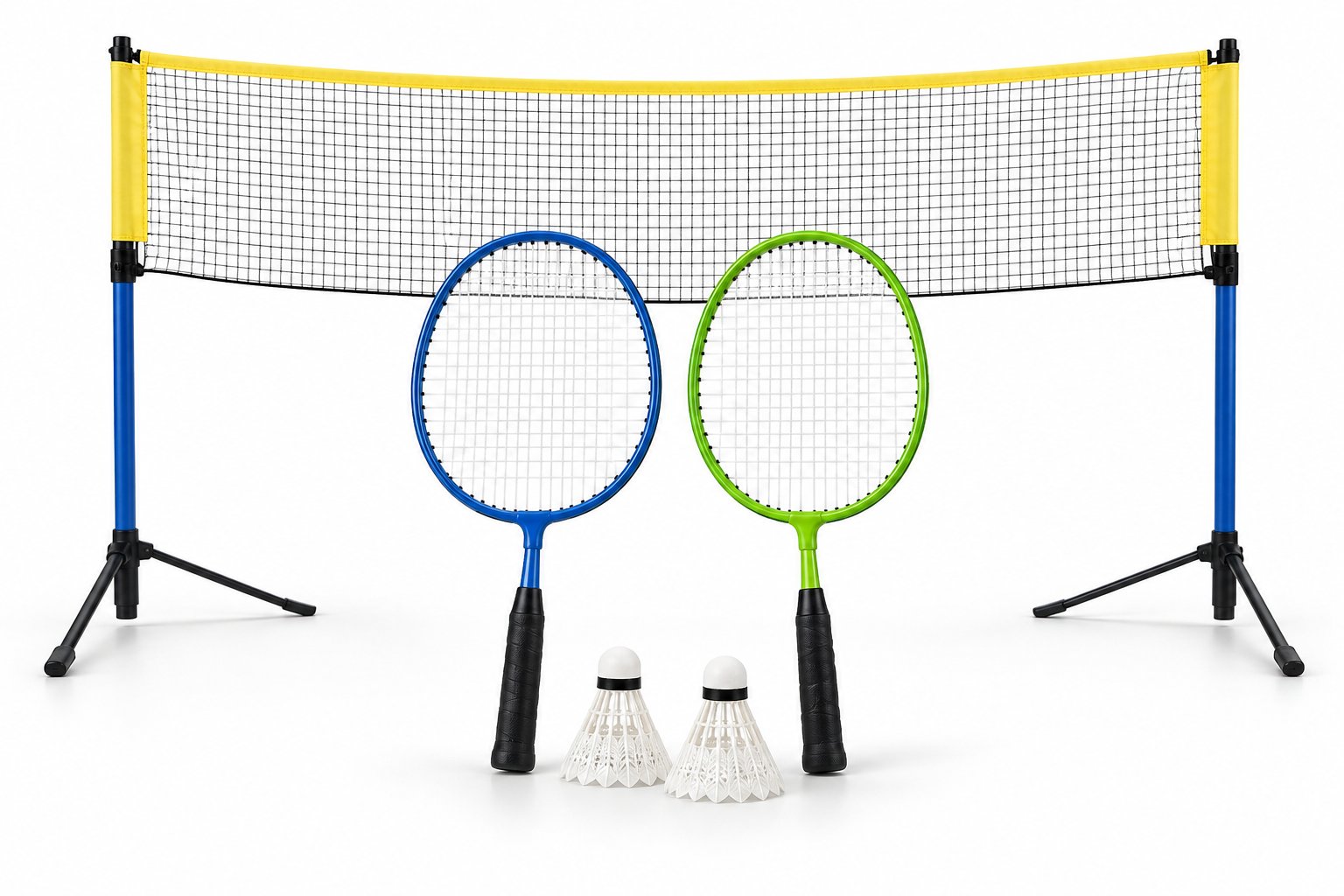
Take the Junior Badminton Set with Net for School Sports Lessons as a concrete example of the bundled approach. The set contains 2 child-sized rackets (53 cm), 2 shuttlecocks, 1 net (300 x 60 cm) and 4 ground pegs, with lightweight composite frames and a nylon net, aimed at ages 6+. It is supplied 16 sets per carton with carry-bag packaging, MOQ 500 sets, and is listed as EN71/ASTM F963 compliant, with OEM/ODM available.
For a school or retailer, the set price covers everything needed to run a lesson or stock a shelf in one line item. The two shuttlecocks inside are a small share of the kit compared with the rackets and net, so the per-shuttlecock figure inside a set looks very different from a standalone pack price. That is not a trick — it is simply a different denominator. When comparing a set against loose shuttlecocks, compare the total cost of equipping a class or a shelf, not the cost of one birdie in isolation.
Bundling also simplifies procurement. One SKU, one carton count and one compliance file are easier to manage than sourcing rackets, nets and shuttlecocks separately from different suppliers. The trade-off is that you inherit whatever shuttlecock spec the set includes, so confirm that spec before ordering.
8. What to confirm with a supplier
Once you understand the drivers, the useful next step is a short list of questions that pins down the comparison. You do not need every answer to start a conversation, but you do need them before you can compare quotes fairly.
- Material and construction: which material is the shuttlecock made of, and how is the skirt built?
- Spec inside a set: if buying a bundled set, what shuttlecock spec is included, and is it the same as the standalone item?
- Durability evidence: how does the supplier describe expected life, and under what use conditions?
- Pack and carton counts: how many shuttlecocks per pack, and how many packs or sets per carton?
- Certification scope: which standards apply, and does the documentation cover this exact product?
- MOQ and price breaks: what is the minimum order, and where do the volume tiers sit?
- Customisation: is OEM/ODM available if you need branded packaging or a different set configuration?
Getting clear answers to these questions turns a vague "how much is a shuttlecock" into a per-unit figure you can actually budget against — and, for a set, a total cost you can defend to a school board or a retail buyer.
Key takeaways
- Per-shuttlecock cost is driven mainly by material (feather vs synthetic), durability, consistency, pack quantity, certification and order volume.
- Synthetic shuttlecocks are usually the practical choice for schools and children because they are more durable and consistent.
- Bundled sets price a whole kit, so compare total cost to equip a class or shelf, not the price of one birdie alone.
- Always confirm material, spec, certification scope, MOQ and carton counts before comparing quotes.
Frequently asked questions
Is a feather shuttlecock more expensive than a nylon one?
Feather shuttlecocks generally sit at a higher price point than synthetic ones because the feathers are a variable raw material that must be sorted and matched, and the assembly is more labour-intensive. For schools and children, nylon shuttlecocks are often the more practical choice because they resist damage better.
Does buying a set make shuttlecocks cheaper?
Not in a per-shuttlecock sense — a set bundles rackets, net, pegs and shuttlecocks into one SKU, so the shuttlecock's share of the price is small. The real saving is procurement simplicity: one SKU, one carton count and one compliance file instead of sourcing components separately.
What is the minimum order for a kids' badminton set?
For the Junior Badminton Set with Net for School Sports Lessons, the MOQ is 500 sets, packed 16 sets per carton. Confirm current MOQ and price tiers directly with the supplier before planning an order.


