A practical selection guide for retailers, gift buyers and new parents on choosing and introducing a baby lovey: what to check for safety, what size to buy, and how to introduce a comforter step by step.
Buyer & Parent Selection Guide
A lovey is the small comforter a baby holds at naptime, in the pram, or on the way to sleep. Retailers and gift buyers ask a short list of questions before they stock one: is it safe, what size is it, and how does a parent actually introduce it? This guide answers those three questions using verifiable product facts and a parent-facing introduction sequence.
On this page
What a lovey does — and how it differs from a security blanket
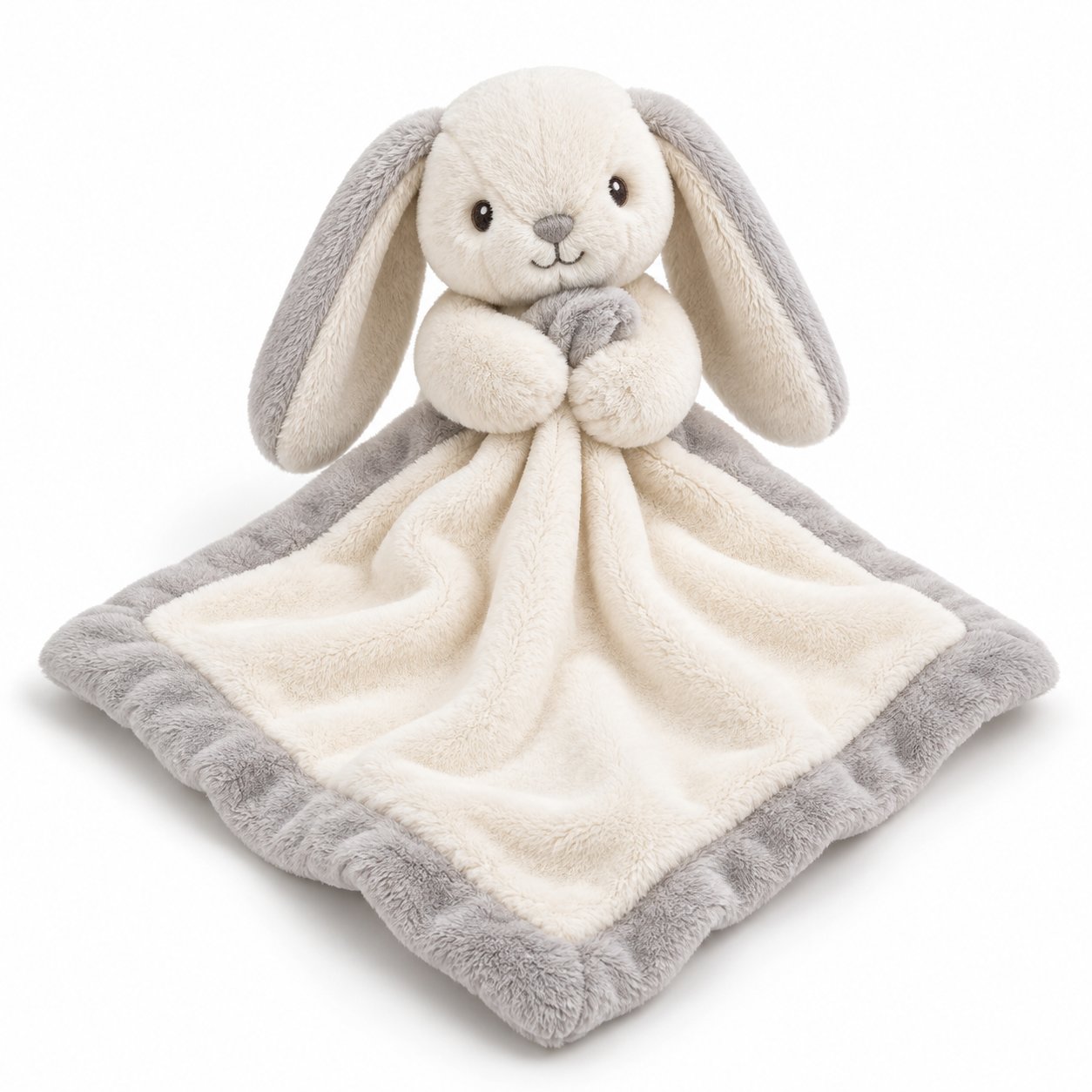
A baby lovey is a small, soft object with a plush toy head or character attached to a fabric base. The toy part gives a baby something to grip; the fabric part gives a familiar surface to hold against the face or hands. A security blanket is usually a full-size blanket that becomes a comfort item, whereas a lovey is a compact comforter made to be carried. If you want the full definition and the retail checks for the blanket format, see what is a security blanket — soothing uses and buyer checks.
In product terms, both formats frequently ship as a set. One real example is the Plush Baby Comforter Blanket Set with Soft Toy: one comforter blanket plus one matching soft toy, packed as a gift box. That combined format is what most buyers are comparing when they search for a "baby lovey blanket."
Safety features to check before listing
Safety is decided at the construction stage, not at the packing stage. When a buyer evaluates a lovey, the following points are the ones that affect both return rates and compliance documentation.
No loose ribbons, no removable small parts
Ribbons, tags that can be pulled free, plastic clips, and detachable eyes or noses are the items that most often create a choking or strangulation concern during a recall review. For the comforter set referenced above, the construction is stated as having no loose ribbons and no small removable parts. That is the design statement to verify in a sample: pull each attached element and confirm it stays fixed.
Embroidered facial features
Embroidered eyes and facial details are stitched into the fabric rather than attached as separate components. For a buyer, this is a checkable feature — hold the toy head to the light, confirm there is no plastic film, no glued-on piece and no stitch line you can lift with a fingernail. The same set uses embroidered facial features per its product detail.
Certification to request
Compliance paperwork has to match the exact item being shipped. The comforter set above is stated as EN71 / ASTM F963 compliant. Ask for the current test report for the actual SKU and colourway, confirm the report references the same construction (materials, attachments, age grading) you are ordering, and keep it with the order file.
Size and material: what the numbers mean
Size is the question buyers ask second most often, because a lovey that is too large does not fit in a pram, and one that is too small does not satisfy the grip a baby wants. The stated dimensions of the reference comforter set are simple and worth reading as a pair:
| Element | Stated dimension | What it means in use |
|---|---|---|
| Comforter blanket | 30 x 30 cm | A compact square that fits a pram seat, a cot corner and a nappy bag pocket. |
| Soft toy | 15 cm | Small enough for a baby's hand to close around, matched to the blanket. |
| Front face | Short plush | The tactile, soft side that invites holding. |
| Back face | Smooth fabric | Lower-pile reverse for a cooler, different surface. |
| Age grading stated | 0+ | Sold as suitable from birth per the manufacturer's product detail. |
For a retailer, the 30 x 30 cm blanket plus 15 cm toy combination makes the set easy to shelf as one unit and to price as a gift. Material choice — short plush front, smooth reverse — is a tactile decision rather than a durability claim; confirm washing instructions and care labelling with the supplier before you print care icons.
If you need a broader view of how plush comfort items are specified in trade, the background piece what is a plush comforter — a buyer's overview covers the material and construction language used across this category.
How to introduce a comforter to a baby
Introduction is a parent question, but it is also a customer-service question: retail teams that can explain the sequence in two sentences get fewer "how do I use this?" tickets. The wording below is deliberately general because age and sleep guidance differ by market.
- Keep it familiar first. Let the comforter be present during calm, supervised moments — pram walks, feeding, floor play — so the smell and texture become known before it is needed at sleep time.
- Handle it the same way every time. Store it in the same place and offer it at the same moments. Familiarity comes from repetition, not from introducing it once.
- Introduce during the day, not at a crisis point. A new object offered for the first time mid-meltdown is unlikely to settle anyone. Introduce it when the baby is already relaxed.
- Start with supervised use. Follow current safe-sleep guidance for your market, and keep the item out of the sleep space until the applicable guidance and the product's own label allow it.
- Add a spare. If the item becomes the preferred comforter, a second identical set avoids losing the routine to a washing day.
The safe-sleep rules a parent must follow in one country are not automatically those of another, and they change over time. Rather than publishing a month-by-month timeline, give parents a clear pointer to the current official guidance for their region, plus the construction facts of the product you are selling.
For retail and gift buyers: a stocking checklist
The reference set is supplied as a gift-boxed pack with an MOQ of 1,000 sets and 48 sets per carton. For a gift channel, the gift box matters as much as the comforter. For a pram-accessory channel, the 30 x 30 cm format and the matched 15 cm toy are the selling point.
| Check | Ask the supplier for |
|---|---|
| Attachment security | Confirmation on ribbons and removable parts; inspect a production sample. |
| Facial details | Confirmation that eyes and features are embroidered, not attached. |
| Compliance | Current EN71 / ASTM F963 report for the exact SKU and colourway. |
| Dimensions | Blanket and toy measurements confirmed against the spec sheet. |
| Packing | Gift-box format, sets per carton, and how the carton is labelled. |
| Commercials | MOQ of 1,000 sets stated openly; discuss any variation before committing. |
These are the points that decide whether a comforter line sells cleanly or generates returns. They are also the points a supplier should be willing to answer in writing.
FAQ
What is a baby lovey blanket?
It is a small comforter with a soft toy head or character attached to a fabric base. It is designed to be carried and held, and it is usually smaller than a security blanket.
What is a baby lovey used for?
It gives a baby a familiar object to hold during pram time, feeding, and settling routines. The toy part provides grip; the fabric part provides a familiar surface.
What size is a baby lovey?
Sizes vary by product. In the comforter set described here the blanket is 30 x 30 cm and the soft toy is 15 cm. Always read the individual spec sheet rather than assuming a category standard.
How do you introduce a comforter to a baby?
Introduce it during calm, supervised moments, offer it at the same times each day, and follow the current safe-sleep guidance for your market before it is used in a sleep space.
Is a lovey safe from birth?
The manufacturer's stated age grading for the reference set is 0+, but age grading and safe-sleep rules are two separate things. Check both the product label and the current official guidance for your market.
Dimensions, compliance and packing details above come from the product's own published specification. Confirm the report and spec against your order before listing.