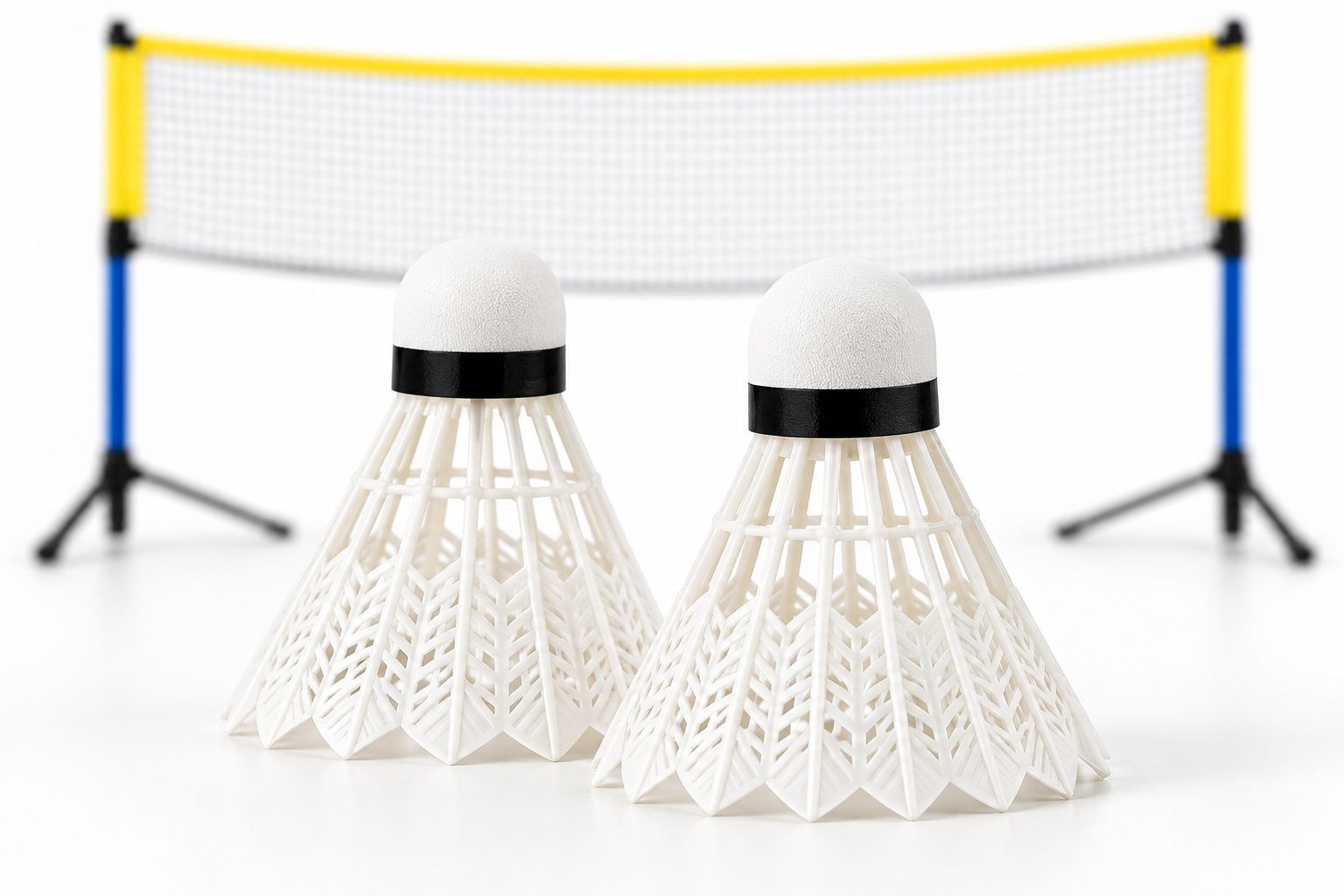
A practical guide for buyers sourcing shuttlecocks for children's badminton sets. Compare plastic and feather options on durability, cost per use, and flight consistency, and learn supply-side checks for replacement parts, packaging, and specifications.
In this guide:
When you source badminton sets for kids, the shuttlecock is the part that takes the most abuse. It gets hit, stepped on, and lost. Buyers who get the shuttlecock right end up with fewer complaints and fewer replacements. This article walks through the selection criteria that matter for children's sets: construction type, durability, cost per use, flight behavior, safety, and what to verify with your supplier before you place an order.
Key takeaways
- Plastic/nylon shuttlecocks are generally the better fit for kids' sets and school programs because they hold up to repeated use and usually cost less per unit over time.
- Feather shuttlecocks offer a different flight feel but are more fragile and not ideal for beginners or rough handling.
- Flight consistency matters for learning; ask suppliers how they check skirt shape and base attachment.
- Confirm spare/replacement availability, packaging inside the set, and exact specs before ordering.
Shuttlecock construction: plastic vs feather
A shuttlecock has two main parts: the base (cork or synthetic) and the skirt (the feathered or plastic part that creates drag). For kids' badminton sets, the skirt material is the key decision.
- Plastic/nylon skirts are molded from synthetic material. They are one piece or welded to the base, which generally makes them more resistant to cracking and bending. Plastic shuttlecocks are the common choice for school sets, recreational play, and beginner training.
- Feather skirts use natural feathers glued into a cork base. They offer a traditional flight feel but are more delicate—feathers can break or separate after a few hits, especially in the hands of children.
This is a qualitative difference. The right choice depends on how the set will be used: casual backyard play, school PE lessons, or club training. For most kids' sets sold to schools and families, plastic is the practical option.
Why plastic suits beginner and school play
Two factors drive the preference for plastic in children's sets: durability and cost per unit over repeated use.
Durability
Children miss-hit, step on shuttlecocks, and pack them away carelessly. Plastic shuttlecocks generally tolerate that kind of handling better than feather models, whose skirts can shed or break after a few hits. How long any individual shuttlecock lasts still depends on how the skirt is attached to the base and how heavily it is used — bonding methods vary between suppliers, so confirm the base construction and any inspection step before you order. For a school that issues sets to multiple classes, durability directly affects how often the equipment needs replacing.
Cost per unit over repeated use
Feather shuttlecocks usually carry a higher unit cost and a shorter effective life in rough play; plastic models usually cost less per unit and stay usable longer, so the cost per session or per student tends to be lower. To turn that into a real comparison for your program, ask the supplier for three inputs: how many shuttlecocks come with each set, the unit price of replacement shuttlecocks, and any usage or replacement guidance for your age group and playing frequency. Then compare total spend against feather pricing under the same usage pattern. The result is not fixed — at very high playing intensity or for advanced club programs, the calculation can favor a different choice.
That said, feather shuttlecocks are not wrong for every situation. Feather becomes worth considering when players are older and more controlled in their strokes, when flight feel matters more than rough-use durability, and when the program can absorb a higher replacement cost. If your buyers are schools or families with younger children, plastic is the safer bet.
Flight consistency and safety for children
Flight consistency affects how quickly a child can learn. A shuttlecock that wobbles or veers off course makes it harder to judge the path of the bird. Plastic shuttlecocks are molded, so they can be produced with consistent skirt shape and weight distribution. Feather shuttlecocks vary more because they are assembled from natural materials.
Safety is also a consideration. Plastic skirts are smooth and won't splinter. Feather shafts can break and leave sharp points. For young children, plastic reduces the risk of minor injuries.
When evaluating flight consistency, ask your supplier about their quality checks: do they test skirt roundness? Do they verify base adhesion? These are the details that separate a reliable shuttlecock from one that frustrates players.
Supply-side checks before ordering
Once you've decided on plastic shuttlecocks for your kids' sets, the next step is to confirm the supply details. These checks protect you from after-sales issues and help you plan inventory.
Spare and replacement availability
Shuttlecocks get lost. Ask your supplier whether they can provide replacement shuttlecocks as a separate SKU. If you are selling sets to schools, having a spare-parts option is a strong selling point. Confirm the minimum order quantity for replacements and whether they come in the same packaging as the set version.
Packaging inside the set
How the shuttlecocks are packed inside the set affects both protection and presentation. Are they bagged individually? Are they secured in a compartment? For retail sets, the packaging should keep the shuttlecocks from being crushed during shipping. For institutional sets, simple protection is enough. Confirm the packaging method with your supplier and request a sample if needed.
Confirming specifications
Specifications vary by model and supplier. Before you order, confirm the following in writing:
- Shuttlecock material (plastic/nylon) and color
- Base material (cork or synthetic) and construction
- Quantity per set (e.g., 2 shuttlecocks per set)
- Packaging method for the shuttlecocks within the set
- Compliance documentation for your target market — EN71 for the EU and ASTM F963 for the US — covering the complete set, not just the shuttlecocks
If your supplier offers OEM/ODM, you can also discuss custom colors or branding on the shuttlecock base. Ask for a sample to verify flight behavior and durability before committing to a bulk order.
FAQ
Are plastic shuttlecocks safe for young children?
Yes. Plastic shuttlecocks have smooth edges and no splintering risk. They are commonly used in school sets for children aged 6 and up. Always confirm that the set meets relevant toy safety standards such as EN71 or ASTM F963.
How many shuttlecocks should be included in a kids' set?
Two is a common number, but this varies by set design. Confirm the quantity with your supplier and consider offering replacement shuttlecocks separately.
Can I customize the shuttlecock color?
Many suppliers offer color customization on plastic shuttlecocks. Ask about minimum order quantities for custom colors and whether they affect lead time.
What is the typical MOQ for kids' badminton sets?
MOQ depends on the supplier and set configuration. For reference, the junior badminton set linked below carries an MOQ of 500 sets. Custom colors or replacement-only orders may have different minimums, so confirm the MOQ for the exact configuration you are quoting.
For a complete kids' badminton set that includes plastic shuttlecocks, child-sized rackets, and a net, see the Junior Badminton Set with Net for School Sports Lessons. It includes 2 shuttlecocks, two 53 cm rackets, a nylon net, and 4 ground pegs, and is available with OEM/ODM options. Contact the supplier to confirm specifications and request a sample.