A practical buying checklist for importers and program buyers sourcing kids and junior badminton rackets: frame material, weight, grip size, junior versus kids specifications, and the factors that drive cost. Includes a ready-to-quote junior school set and OEM/ODM options from LequToys.
B2B Buying Guide for Importers and Program Buyers
Choosing badminton rackets for kids and schools comes down to four decisions: frame material, weight, grip size, and whether the racket is sized for kids or for juniors. Get those right, and the racket survives a school term instead of a single PE lesson. Get them wrong, and you face returns, breakages, and complaints from teachers. For importers, the same four decisions also determine your landed cost and how you position the product in your catalog. This guide walks through each one, then covers what drives cost and how OEM customization works.
Key Takeaways
- A racket that fits a six-year-old will not fit a twelve-year-old. Kids and junior sizes are not interchangeable.
- Frame material, weight, grip size, and racket length are the four selection criteria that matter most for school and retail programs.
- Cost is driven by material, construction, packaging, and order quantity — not by brand markup alone.
- For classroom or club kits, a bundled set with a net and shuttlecocks reduces the number of SKUs you need to manage.
- OEM and ODM options let you put your own brand, colors, and packaging on a racket that already meets EN71 and ASTM F963 requirements.
What This Guide Covers
- Why kids and school rackets need different specifications
- A practical selection checklist: frame material, weight, grip, length
- Kids versus junior specs: a quick comparison
- What drives the cost of badminton rackets
- OEM and ODM customization: what to specify
- FAQ
Why Kids and School Rackets Need Their Own Specifications
An adult racket is built for an adult arm, an adult grip, and an adult swing. A child who picks one up will compensate by choking up on the handle, swinging with the wrist, and dropping the racket head. The result is poor form, low enjoyment, and — in a school setting — a racket that gets dropped, stepped on, or used as a walking stick.
For a buyer, this matters for two reasons. First, a racket that is too heavy or too long gets returned. Second, a racket that is too light or too flimsy breaks. The sweet spot for school and kids programs is a racket that is light enough for a six-year-old to swing and durable enough to survive a term of rotating classes.
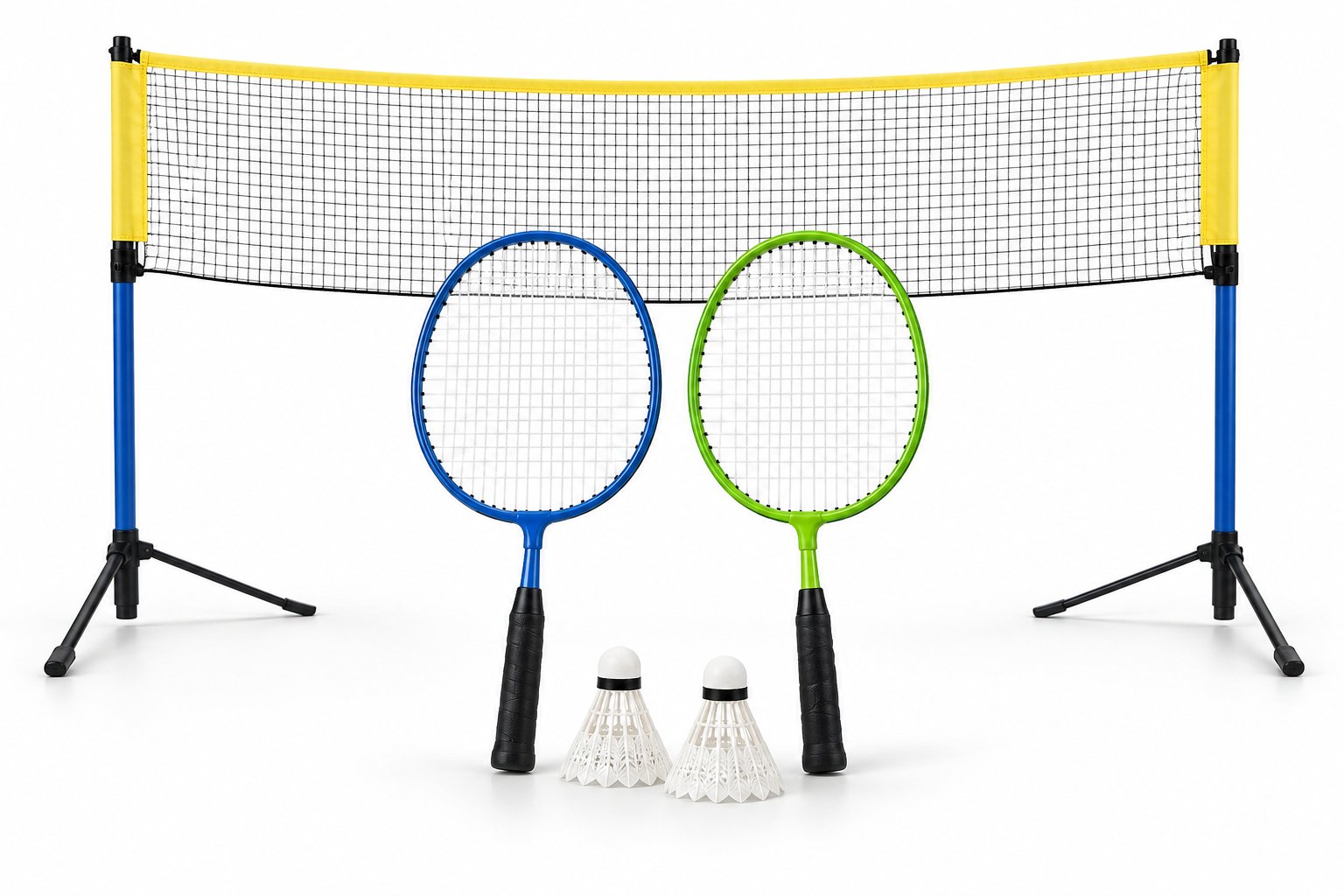
That is why a dedicated junior set makes sense for schools and clubs. As an example, the Junior Badminton Set with Net for School Sports Lessons uses lightweight composite rackets and a nylon net, and is sized for ages 6 and up. It ships with two rackets, two shuttlecocks, one net, and four ground pegs — everything a teacher needs for a lesson, in one box.
The Practical Selection Checklist
Use this checklist when comparing samples or quotations from different suppliers. Each item has a direct effect on how the racket performs in a school or retail setting.
Frame Material
The frame material sets the baseline for weight, stiffness, and durability. For kids and school programs, the common options are:
- Aluminum: Heavier and less stiff, but inexpensive and hard to break. Best for the youngest age groups.
- Composite (graphite or fiberglass blends): Lighter than aluminum and stiffer, which makes it easier for a child to swing. This is the material used in the LequToys junior set.
- Steel: Durable but heavy. Rarely suitable for kids.
- Wood: Occasionally used for very young children, but heavy and not weather-resistant.
For a school program, composite is usually the best balance. It is light enough for children to handle and stiff enough to produce a clean hit.
Weight
A racket that is too heavy forces a child to grip harder and swing slower. A racket that is too light can feel uncontrollable. As a rule of thumb, younger children need the lightest rackets, and older juniors can move toward slightly heavier frames. If your supplier can provide the racket weight in grams, ask for it — weight is one of the easiest specifications to compare across quotations.
Grip Size
Grip size is measured as the circumference of the handle. If the grip is too large, the child cannot close their fingers around it and will hold the racket in their palm. If it is too small, they will squeeze too hard. For kids and junior rackets, grip sizes are smaller than adult sizes; confirm the grip circumference with the supplier before ordering, especially if you are ordering for a specific age range.
Racket Length
Racket length affects reach and control. Longer rackets give more reach but are harder to maneuver. Shorter rackets are easier for children to control. The LequToys junior set uses a racket length of 53 cm, which is sized for the intended age group. When comparing suppliers, check the racket length against the age range you are targeting; a mismatch here is one of the most common causes of returns.
Assembly and Set Contents
For school programs, the set contents matter as much as the racket. A tool-free assembly net means a teacher can set up a lesson without tools. Ground pegs keep the net in place on grass or a gym floor. Shuttlecocks included in the box mean the set is ready to use on arrival. If you are sourcing for a school district or a club program, a bundled set reduces the number of purchase orders and SKUs you have to manage.
Kids Versus Junior Specs: A Quick Comparison
Kids and junior rackets are often grouped together, but they serve different age bands. The table below shows what typically changes between the two.
| Specification | Kids Rackets | Junior Rackets |
|---|---|---|
| Typical age band | Younger children | Older children and young teens |
| Frame material | Aluminum or light composite | Composite |
| Weight | Lightest available | Light, but slightly heavier than kids |
| Grip size | Smallest grip circumference | Small grip, approaching adult sizing |
| Racket length | Shorter | Longer than kids, shorter than adult |
| Best for | First-time players, PE lessons | Club play, school teams, developing players |
If you are sourcing for a school district that covers multiple age groups, you may need both. If you are sourcing for a single age band, confirm the racket length and grip size against that band before placing the order.
What Drives the Cost of Badminton Rackets
Buyers searching for "how much do badminton rackets cost" usually want a per-unit figure. The honest answer is that price depends on several variables, and any supplier who quotes a single number without asking about them is guessing. The main cost drivers are:
- Frame material: Aluminum is the least expensive option; composite materials cost more because of the raw material and the manufacturing process.
- Construction: A one-piece frame is generally more expensive to produce than a multi-piece frame, but it also tends to be more durable. Stringing, grip tape, and end caps add cost.
- Packaging: A poly bag costs less than a printed color box, and a printed color box costs less than a carry bag. If you are selling to retail, packaging is part of the product; if you are selling to schools, a carry bag may be more useful.
- Order quantity: Unit cost falls as order quantity rises. For the LequToys junior set, the MOQ is 500 sets, packed 16 sets per carton with a carry bag. If your order is smaller than the MOQ, expect a higher unit cost.
- Set contents: A racket-only SKU will cost less than a full set with a net, shuttlecocks, and ground pegs. Decide early whether you are buying rackets or a complete lesson kit.
To get a meaningful quotation, share your target age group, order quantity, packaging preference, and whether you need a net and shuttlecocks in the box. Those four answers will let a supplier give you a realistic per-unit cost instead of a range.
OEM and ODM Customization: What to Specify
If you are building a house brand or a school-district program, OEM and ODM options let you put your own identity on the product. When discussing customization with a supplier, these are the elements to specify:
- Racket colors and graphics: Frame color, grip color, and any printed graphics or logos.
- Packaging: Carry bag, color box, or carton branding. Confirm the packaging dimensions and the number of sets per carton.
- Set contents: Whether the net, shuttlecocks, and ground pegs are included, and whether you want to add or remove items.
- Compliance documentation: For toy-adjacent sports products sold into the EU and US, EN71 and ASTM F963 compliance is often a requirement. Confirm with the supplier which standards the product meets and request the relevant documentation for your target market.
- Order quantity and lead time: Customization usually carries a minimum order quantity. For the LequToys junior set, the MOQ is 500 sets. Confirm lead time with the supplier once your specifications are finalized.
OEM and ODM work best when you bring a clear brief: target market, age group, packaging format, and compliance requirements. The clearer your brief, the faster the supplier can quote and sample.
Frequently Asked Questions
What age are junior badminton rackets suitable for?
Junior rackets are generally designed for older children and young teens, while kids rackets are designed for younger children. The LequToys junior set is sized for ages 6 and up, with a racket length of 53 cm.
How much do badminton rackets cost?
Cost depends on frame material, construction, packaging, set contents, and order quantity. Aluminum rackets cost less than composite rackets; racket-only SKUs cost less than full sets with a net. To get a specific price, share your target age group, order quantity, and packaging preference with the supplier.
Do I need a net for a school badminton program?
For a school lesson, a net makes the game playable and keeps students organized. The LequToys junior set includes a nylon net measuring 300 × 60 cm and four ground pegs, and assembles without tools.
What is the minimum order quantity for the junior badminton set?
The MOQ for the LequToys junior set is 500 sets. The set is packed 16 sets per carton with a carry bag.
Are the rackets compliant with EN71 and ASTM F963?
LequToys products are compliant with EN71 and ASTM F963. Confirm the specific documentation requirements for your target market with the supplier before ordering.
Can I customize the rackets with my own brand?
Yes. LequToys offers OEM and ODM options for badminton sets, including racket colors, grip colors, packaging, and set contents. Confirm the customization details and MOQ with the supplier.
Ready to Source Junior Badminton Sets?
LequToys manufactures badminton sets, RC toys, plush, and wooden and educational toys, with OEM and ODM options and EN71 / ASTM F963 compliance. To request a quotation or a sample of the Junior Badminton Set with Net for School Sports Lessons, share your target age group, order quantity, and packaging requirements. View the product details and request a quote.