
A practical care guide for school, club and retail buyers: how to clean the frame, string bed and grip on badminton rackets, when grip tape actually needs replacing, how to protect string tension in storage, and what spares and care-card wording belong in a purchasing specification.
Wipe the frame and string bed with a barely damp cloth, keep water out of the frame head and string bed, dry the racket fully before storage, replace grip tape once it hardens or slips, and store rackets flat and away from heat. That is the whole routine. Cleaning does not restore lost string tension, so treat care and restringing as two separate decisions.
Most rackets that come back damaged from a school term were not worn out by play. They were cleaned too wet, left in a hot vehicle, hung by the frame on a peg, or stacked under net poles in a storage cupboard. Each of those is a purchasing problem as much as a coaching one, because it decides what you buy again next term and what you write into the specification. This guide covers hands-on care of the racket itself and translates each step into what a school sports buyer, club buyer or retail buyer should specify and stock.
In this guide
- Three surfaces, three different risks
- Cleaning the frame, step by step
- The string bed: wipe, do not scrub
- Grip tape: what wears out first
- Protecting string tension in storage
- What buyers should stock and specify
- Buyer questions
Key takeaways
- Clean with a barely damp cloth and dry completely; never soak, rinse or machine wash a racket.
- The string bed is wiped along the strings, never scrubbed across them.
- Grip tape is the wear item that actually fails in school use; overgrips are the cheap stock item.
- Heat, stacking and hanging by the frame do more tension damage than dirty strings.
- Write care instructions into the specification and put a care card in every carry bag.
Three surfaces, three different risks
A badminton racket is not one surface to be cleaned. It is three, and each fails differently. Knowing which one you are touching keeps staff and students from using the same motion on all of them.
| Surface | What it is | Main risk during cleaning | Correct action |
|---|---|---|---|
| Painted frame | Lightweight composite frame and shaft | Solvent, abrasion and water seeping into the frame head around the grommets | Wipe with a barely damp cloth, then dry |
| String bed | Factory-strung nylon strings crossing in a grid | Scrubbing across strings loosens the weave and snags frayed strands | Support from behind, wipe along the strings |
| Grip | Soft grip under tape, or an overgrip layer | Washing the grip soaks the handle; a hardened grip slips in the hand | Wipe lightly, or simply replace the tape |
The frame is the tolerant surface. The string bed and the grip are not, and they are the two places where a well-meant clean turns into an early replacement.
Cleaning the frame, step by step
Work through these in order. The whole routine takes a few minutes per racket and needs only a cloth, a mild soap solution if the frame is genuinely grubby, and a dry towel.
- Wring out the cloth first. A barely damp cloth is the standard: it lifts court dust and hand marks without pushing water toward the frame head. If you can squeeze a drop out of the cloth, it is too wet.
- Wipe around the frame head and down the shaft. Follow the shape of the head rather than scrubbing in circles, and give the shaft a single pass. Avoid printed decals and model markings if you want them to stay legible.
- Clean around the grommets. The grommets are the small plastic inserts where strings enter the frame. Dust collects against them. Wipe around them, not into them, and do not push water into the frame head through the string holes.
- Wipe the handle before rewrapping. If you are replacing tape anyway, clean the bare handle first so the new tape bonds to a dry, dust-free surface instead of trapping grit underneath.
- Dry the racket fully. Towel dry, then leave it at room temperature before it goes back in the bag. A racket stored damp is how grips go soft and frames pick up marks.
- Inspect the frame head and the shaft joint. Look for cracks, dents at the throat, or a loose joint where the shaft meets the head. This inspection is the real point of the routine, because a damaged frame should be pulled from the class set before it fails mid-lesson.
- Put the racket back in the carry bag. The set ships with a carry bag for a reason; the bag is the storage method, not just transport packaging.
Do not use alcohol, solvent cleaners, abrasive pads or a pressure hose on any part of the racket. None of them are needed to remove court dust, and all of them act on the frame finish or the grip.
The string bed: wipe, do not scrub
Strings pick up dust and shuttlecock residue, and the temptation is to scrub them clean like a floor. Do not. The string bed holds tension through an even weave, and sideways scrubbing works against that weave.
- Support the string bed from behind. Place a flat palm against the strings on the far side before wiping the near side, so you are not pressing the bed inward as you clean.
- Wipe along the strings, not across them. Run the cloth parallel to the string direction in short passes. This lifts dust without dragging the cross strings out of position.
- Watch for frayed strands. A fuzzy or split string is a sign the bed is near the end of its life. Note it and pass the information to whoever manages the equipment budget.
- Keep water out of the string bed. A damp cloth is fine. Water sitting in the weave around the grommets is not, and it is one more route into the frame head.
One thing cleaning cannot do is bring back tension. Strings lose tension through play and through temperature cycling, and no amount of wiping reverses that. Restringing is a separate decision with its own cost, and for a junior racket it needs to be weighed against the price of the racket itself, which is quoted against the specification you order.
Grip tape: what wears out first
On a school or club racket, the grip is usually the first thing to fail. Two layers matter here. The original grip is the base layer fitted to the handle at manufacture. An overgrip is a thin tape wrapped over it to add tackiness and absorb sweat. Replacing an overgrip is a two-minute job; replacing the original grip is a bigger one and usually unnecessary if the base layer was never soaked.
When to replace
- The tape has hardened and no longer grips in a sweaty hand.
- The surface has become slick or polished, so the racket twists on off-centre hits.
- Edges are lifting, or the overlap has started to unroll during play.
- The grip feels compressed and thin compared with a new racket from the same set.
Wrapping sequence
- Remove the old overgrip and wipe the handle dry.
- Start at the butt cap, the flared end at the base of the handle, and anchor the tape end there.
- Wrap upward with a consistent overlap on every turn; an uneven overlap is what creates ridges that blister hands.
- Keep light tension on the tape as you go, so it lies flat rather than bunching.
- Finish at the top with the tape supplied with the grip, or a short strip of finishing tape.
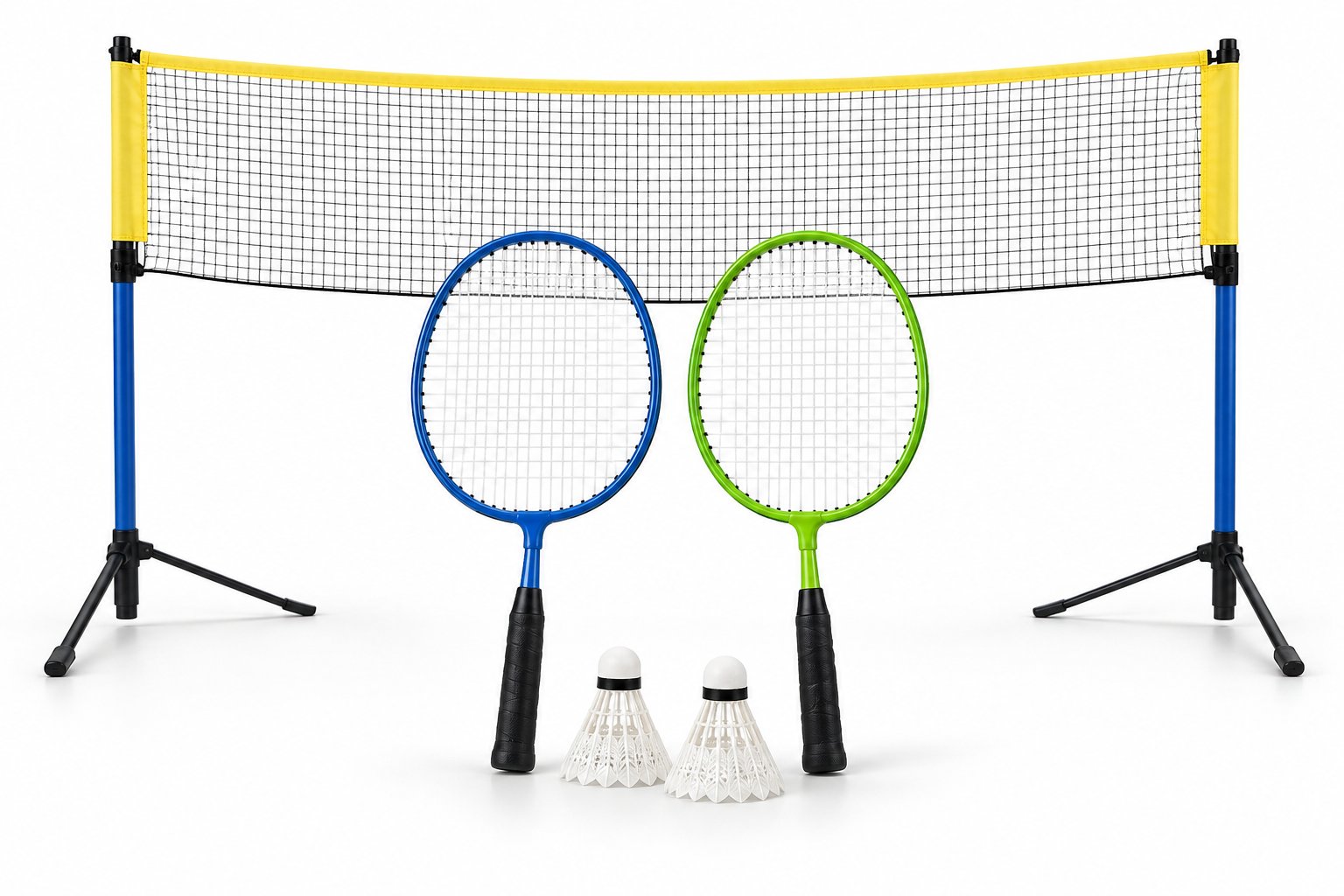
The junior badminton set with net for school sports lessons ships with soft grips already fitted and a carry bag for storage, so overgrip replacement is the main wear item a school needs to stock. The set itself contains 2 rackets, 2 shuttlecocks, 1 net and 4 pegs, with rackets at 53 cm and a net at 300 x 60 cm, in a carry bag packed 16 sets per carton at a 500-set MOQ.
Protecting string tension in storage
Storage does more damage to string tension than most cleaning routines. Strung rackets are under load all the time, and heat and pressure both work against that load.
- Temperature swings. A racket that moves between a cold store room and a warm hall repeatedly goes through expansion and contraction. Aim for a stable indoor store.
- Hot vehicles. Leaving rackets in a vehicle in the sun is the single fastest way to soften strings and stress the frame. Carry them in, every time.
- Stacking bags on top of rackets. Weight on a strung frame is pressure on the string bed. Do not pile net poles, mats or other bags on top of racket bags.
- Hanging on a peg. Hanging a strung racket by the frame concentrates load at one point on the head. Keep rackets flat in the bag instead.
- Keep rackets in the carry bag. The bag keeps dust off the grip and stops frames knocking against each other in a cupboard.
- Store the net and pegs separately. Fold the net and keep the pegs in their own container, so metal poles and pegs never press on frames or string beds.
- Store rackets strung. Leaving a racket strung is normal; the tension loss in storage comes from heat and pressure, not from the string bed simply being under load.
None of this requires special equipment. It requires a storage decision written down, so that whoever tidies the equipment cupboard at the end of term does the same thing as the person who set it up. The set is suitable for age 6+ and is EN71 and ASTM F963 compliant, which speaks to the product as supplied; the condition it is in two terms later depends on this routine.
What buyers should stock and specify
This is replenishment planning, not set selection. The question is what you keep on the shelf so a racket stays in service between orders, and what wording you put in the purchasing specification so the care routine survives staff turnover.
Stock items
- Overgrips in enough quantity to re-tape the school or club fleet once, plus a working margin. This is the highest-turnover item on the list.
- Spare shuttlecocks to match the 2 supplied per set, so a lost shuttle does not take a racket out of a lesson.
- Cleaning cloths kept with the equipment, not borrowed from the kitchen, so the barely-damp rule is easy to follow.
- Carry bags as a replacement item if bags are separated from sets in storage.
Specification wording
Ask for a care card inside every carry bag. The card should carry the routine in short form: wipe with a barely damp cloth, keep water out of the frame head and string bed, dry before storage, replace the overgrip when it hardens or slips, store flat away from heat, and keep net poles and pegs off the rackets. A printed card travels with the set into the school, which is where the routine has to happen.
Then write the same points into the purchasing specification under a care and storage clause, so the expectation is on record alongside set contents, grip specification, packaging and carton quantity. A specification that lists 2 rackets and 2 shuttlecocks but says nothing about grip replacement will still leave you buying overgrips ad hoc halfway through the year.
The school sports badminton set is the reference point for these clauses: 2 rackets with lightweight composite frames and soft grips, 2 shuttlecocks, 1 net at 300 x 60 cm, 4 pegs, carry bag, 16 sets per carton. OEM and ODM are available if a programme wants its own care card wording or packaging print.
Buyer questions
Can rackets be washed, or put in a dishwasher?
No. Neither washing nor a dishwasher is appropriate for a strung racket. Water in the frame head and string bed, plus heat and detergent, act on the frame, the strings and the grip at once. Clean with a barely damp cloth and dry fully.
How often should a grip be replaced?
Replace on condition rather than on a calendar: when the tape hardens, slips, polishes smooth, or starts to lift. In heavy school use that can be several times a season; in a lightly used club set it may be far less. Stock overgrips so the replacement is never delayed by ordering.
Should a racket be stored strung?
Yes, storing a racket strung is normal. Protect the tension by controlling what happens around it: stable indoor temperature, no hot vehicles, nothing stacked on top, no hanging by the frame, and net poles and pegs stored separately.
Can string tension be recovered without restringing?
No. Cleaning removes dust; it does not restore tension. Once the string bed has lost tension through play and temperature cycling, restringing is the only route back, and that is a separate purchasing decision from routine care.
Is a junior racket worth restringing at all?
Compare the restringing cost quoted to you against the per-racket cost in your specification-based quotation, including packaging and carton quantity. Where the restringing quote approaches the replacement cost, replacing the racket is the more sensible route; where it is clearly lower and the frame passes inspection, restringing keeps the set in service. Because rackets arrive factory strung, there is no restringing cost at the point of purchase, only later.
Pricing for the junior badminton set with net is quoted against the specification, so set contents, grip specification, packaging and carton quantity all change the quotation you receive. If you are planning replenishment for a school programme, club or retail range, send your requirement, including any care-card wording and overgrip quantities you want packed with the sets, and ask for a specification-based quote.


