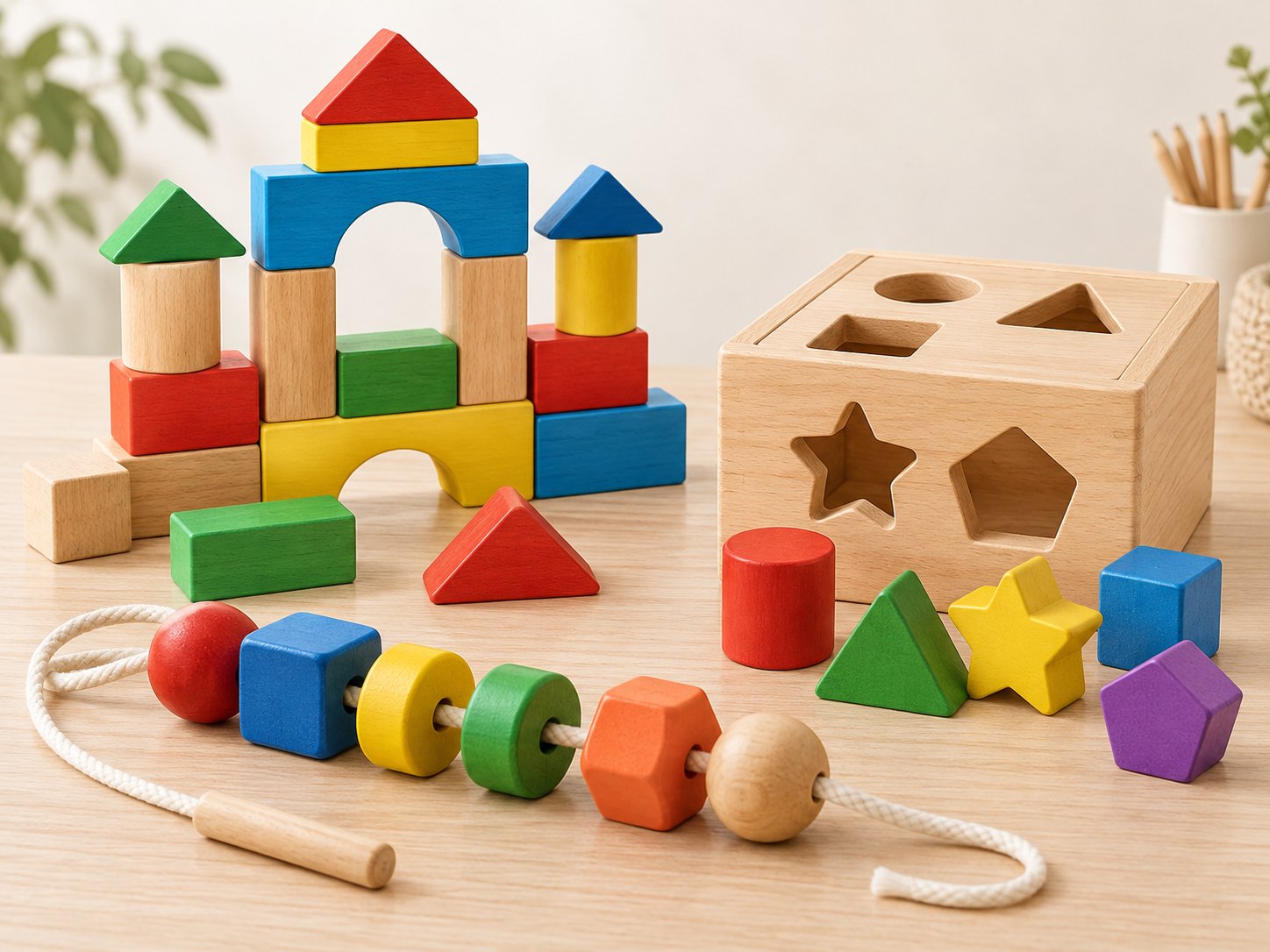
A practical cleaning guide for parents, preschools, and retail buyers: which methods are safe for finished wooden toys, what to avoid, how often to clean by principle rather than a rigid schedule, and why the quality of the factory finish determines how well a wooden toy survives years of cleaning.
Care & Maintenance
Wooden toys get chewed, dropped, and dragged across the floor. Cleaning them is straightforward once you know which surfaces you are working with and which methods quietly damage the finish over time.
Key points before you start
- Never soak wooden toys. Water that seeps into end grain or joints swells the wood and lifts the finish.
- A damp cloth with a mild soap is enough for routine cleaning. Disinfection is a separate question with its own limits.
- What you can safely use depends on the finish, not just the wood species.
- Cleaning frequency is best decided by use pattern: mouthing, shared classroom use, or display.
- For retail buyers, how well a toy survives repeated cleaning is set at the finishing stage, before it ever reaches a shelf.
Why wooden toys need a different approach
Plastic toys tolerate being dunked in a sink. Wood does not. Wood is hygroscopic: it takes on and releases moisture with the surrounding air, and it moves as it does. A sealed, well-finished surface slows that exchange down considerably, but it does not make the toy waterproof. Water that sits on the surface, and especially water that reaches exposed end grain or an unsealed joint, is the main cause of swelling, raised grain, cracking, and fading paint.
The second issue is chemistry. Many household cleaners are designed for hard, non-porous surfaces and contain solvents, bleach, or aggressive surfactants. On a painted or lacquered toy, those can dull the surface, break down the coating, or leave residue that ends up in a child's mouth. Cleaning wooden toys safely means choosing methods that lift dirt and germs without attacking the finish.
Safe routine cleaning methods
Dry cleaning first
Most of the day-to-day grime on a wooden toy is dust, crumbs, and dried food. Start dry. A soft cloth, a soft-bristled brush, or a dry microfiber pad removes this without introducing any moisture at all. For blocks and puzzles with recessed details, a soft brush reaches edges a cloth cannot. Dry cleaning alone handles a large share of daily maintenance and is always the safest option.
Damp cloth with mild soap
When a toy needs more than dusting, use a cloth wrung out until it is barely damp, not wet. A small amount of mild liquid soap in lukewarm water is generally sufficient. Wipe the surface, then go over it with a clean damp cloth to remove soap residue. Dry immediately with a soft towel rather than letting the toy air-dry, and pay attention to joints, edges, and any recessed area where water can collect.
- Keep the cloth damp, never dripping.
- Work section by section so no area stays wet for long.
- Dry joints and painted edges first; these are the most vulnerable points.
- Let the toy sit in open air after drying before it goes back into use or storage.
Disinfecting, handled carefully
Disinfection is a different task from cleaning, and it is where most damage happens. Choose a method appropriate to the finish and to how the toy is used. Food-safe surface sanitizers formulated for use on children's items, or a diluted alcohol wipe applied sparingly and allowed to flash off, are common choices in childcare settings. Whatever product you use, apply it to a cloth rather than pouring or spraying it directly onto the toy, keep it away from joints and exposed wood, and wipe the surface after the contact time specified on the product label.
Two things are worth being clear about. First, disinfection is not a substitute for cleaning: a sanitizer applied over dried food or a biofilm will not work as intended, so clean first. Second, some finishes react to alcohol or to repeated sanitizing. If the surface dulls or feels tacky after a wipe, that finish is not meant for frequent chemical disinfection and should be cleaned with the damp-cloth method instead.
What to avoid
| Method | Why it damages wooden toys |
|---|---|
| Soaking, dishwashing, or submerging | Water enters joints and end grain, swelling the wood and lifting paint, lacquer, or varnish. |
| Bleach and abrasive scouring powders | Attack the coating, leave residue on a surface children mouth, and can discolor the wood. |
| Solvent cleaners, nail polish remover, general-purpose degreasers | Dissolve or cloud the finish and can strip color from painted elements. |
| Spraying cleaner directly onto the toy | Liquid pools in recesses and joints; overspray reaches areas you cannot dry. |
| Prolonged air-drying while wet | Prolongs the time water has to penetrate, especially at edges and open joints. |
| Dishwasher or steam sterilization | Heat and moisture together are the fastest way to ruin a wooden toy. |
How often should wooden toys be cleaned?
There is no single interval that fits every setting, and a fixed schedule is less useful than a principle. Decide by use and by who handles the toy.
- Mouthed by infants and toddlers: clean after each use, since saliva and food residue sit directly on the surface.
- Shared use in preschools and playgroups: clean at the end of each session, and disinfect according to your setting's hygiene policy when a toy has been in a child's mouth or when illness is circulating.
- Home use by older children: a wipe-down when the toy looks or feels grimy, plus a dry dusting in between.
- Retail display or storage: dust periodically; no wet cleaning is needed unless the surface is actually soiled.
The principle behind all four cases is the same: clean when contamination is likely, not on a calendar. Frequent light cleaning with a damp cloth is far kinder to a finish than occasional aggressive scrubbing.
Lacquered, oiled, or unfinished: why the finish decides the method
Two wooden toys can look identical and behave completely differently under the same cleaning routine, because the surface is what you are actually cleaning. A sealed film finish, such as a child-safe lacquer or varnish, forms a continuous barrier that resists a damp cloth well. An oiled or waxed finish sits in the wood rather than on top of it; it can be wiped but may need occasional re-oiling, and it is more sensitive to repeated wetting. Unfinished wood is the most absorbent of all and the least tolerant of any liquid.
This is also why the label matters. If a manufacturer or supplier specifies a cleaning method for a finish, follow it rather than a general rule from the internet. If you do not know the finish, treat the toy as the most delicate case: dry cleaning and a barely damp cloth, no chemical sanitizers.
For retail buyers and preschool purchasing: finish quality is the real variable
Anyone sourcing wooden toys for resale, for a preschool, or for a rental library is buying into a cleaning routine, whether they intend to or not. A toy that survives damp wiping and occasional sanitizing through years of classroom use is a different product from one whose paint dulls or lifts after a few months. That difference is created at the finishing stage, and it is worth asking about directly during supplier evaluation.
Useful questions to put to a wooden toy manufacturer:
- Which finish is applied, and is it suitable for toys intended to be mouthed by young children?
- How does the finish hold up to damp wiping and to the sanitizing method used in the target market?
- Which toy safety standards does the product comply with for the destination market?
- What does the factory's own quality control check on the finished surface before shipment?
Fujian Lequ Wanwan Co., Ltd. is a B2B toy manufacturer and exporter founded in 2013, supplying North American and European buyers with OEM and ODM wooden toy programs. The company holds EN71 and ASTM F963 certification for its toy products and operates an ISO 9001:2015 quality management system, with an in-house QC laboratory used to check production before shipment. Buyers assessing how a wooden toy will behave after a year of cleaning are welcome to raise finish and compliance questions with the team during sourcing.
FAQ
How do I disinfect wooden toys without damaging them?
Clean the surface first with a barely damp, mild-soap cloth and dry it. Then apply a child-safe surface sanitizer or a diluted alcohol wipe to a cloth, not directly to the toy, and keep it away from joints and exposed wood. Wipe off residue after the contact time stated on the product label and let the toy dry fully. Because some finishes respond badly to repeated alcohol exposure, test on an inconspicuous area first if you are unsure of the finish.
Is lacquered wood easier to clean than unfinished wood?
Yes. A lacquered or varnished toy has a sealed surface that resists a damp cloth and tolerates routine wiping far better than bare wood. Unfinished wood is absorbent and should be cleaned dry or with a very lightly damp cloth only, since liquid can raise the grain and stain the surface. Oiled and waxed finishes fall between the two: wipeable, but less resistant to frequent wetting than a sealed film finish.
Can I put wooden toys in the dishwasher or sterilizer?
No. Heat and prolonged moisture together cause swelling, cracking, and finish failure. Hand-wiping with a damp cloth is the only safe approach for wooden toys.
My wooden toy feels slightly rough after cleaning. What happened?
Raised grain is the usual sign that too much moisture reached the surface or that the finish is thin in that area. Let the toy dry completely, then check whether the roughness is only on the surface or whether the coating has lifted. If the finish has failed, the toy may need refinishing by the manufacturer's recommended method or should be retired from mouthing use.
Cleaning wooden toys safely comes down to three habits: keep water to a minimum, match the method to the finish, and clean according to use rather than a calendar. For buyers and institutions, the longer-term answer is upstream. A toy built with a properly applied, compliant finish holds up to years of wiping and sanitizing; one that is not will show it early. Asking the right questions about finish and certification at the sourcing stage is what keeps a wooden toy line cleanable, and saleable, over its full service life.