A practical guide for schools, event organizers and retail buyers on running ring toss as a repeatable group activity — throwing-distance choices by age group, simple scoring formats for classes and events, rotation and team play, and why a matched set outperforms loose parts for scheduled events.
Event Play Guide for Schools & Organizers
If you run ring toss once a year at a fete, almost any set will do. If you run it every term across a playground, in PE lessons, at sports day and at a community fair, the activity has to survive repeat use, mixed ages and unpredictable ground. This guide focuses on that second case: how to organize the ring toss game as a repeatable group activity, and what to look for when you buy the kit.
Key takeaways
- Set throwing distance by age group, not by the maximum a strong thrower can reach.
- Use one scoring format per event slot so volunteers and children learn it once.
- Rotate in fixed teams or fixed rounds so queues stay short and results stay comparable.
- A matched set with consistent ring and post dimensions keeps scores meaningful between sessions — loose parts do not.
Set the throwing distance by age group
The distance from the throwing line to the posts decides whether the activity is fun or frustrating. Too close and the game ends in seconds; too far and younger children lose interest before their first hit. Rather than chasing a single "correct" distance, treat it as a setting you adjust for each group, and mark the line so it can be reproduced next time.
- Early years (age 3+): short distance, and let the child stand closer than the marked line if needed.
- Lower primary: one line that most of the class can reach within a few attempts.
- Upper primary and teens: move the line back and use it as the standard for that age group.
- Mixed-age family events: run two or three parallel lines and let participants self-select.
The exact figures you use are your call — they depend on the age mix and the surface. What matters for repeat events is that the lines are marked once (paint, tape or a cone) and reused, so scores across classes are comparable rather than random.
Pick one scoring format per event slot
Scoring is where ring toss events go wrong. Volunteers invent rules on the spot, two classes play by different rules, and the final tally means nothing. Choose a small number of formats and assign each one a slot. Keep the numbers you assign to those formats consistent for the whole event, and write them on a board so everyone plays the same game.
| Format | Best for | How it runs |
|---|---|---|
| Single round, best of throws | Short class slots, reception-age groups | Each player throws the full set once; record hits only. |
| Running total | PE lessons, after-school clubs | Players keep adding across several rounds; compare by total. |
| Team relay | Sports day, house competitions | Teams take turns; team total decides the winner. |
| Target-only scoring | Fundraisers, fêtes | Only the designated posts score; keeps stations moving fast. |
Whatever values you set for "on the post" versus "leaning against it", decide them once and print them. Changing the value between stations is the most common reason a ring toss tournament loses credibility.
Rotation and team play that keeps queues moving
Queue time, not throw time, is what makes a ring toss station feel slow. Two changes fix most of it:
- Fixed team size. Groups of three to five. Larger groups spend most of the slot waiting.
- Parallel lanes. Two or three sets side by side cut the queue roughly in proportion to how many you run. This is also the strongest argument for buying matched sets rather than borrowing assorted rings and posts from a cupboard.
- Retrieve-and-pass. The thrower collects the rings and hands the set to the next child. Rings that spring back to shape after bending make this faster and safer than rigid rings that deform or crack when stepped on.
For a full school, running one station per class group with a fixed rotation time (say, a few minutes per group) keeps the whole event on schedule without volunteers having to improvise.
Why a matched set beats loose parts for repeat events
Loose parts fail slowly and quietly. A ring from one set is a different diameter from another; a post from a home-made kit is a different height; scores stop being comparable across classes, and the activity loses its value as a repeatable lesson or competition. A matched set removes that drift.
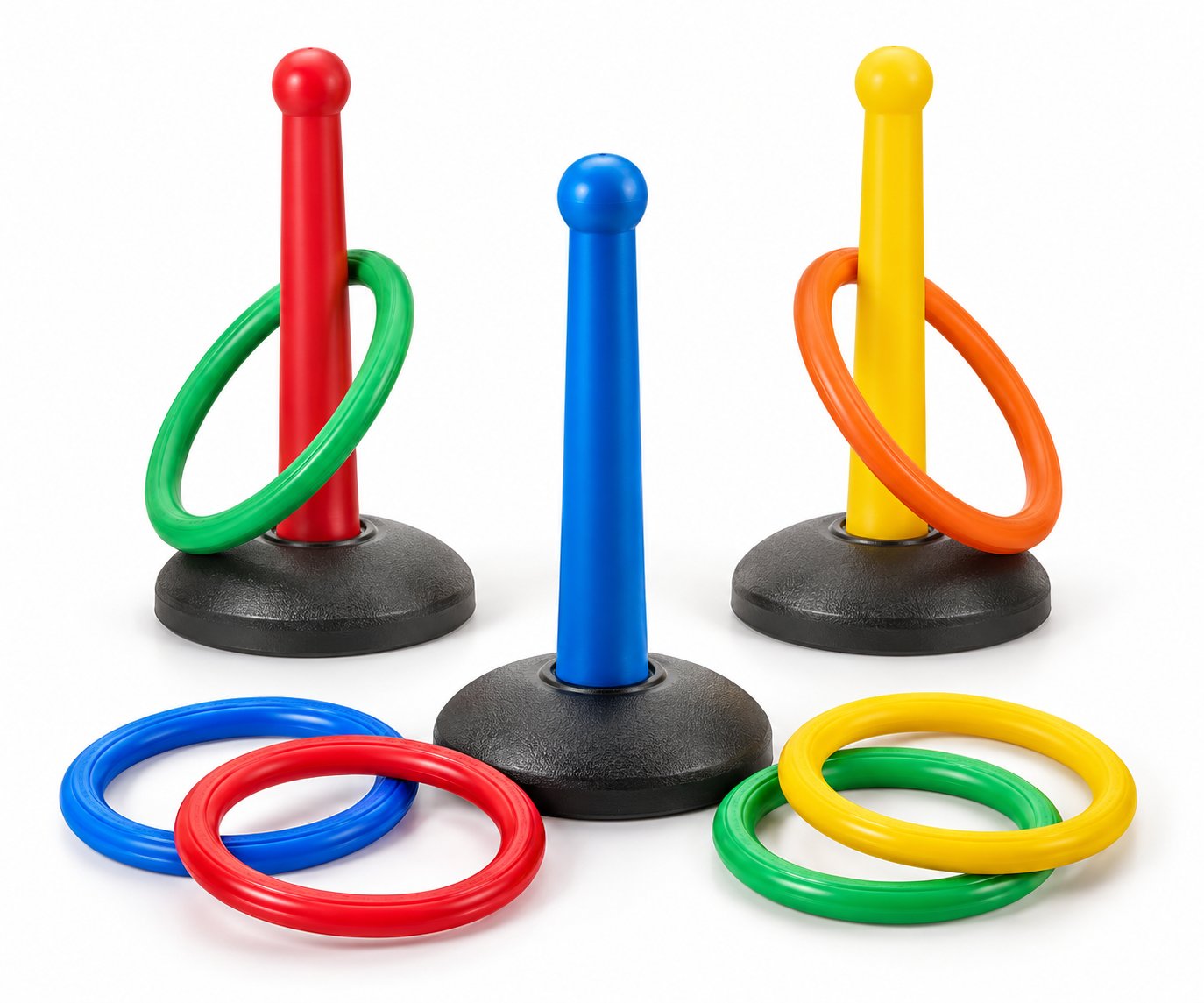
Specification example — Ring Toss Garden Game Set with 6 Rings for Playgrounds:
- 6 flexible PP rings, 18 cm diameter, return to shape after bending
- 3 weighted plastic posts, 45 cm high
- Rounded post tops reduce snagging during play
- Posts push into grass or sand without tools
- Age 3+
- Mesh carry bag packaging; export carton of 24 sets
- EN71 / ASTM F963 compliant
- MOQ 500 sets; OEM/ODM available
The consistent 18 cm ring and 45 cm post give you the fixed reference points that scoring formats need. The rounded tops matter more than they sound: on a snagging post, rings catch and drop half way down, and children argue about whether it counted. The push-in posts mean the same set works on a grass field, a playground edge and a sand pit without tools or ground fixings.
For buyers equipping a whole school or a rental fleet, the practical kit is one set per lane, plus spares. You can see the full specification on the Ring Toss Outdoor Game Set product page.
Running the station: a short checklist
- Mark the throwing lines for each age group before the event starts.
- Write the chosen scoring format and values on a board at the station.
- Set up two or three parallel lanes for larger groups.
- Brief volunteers on the one format for that slot — no improvised rules.
- Collect and store the sets in the mesh carry bag at the end of each session so the next class gets a complete set.
For procurement, ask the supplier for the unit and carton packing quantity, the compliance documentation that applies to the version you are buying, and whether OEM/ODM branding is available if the sets are for resale. The matched playground set above is available at an MOQ of 500 sets with mesh carry bag packaging in an export carton of 24 sets.
FAQ
Can the same set be used indoors?
The posts are designed to push into grass or sand without tools. Indoor use depends on your surface and whether you can support the posts; confirm with the supplier if indoor play is a requirement.
What age group is the set intended for?
Age 3 and above. Adjust throwing distance rather than switching equipment for older groups.
How many sets should a school order?
That depends on class sizes and how many parallel lanes you want to run. One set per lane, plus at least one spare, is a practical starting point for repeated events.
Is custom branding available?
OEM/ODM is available. The MOQ is 500 sets, so branding works best for a school district, a chain of venues or a retail program rather than a single site.