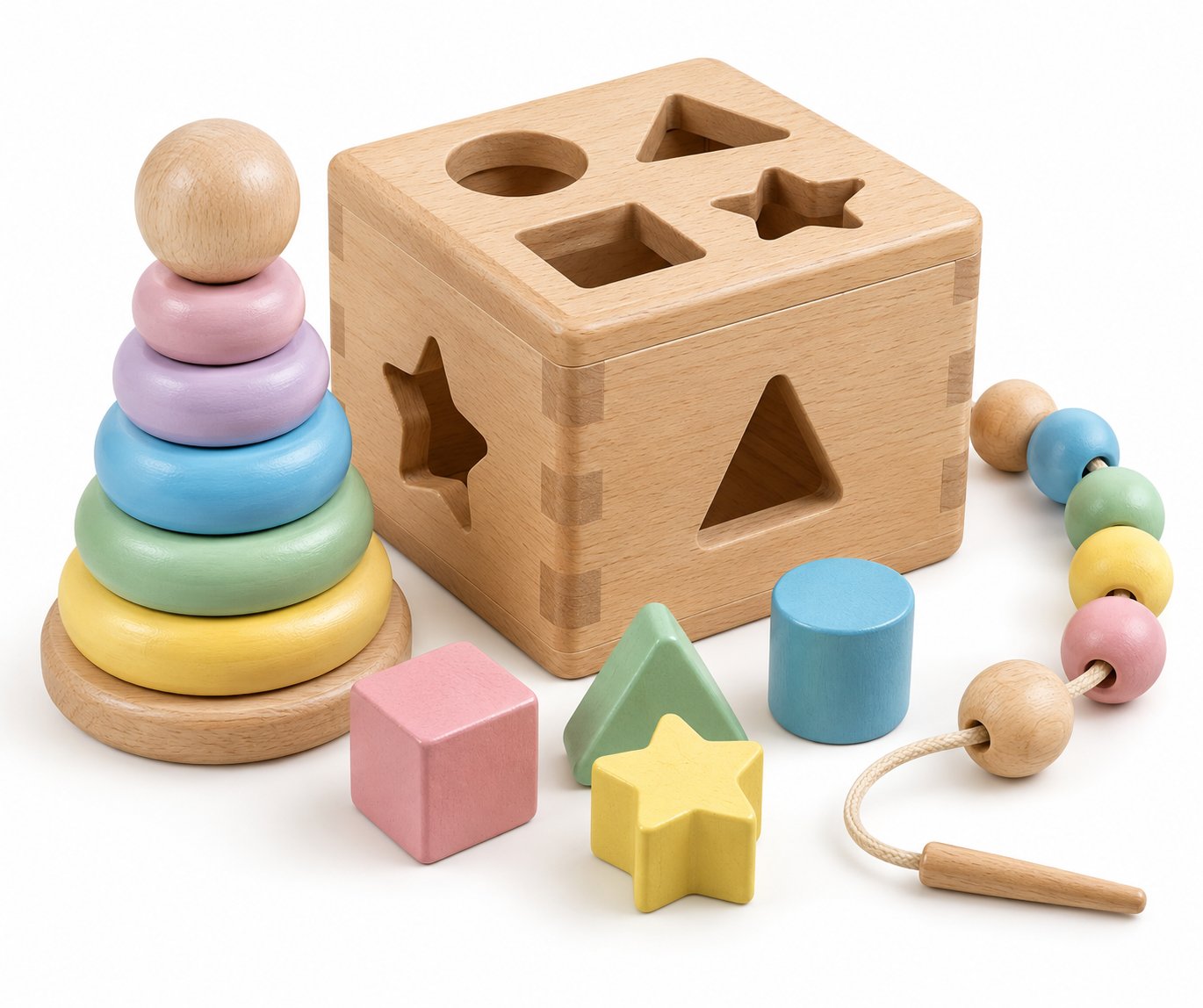
A hands-on guide for parents, preschool teachers and activity organizers: how to thread small beads step by step, how to set up the table so small hands succeed, first patterns to try, and how to run threading with a group. Includes what to look for in a classroom threading set.
Hands-on activity guide
Threading looks simple from the adult side of the table. Then you hand a lace and a bowl of beads to a three-year-old and watch the bead slide off the lace end five times in a row. The fix is rarely in the child's fingers — it is in the setup. This guide covers how to thread small beads step by step, how to prepare the table so small hands succeed, and how to keep a group of children threading without a traffic jam at the bead bowl.
The whole method in one box
- Beads: 2.5 cm diameter is large enough for the pincer grip and too large to swallow.
- Lace end: if the tip is soft, wrap 2–3 cm with tape or tie a firm knot.
- Hold: bead in one hand, lace tip in the other, level with the hole.
- Push: turn the bead toward the lace, don't stab the lace at the bead.
- Pull: slide the bead to the knotted end, then repeat.
- Age: age 3+ for beads of this size — anything smaller goes in the mouth-checks category.
Why the setup matters more than the technique
A child who is asked to hold a bead, find the hole, hold a lace, and aim the lace well enough to enter the hole is doing four jobs at once. Hand-eye coordination is the job we want to practice; the other three are logistics. Every part of the setup that removes logistics — a stiffened lace end, a bead that stays still, a work surface that doesn't roll — buys attention for the part that actually develops the skill.
That is also why bead size matters for this age group. For adult threading, 2.5 cm is small. For a three- to five-year-old, it is the size where a pincer grip works and the risk of swallowing is low. If you are working with children under three, threading with large beads under close supervision is a different activity from what is described here; keep anything bead-shaped out of reach when the adult's attention leaves the table.
What you need on the table
- One threading lace per child, or one lace per pair if you are short on laces.
- A bead bowl per two children, not one bowl for the whole table. Shared bowls are where most disputes start.
- A shallow tray or rimmed mat so beads that roll stay inside reach.
- Tape, or a pre-knotted lace end, for the first sessions.
- A finished sample — a two-bead, two-color strip is enough — as a visual target.
Step-by-step: how to thread a bead
Teach the movement in this order and give the child the same six-step sequence every time. Repetition of the sequence, not the speed of the threading, is what builds the habit.
- Prepare the lace end. If the tip is soft or frayed, wrap the last 2–3 cm tightly with tape, or tie a small overhand knot and trim close to the knot. A firm tip turns a wobbly aim into a straight push.
- Tie the far end. Knot the other end of the lace, or fix it to the tray with a finger. This is the single change that stops beads falling off the back and is worth doing every session.
- Lay the bead down. Set the bead flat on the tray with the hole facing the child. Letting the bead rest on the surface is easier for a young child than holding it in the air.
- Hold the bead with the guiding hand. Pinch the bead between thumb and index finger — this is the pincer grip the activity is building — and keep it still.
- Push the lace through. Bring the stiffened lace tip to the hole and turn the bead slightly until the tip enters. If the lace bends, the tip is too soft, not the child's hand too slow.
- Pull and repeat. Slide the bead down the lace to the far knot, then thread the next bead. Say the same short instruction each time: push, pull, next.
Expect the first bead to take a minute or more. By the third bead it usually drops to a few seconds. If a child is still fighting the lace after several attempts, check the lace end before you correct the child — soft tips and frayed tips cause more failures than young fingers do.
Fixing the four most common threading problems
| What you see | Likely cause | What to change |
|---|---|---|
| Bead slides off the lace every time | No knot or stop at the far end | Tie the far end, or loop the lace through the last bead twice |
| Lace keeps bending away from the hole | Soft or frayed tip | Tape the last 2–3 cm, or use a lace with a rigid tip |
| Child gives up after one attempt | Bead rolling while they aim | Bead flat on the tray, hole facing the child, guiding hand steadying it |
| Two children pulling the same lace | Shared lace between neighbors | One lace each, or one lace per pair with a turn-taking rule |
First patterns to try, in order
Sequencing is where threading stops being only a fine-motor task and starts being a thinking task. Move through these four patterns over several sessions rather than in one sitting.
- Free threading. A handful of beads, no target. The purpose is simply getting lace through hole, repeatedly.
- Two-color repeat. Red, blue, red, blue. Say the color names aloud while threading — this links the movement to language.
- Count and thread. Thread exactly five beads, then stop and count them together. Counting aloud while threading slows the pace and adds a number check at the end.
- Shape or size sequence. Round, square, round, square, or small-to-large order. This is where children start planning ahead instead of grabbing the next bead at hand.
Running threading with a group
A kindergarten or activity-class table for twenty children needs different logistics than one child at a kitchen table. A workable arrangement is one bead bowl per two children, one lace per child, and a set of trays on a low table so children can reach without standing. Tasks that take a child one minute alone can take three minutes in a group, so plan short sessions — ten to fifteen minutes of threading is plenty for the 3–5 age group.
Two organization rules save most of the cleanup: keep a shallow tray under each workstation area so dropped beads stay near the table, and use laces, not containers, to move finished work. Threaded beads on a lace stay together in a bag; loose beads in a container tip out on the floor.
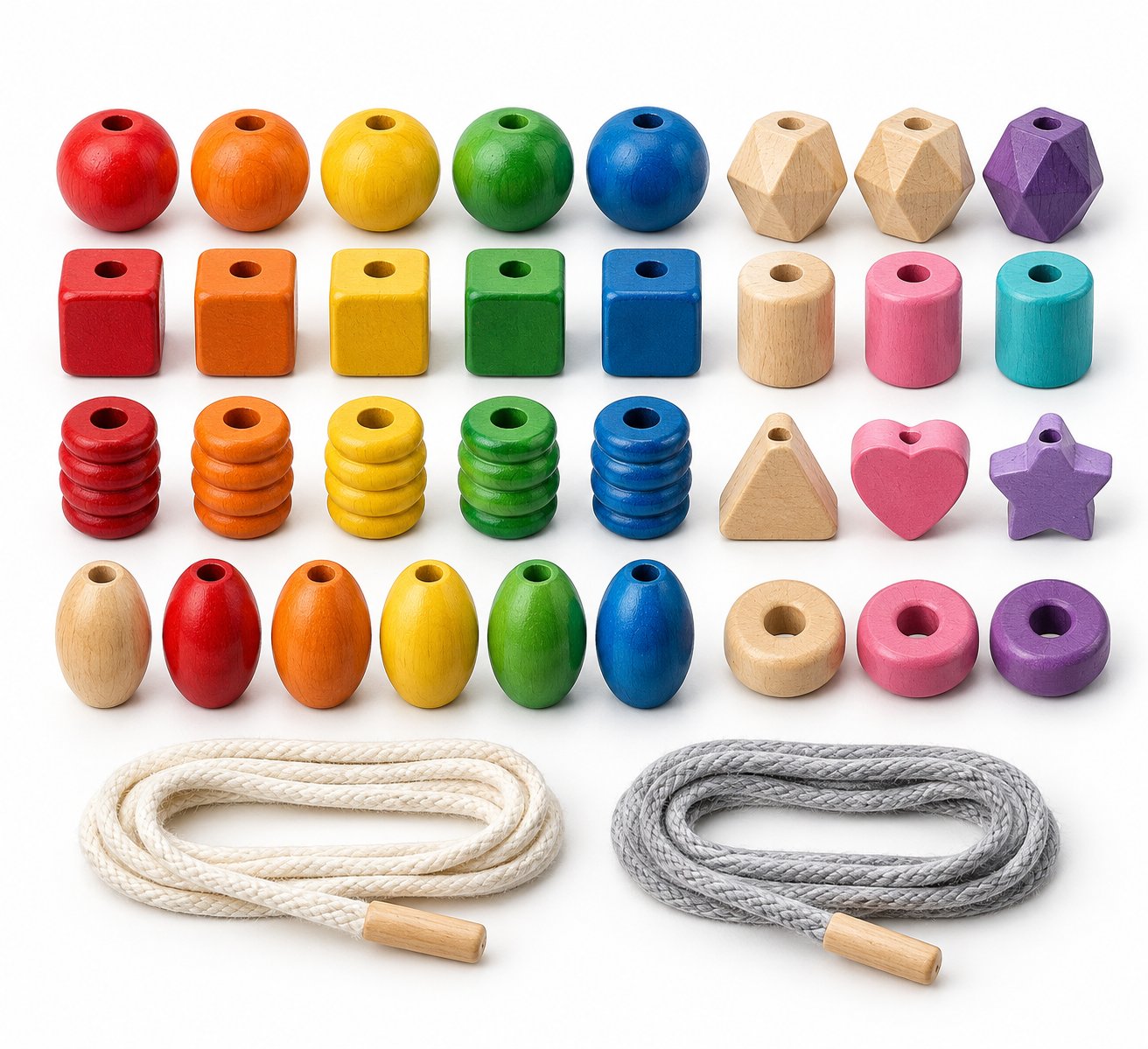
For a group of twenty children threading once a week, one set is not enough. Plan one set per two children sharing a bowl, plus a few spare sets for the table.
What to look for in a classroom threading set
Once you have run threading with a group, the buying criteria become obvious, and they are not the same as the criteria for a home toy.
- Bead diameter. 2.5 cm is the size that works for age 3+ hands. Anything noticeably smaller is a choking risk and a harder target for small fingers.
- Lace, not string. A 75 cm lace is long enough to thread a full set and short enough that a child is not stepping on the trailing end. A rigid wooden-tipped end saves you from taping every lace in the box.
- A stop at the far end. Wooden tips at both ends, or a permanently knotted end, so beads cannot slide straight off during the first sessions.
- Color and shape variety. 30 beads in assorted shapes and colors is enough to run the two-color repeat and the shape sequence in one box, rather than buying separate bags per pattern.
- Durability under group use. Wooden beads and cotton laces are the materials that survive being dropped, walked on and used by a table of children; the same set also holds up to repeated threading and unthreading throughout a term.
At classroom quantity, the practical details matter more than the finish. For a setting that buys by the term, a wooden bead threading set with 30 beads, 2 cotton laces and 2.5 cm beads covers both the free-threading stage and the first two sequencing patterns without extra parts. Sets intended for resale or for a program's own use are normally specified at a 500-set minimum order, packed in color boxes and then in export cartons, and toy safety materials for the EU and US markets normally mean EN71 and ASTM F963 documentation. If you need your own box, label or bead-color mix for a classroom program, that falls under the OEM/ODM side and is worth confirming early, because it changes the tooling and packaging lead time.
How this connects to the rest of the bead work
Threading a bead is one activity, but the reasons a threading table earns its space in a classroom are broader: grasping, aiming, sequencing, counting and turn-taking all happen in the same fifteen minutes. If you are deciding whether to include threading in a program at all, the skills behind the activity are covered in more depth in the background article on what threading toys are for and the skills behind the beads. Read that one first if the question is why; this article is for the how.
FAQ
What size beads are safe for a three-year-old to thread?
For this activity, 2.5 cm diameter beads are the working size for age 3+. They are large enough to grip with a pincer hold and to be aimed at a hole, and small enough to allow a lace through comfortably. Beads below that work at the table only under constant adult supervision.
How long should a threading lace be for small children?
A 75 cm lace is a practical length for a preschool table. Longer laces trail on the floor and get stepped on; shorter ones fill up before a child has threaded a full pattern.
How do I stop beads sliding off the end of the lace?
Tie a knot at the far end, or use laces with wooden tips at both ends. This is the first thing to fix if a child is losing beads repeatedly.
How many beads do I need per child?
One child can work through a set of 30 beads in a fifteen-minute session once they are threading fluently. For a group, plan one set per two children sharing a bowl, plus a few spare sets for the table.
Can I order a threading set with our own colors or packing?
OEM and ODM options are available for programs and resellers, including custom packaging. Minimum order is normally 500 sets, packed in a color box and then in an export carton. Confirm your required bead mix and packaging with the supplier before ordering.
Start with one lace, six beads and a knot at the far end. Get that first bead through, and the rest of the activity — patterns, counting, group tables — follows much more easily than it looks from the adult's chair. If you are specifying a threading set for a classroom or a reseller program, the Wooden Bead Threading Set lists the bead, lace and packaging details for that purchase.