
A clear guide to shape sorter age ranges: what developmental milestones support shape sorting, which features suit which age bands, safety considerations for buyers, and how retailers and importers can evaluate wooden shape sorter wholesale options.
Early Childhood Toy Guide
If you have ever stood in a toy aisle wondering whether a shape sorter suits a one-year-old or a three-year-old, the honest answer is: it depends less on the calendar and more on the specific design. The "right" age for a shape sorter is determined by the size of the pieces, the complexity of the sorting task, and the child's developmental stage—not by a single universal number printed on the box. This guide breaks down the age ranges that actually matter, the features that align with each stage, and what buyers and retailers should look for when sourcing these toys, including the demand for durable wooden shape sorter wholesale options.
Key Takeaways
- Most shape sorters target children between 12 months and 3 years, but the design dictates the true fit.
- Simple one-piece-per-shape sorters suit 12–18 months; multi-shape and puzzle-style sorters work better from about 18 months to 3 years.
- Small parts, removable pegs, and loose pieces are the main choking hazards—safety standards are driven by part dimensions, not age labels alone.
- For B2B buyers, wooden shape sorters are a strong category because they are durable, repairable, and appeal to parents seeking plastic-free options.
- Always confirm compliance documentation and material specifications with your supplier before ordering.
Why There Is No Single Age for a Shape Sorter
A shape sorter is not one toy. The category includes everything from a simple wooden cube with three chunky shapes to a complex 12-piece puzzle with stacking rings and a pull-along cord. Each configuration places different demands on a child's hand strength, visual discrimination, and problem-solving. That is why manufacturers and retailers assign different age recommendations to products that share the same category name.
The age printed on packaging is typically the minimum recommended age, derived primarily from safety testing and small-parts regulations. It tells you when a toy is safe for a child to use, not necessarily when it becomes developmentally interesting or achievable. A toy labeled "12 months+" may be safe for a one-year-old but not fully usable until closer to 18 months, when shape-matching clicks into place.
For parents, this means the label is a starting point. For retailers and importers, it is a compliance baseline that must be supported by documentation—not a marketing claim to be adjusted at will.
Age-by-Age Breakdown: What Works at Each Stage
The following table summarizes the typical developmental fit for common shape sorter configurations. Use it as a general planning guide; every child develops at a slightly different pace.
| Age Range | Developmental Focus | Best-Fit Sorter Features |
|---|---|---|
| 6–12 months | Cause-and-effect play, grasping, mouthing | Large, soft pieces; simple put-in/take-out; no removable small parts |
| 12–18 months | Shape recognition, hand-eye coordination, trial and error | 3–5 chunky geometric shapes; easy-grip knobs; one-piece-per-shape design |
| 18–24 months | Problem-solving, matching, early language | 6–8 shapes; varied colors; sorters that combine shapes with stacking or posting |
| 2–3 years | Fine motor precision, naming shapes, cooperative play | Multi-layer puzzles; shape sorters with 10+ pieces; sorters with pegs or lacing |
| 3+ years | Advanced matching, imaginative play | Complex puzzle sorters; sorters with removable lids; initial sorting by attribute |
6–12 Months: Exploration Before Sorting
Very young infants are not yet sorting shapes. They are learning that their hands can make things happen. A shape sorter for this age group should be treated more as a sensory and cause-and-effect toy: large pieces that are easy to hold, soft edges, and a simple open-and-close action. Many products marketed for this range are actually designed to grow with the child, becoming true sorters later. Safety here is critical—anything that fits into a small-parts cylinder is a choking risk, so the pieces must be generously sized and securely attached where applicable.
12–18 Months: The Classic First Shape Sorter
This is the sweet spot for the iconic shape sorter: a wooden cube or box with a lid and three to five chunky shapes—circle, square, triangle, and perhaps a star or heart. At this stage, children begin to rotate objects in their hands, test different orientations, and experience the satisfaction of a shape dropping through the matching hole. The best designs use easy-to-grip knobs or thick pieces, and they avoid frustratingly tight tolerances. A shape that requires too much force or precision will lead to abandonment; a slight bevel on the hole edges and smooth-sanded wood make success achievable.
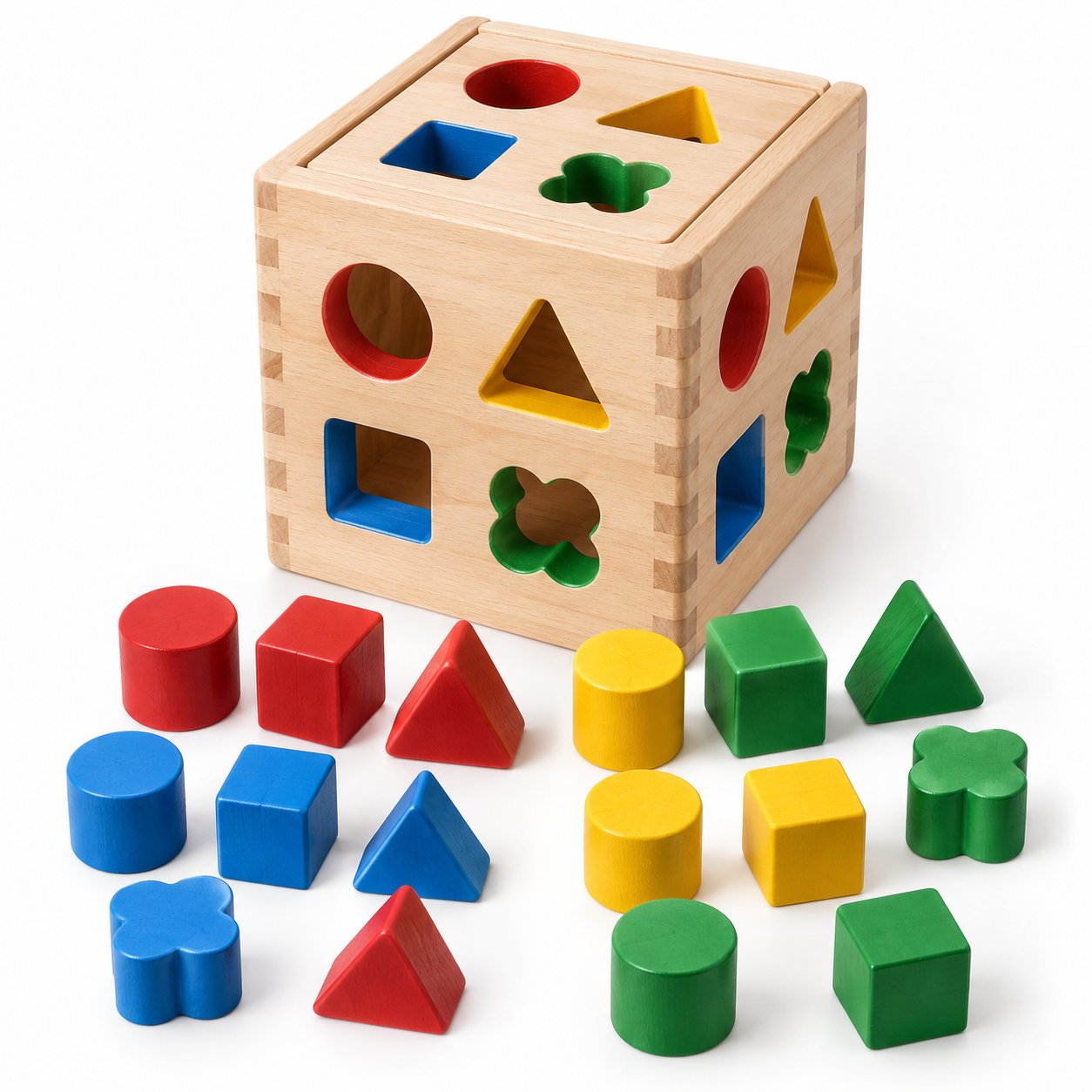
A classic example is a wooden shape sorter cube with 12 blocks in four shapes and four colors, where the lid opens for quick reset between rounds — the kind of practical detail that keeps a toddler engaged instead of frustrated.
18–24 Months: Adding Complexity
Once a child has mastered the basic shapes, they are ready for more. Sorters with six to eight shapes, or those that combine shape sorting with stacking rings, posting boxes, or color matching, hold attention longer. This is also the age when children start naming shapes and colors, so toys that support language development have extra value. For parents, this is often the stage when a first wooden shape sorter is outgrown—and a second, more complex one is introduced.
2–3 Years: Precision and Puzzle Play
By age two, many children can complete a multi-piece shape sorter puzzle with minimal help. They enjoy the challenge of matching not just shape but also size and orientation. Products in this range often feature 10 or more pieces, layered puzzles, or sorters with a removable lid that adds a step. The focus shifts from simple matching to sequencing and planning. Retailers should note that this age group overlaps with preschool toys, so packaging and safety labeling must be precise.
3+ Years: Beyond the Basics
Shape sorters remain useful beyond three years, but they compete with more advanced puzzles, building sets, and creative play. Some sorters designed for this age include attribute sorting (by color, size, or shape simultaneously), lacing activities, or cooperative game elements. These are less about shape recognition and more about rule-following and fine motor control.
Safety and Compliance: What Buyers Must Verify
Age grading is not just a developmental exercise—it is a regulatory requirement in most markets. In the United States, the Consumer Product Safety Commission (CPSC) enforces small-parts regulations under 16 CFR Part 1501. In the European Union, EN 71-1 sets mechanical and physical property requirements, including a small-parts cylinder test. Toys intended for children under three years must not contain small parts that could detach and pose a choking hazard.
For importers and retailers, the practical checklist includes:
- Small-parts testing: Confirm that the product has been tested to the applicable standard for the target age group. This is typically documented in a test report from a third-party lab.
- Material safety: Wooden toys should be tested for heavy metals in coatings and finishes, and for formaldehyde if composite woods are used. Paints and inks must comply with applicable limits.
- Mechanical hazards: Check for sharp edges, splinters, and detachable components. Magnets, if present, must meet strength and size requirements.
- Age labeling: The age recommendation on the packaging must be consistent with the test report and the actual product design.
Because regulations vary by destination market, the safest approach is to request the specific test reports and certificates that apply to your target country. Do not assume that a CE mark or an ASTM label covers every market or every product variant.
What Retailers Should Consider When Sourcing Wooden Shape Sorters
Wooden shape sorters have carved out a stable niche in the toy market. They appeal to parents looking for durable, plastic-free alternatives, and they often carry a higher perceived value than plastic equivalents. For buyers, this translates into several practical considerations.
Material and Construction
Look for solid wood—rubberwood, beech, pine, or similar—with smooth, rounded edges and non-toxic water-based finishes. Plywood or MDF can be used in some components, but they must be properly sealed and tested. The thickness of the wood affects durability and the weight of the piece; thicker pieces are generally easier for small hands to grip.
Design for Manufacturability
Shape sorters involve cutting, sanding, drilling, and finishing. Designs with simple shapes and consistent tolerances are easier to produce at scale. If you are sourcing from a wooden shape sorter wholesale supplier, ask about their in-house capabilities: CNC cutting, laser engraving, and spray finishing lines all affect lead time and consistency. Also clarify whether custom shapes, colors, or packaging are available, and under what minimum order quantities.
Compliance Documentation
Request test reports for the exact product you intend to order, not for a similar item. Confirm the report references the correct age group, the correct materials, and the correct destination market. If the supplier cannot provide this, treat it as a risk signal.
Packaging and Display
Retail packaging should clearly state the age range, safety warnings, and country of origin. For online sellers, the packaging must also survive shipping; a simple printed box or a drawstring bag may suffice. Discuss packaging options early, as they affect unit cost and freight volume.
Frequently Asked Questions
Shape sorters are generally not recommended for children under 12 months unless the product is specifically designed for that age with large, soft, non-detachable pieces. For a 6-month-old, cause-and-effect toys and sensory exploration are more appropriate. Always follow the manufacturer's age recommendation.
Yes. Children develop fine motor skills at different rates. Some two-year-olds can complete a six-shape sorter easily; others need more time. If a child is consistently frustrated, try a sorter with fewer shapes or larger, easier-to-grip pieces. If you have concerns about motor development, consult a pediatrician.
Safety depends on the specific product and its compliance with applicable standards, not on the material alone. Wooden toys can have splinters or finish issues if poorly made; plastic toys can have sharp edges or weak joints. In both cases, look for third-party test reports and a design that matches the child's age.
Most shape sorters on the market are labeled for 12 months to 3 years. Within that range, the simplest designs suit the younger end, while multi-piece puzzle sorters are better for children over 18 months.
Final Thoughts
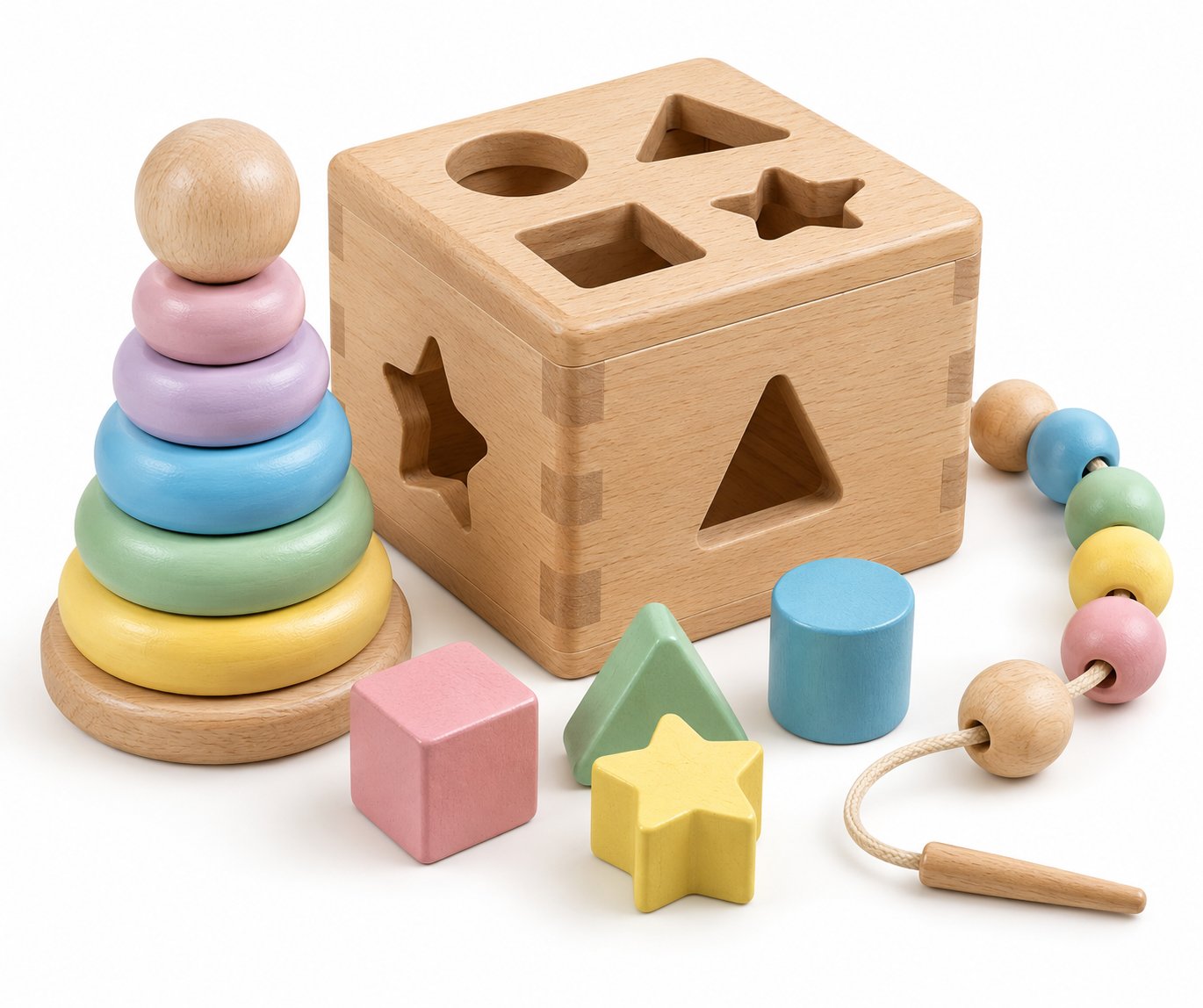
The age-appropriateness of a shape sorter comes down to the match between the child's developmental stage and the design of the toy. Parents should treat the age label as a safety guide and observe their child's interest and ability. Retailers should verify compliance documentation and consider the durability and appeal of wooden options. Multi-activity designs such as a wooden Montessori learning set with shape sorting and threading extend simple sorting into stacking and lacing as children grow. For B2B buyers, the wooden shape sorter category offers a resilient product with clear consumer demand—provided that sourcing decisions are backed by samples, test reports, and a clear understanding of the target market's regulations.
If you are evaluating wooden shape sorter wholesale options, start by requesting product specifications and compliance documents for the exact models you are considering, and ask for samples to assess quality firsthand.