
Regulation ten-pin bowling pins are wood-based, but kids' and garden bowling sets are usually moulded from PE or similar plastics. This guide breaks down how wood and plastic behave in outdoor use, what material choice means for weight, weather resistance, cleaning and safety, and what importers should specify when ordering a kids' bowling set.
Materials Explainer
Bowling pins are not all made from the same material. Regulation ten-pin bowling pins are wood-based, while kids' and garden bowling sets are typically moulded from plastic. The material decides how heavy each pin feels, whether the set can stay outside, how it is cleaned, and which safety standards a supplier can realistically test against.
Short answer: what is a bowling pin made of depends on the lane it plays on. Competition pins use a wood core with a hard coating. Kids' sets, garden sets and most promotional sets use moulded PE or similar plastic because it survives weather, rough handling and repeated wiping.
Regulation pins: wood-based construction
Ten-pin bowling pins used on regulation lanes follow a traditional build: a hardwood core, usually bonded from several pieces, covered with a hard outer coating that takes the impact of a heavy ball. That construction is why competition pins feel dense and produce a specific sound on impact. Manufacturers of regulation pins work to tight dimensional tolerances because lane equipment and scoring systems depend on repeatable pin placement.
Those same qualities make regulation pins a poor fit for a family garden or a school playground. They are heavy, the outer coating can chip when pins are thrown or dropped onto concrete, and they need dry storage. That is the reason kids' sets are not simply smaller versions of lane pins.
Kids' and garden pins: moulded plastic
Most indoor kids' sets and outdoor garden sets use hollow or semi-hollow plastic pins. Polyethylene (PE) is a common choice for outdoor sets because it handles moisture, temperature swings and UV exposure better than many rigid plastics, and it can be wiped clean without special care.
The moulding process also allows features that are difficult or expensive to add to wood: rounded edges, a wider base for stability on grass, and consistent wall thickness so every pin in the set behaves the same way when hit. Colour can be moulded through the material rather than painted on, so a scuff does not leave a white patch behind.
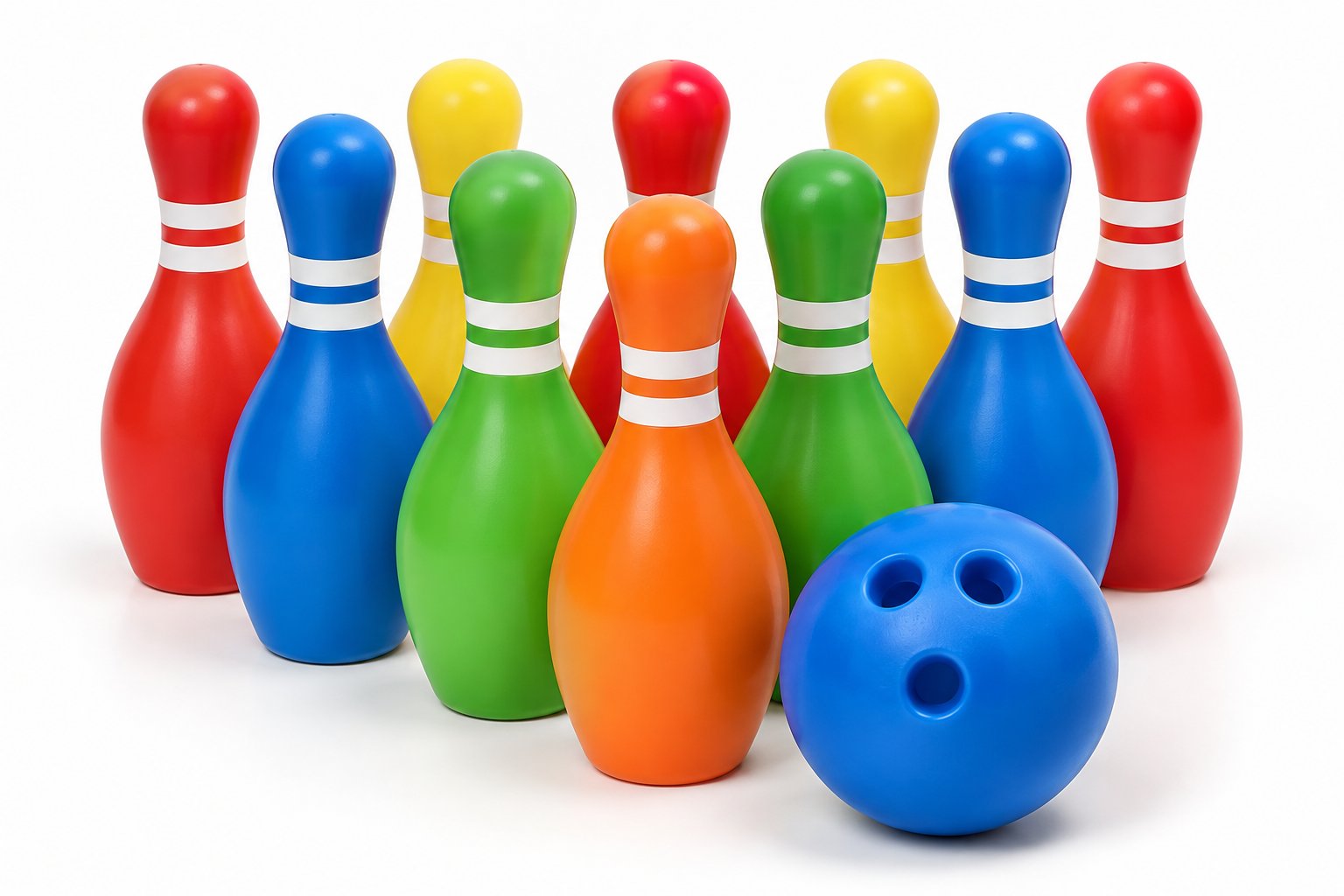
This is the construction behind our own Kids Garden Bowling Set with 10 Pins for Outdoor Play: ten weather-resistant PE pins, one 16 cm ball with moulded finger holes sized for smaller hands, and a mesh carry bag. The set is designed to be left outdoors between sessions and wiped with a damp cloth.
Wood vs plastic at a glance
The comparison below is about behaviour and use case, not about one material being better than the other. A regulation pin and a kids' garden pin are solving different problems.
| Property | Wood-based regulation pin | Moulded plastic kids' pin |
|---|---|---|
| Typical use | Indoor bowling lanes with pin-setting equipment | Gardens, playgrounds, indoor play, promotional sets |
| Feel and weight | Dense, heavy, designed for impact from a regulation ball | Light enough for children to lift, set up and knock over |
| Weather exposure | Needs dry storage; coating can chip | PE resists moisture and outdoor temperature changes |
| Cleaning | Careful handling to protect the coating | Wipe with a damp cloth |
| Safety testing focus | Dimensional and performance specifications | Sharp edges, small parts, material safety (e.g. EN71, ASTM F963) |
| Base for customisation | Limited by the coating process | Colour, size, graphics and set contents can be tooled |
What a plastic kids' set looks like on paper
When a buyer asks about pin material, they usually also need to confirm the dimensions and set contents that go with it. Here are the reference figures for the garden set mentioned above:
| Item | Value |
|---|---|
| Material | Weather-resistant PE plastic |
| Set contents | 10 pins + 1 ball |
| Pin height | 28 cm |
| Ball diameter | 16 cm, moulded finger holes |
| Recommended age | 5+ |
| Storage | Can be left outdoors; wipe with a damp cloth |
| MOQ | 500 sets |
| Packaging | Mesh carry bag + export carton, 20 sets per carton |
| Compliance | EN71 / ASTM F963 |
| Customisation | OEM/ODM available |
Weights are not listed here because plastic pin weight varies with wall thickness and mould design. If weight matters for your market or shipping plan, request the figure for the exact tooling version you are considering.
Buyer checklist before you order
Material is only one line in a purchase order. These are the points worth confirming with any supplier of kids' bowling sets:
- Plastic type stated in writing. "Plastic" is not enough. Ask whether the pins are PE, PP or another resin, and whether the resin is virgin or regrind. The answer affects colour consistency and crack resistance.
- Wall thickness and base design. Thicker walls feel more solid; a wider base helps pins stand on uneven grass and reduces frustration for younger players.
- Weather claim backed by the material. PE is a reasonable choice for outdoor use, but confirm the supplier's storage and cleaning instructions rather than assuming the set is fully waterproof.
- Ball size against pin height. A 16 cm ball with a 28 cm pin is proportional for children aged five and up. Check that the finger holes suit your target age group.
- Safety test reports. Request EN71 or ASTM F963 reports that name the specific product and version. Company-level certification does not automatically cover every SKU.
- MOQ and packaging. Confirm the MOQ, whether the mesh carry bag is standard or optional, and how many sets fit per export carton.
- Customisation scope. If you need your own colours, logo or set contents, confirm what is achievable at the MOQ and what requires new tooling.
FAQ
Are kids' bowling pins made of wood or plastic?
Most kids' and garden sets are plastic. PE is common for outdoor sets because it copes with moisture and temperature changes. Wooden pins do exist in some toy ranges, but they are heavier, more sensitive to damp, and harder to mould into stable, child-friendly shapes.
Can plastic bowling pins be left outside?
A set made from weather-resistant PE can be left outdoors between sessions and wiped with a damp cloth. For long storage or extreme heat, follow the supplier's care instructions.
What safety standards apply to kids' bowling sets?
EN71 and ASTM F963 are the two standards most often requested by EU and US buyers respectively. Ask for a report that covers the exact product and version you are ordering.
Can the pins be customised?
OEM/ODM is available for this product line. Colour, graphics and set contents are the usual starting points, but tooling requirements and minimum order quantities should always be confirmed with the supplier before committing.
For buyers comparing options, the practical question is not whether one material is superior, but whether the pin you choose matches the play environment, the age group and the safety file you need to submit. A moulded PE set with the right dimensions and test paperwork will clear customs and satisfy retail buyers far more smoothly than a generic "plastic bowling set" with no material detail attached.


