Montessori toys are self-correcting, hands-on learning materials rooted in Maria Montessori's educational principles. For retailers and preschool buyers, this guide explains what makes them different, how to evaluate quality and safety, sourcing considerations for wholesale, and what to check before placing an order.
Montessori toys are not a marketing label. They are physical learning materials designed around the observation that young children teach themselves through purposeful, self-directed activity. For a retailer or preschool buyer, the practical question is not whether a product carries a "Montessori" sticker, but whether it actually supports the developmental work it claims to support — and whether it will hold up in a classroom or on a retail shelf.
This guide covers what distinguishes Montessori toys from conventional educational products, the materials and construction details that matter, how to evaluate quality and safety, and the selection, sourcing, and supplier-evaluation questions that come up in wholesale purchasing.
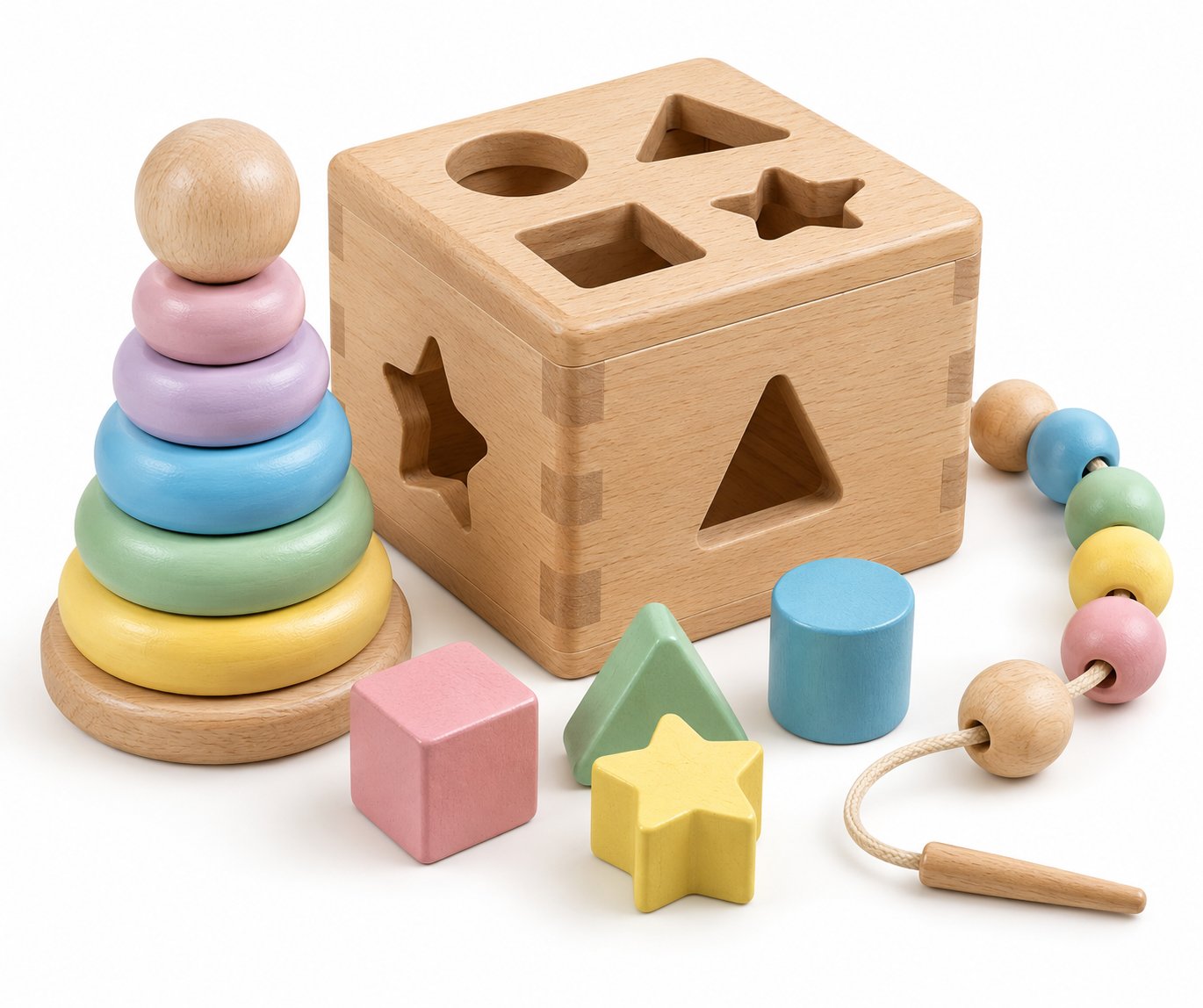
Concrete examples make these criteria easier to apply. A classroom-ready example is our wooden Montessori learning set with shape sorting and threading, which combines a shape-sorting box, stacking rings, and a bead-threading activity in one kit built from smooth, child-safe wood with a non-toxic coating.
What Makes a Toy “Montessori”
Maria Montessori's method treats the child's environment as the teacher. Materials in a Montessori classroom share several characteristics that distinguish them from general toys:
- Self-correcting design. The material tells the child whether the work is correct, reducing the need for adult intervention. A cylinder that only fits one hole teaches size discrimination without verbal instruction.
- Isolation of one quality. A material typically focuses on a single concept — size, color, shape, weight, or texture — so the child can concentrate on one attribute at a time.
- Real, functional materials. Montessori materials favor wood, metal, glass, and natural fibers over plastic replicas. Weight and texture matter because the child is refining their senses.
- Sequenced progression. Materials are arranged from simple to complex and from concrete to abstract. A pink tower leads to later dimensional work; sandpaper letters lead to writing.
- Open-ended, limited quantity. Montessori shelves typically hold one of each material. The child chooses, completes the work, and returns it — building independence and order.
- No rewards, lights, or forced entertainment. The material itself is the point. Electronic sounds and flashing lights are generally absent.
For a preschool, this means materials are chosen to fit a prepared environment and a specific developmental sequence, not simply to fill shelves. For a retailer, it means the customer base is often parents and educators who research before they buy — and who will notice low-quality substitutes.
Common Types of Montessori Materials
Montessori materials are usually grouped by area of activity. Buyers sourcing for preschools will recognize these categories from classroom setup lists.
| Category | Typical materials | Skill focus |
|---|---|---|
| Practical life | Pouring sets, transferring tongs, dressing frames, cleaning tools | Coordination, independence, concentration |
| Sensorial | Pink tower, brown stair, color tablets, knobbed cylinders, geometric solids | Discrimination of size, color, shape, weight |
| Language | Sandpaper letters, movable alphabet, object-to-picture matching | Phonemic awareness, letter formation, vocabulary |
| Mathematics | Number rods, spindle boxes, golden beads, counting frames | Quantity, numeral recognition, decimal system |
| Culture and science | Puzzle maps, botany and zoology puzzles, land and water forms | Geography, biology, classification |
| Pincer grip and pre-writing | Knobbed puzzles, threading, lacing, tray activities | Fine motor control, hand-eye coordination |
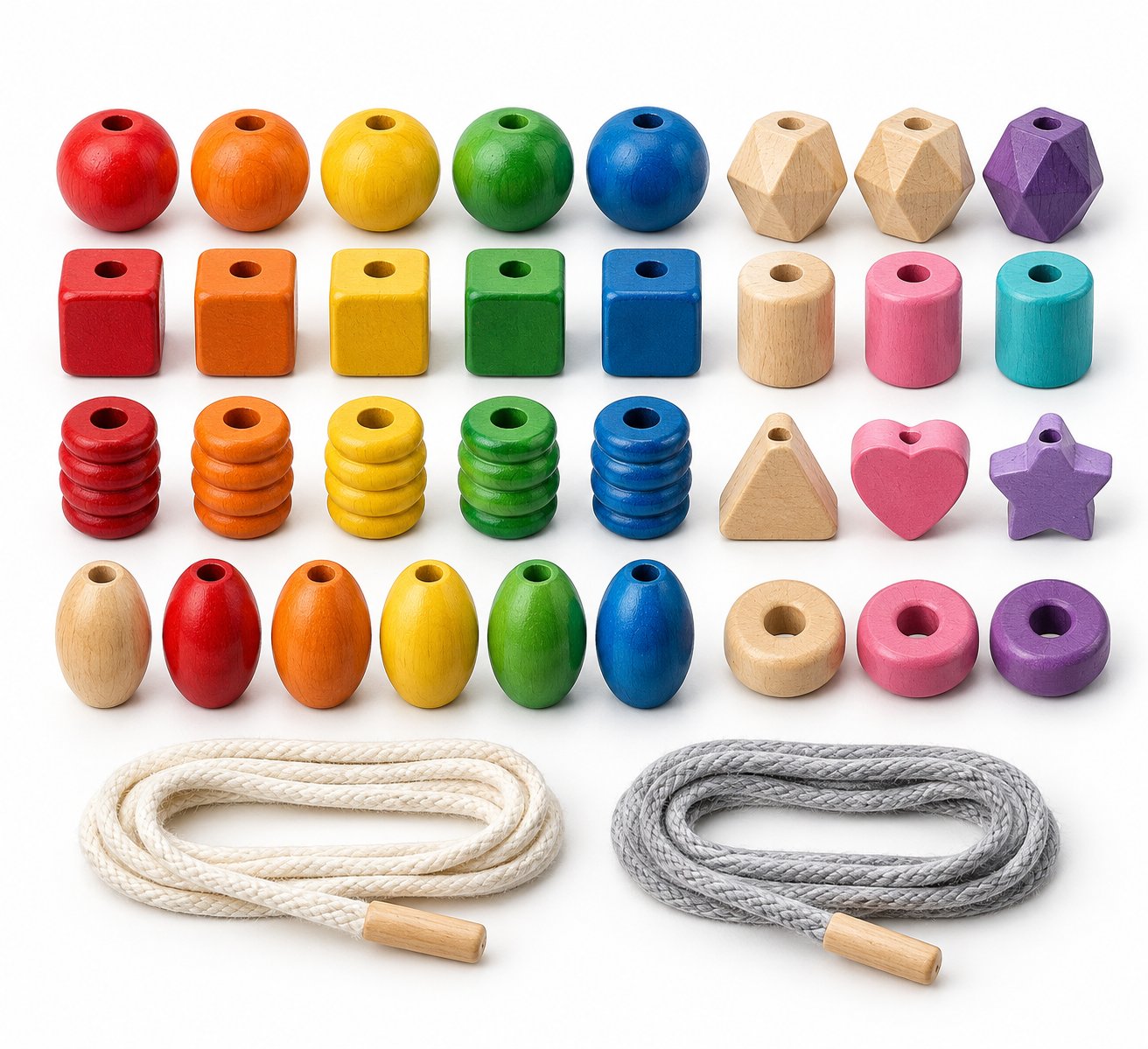
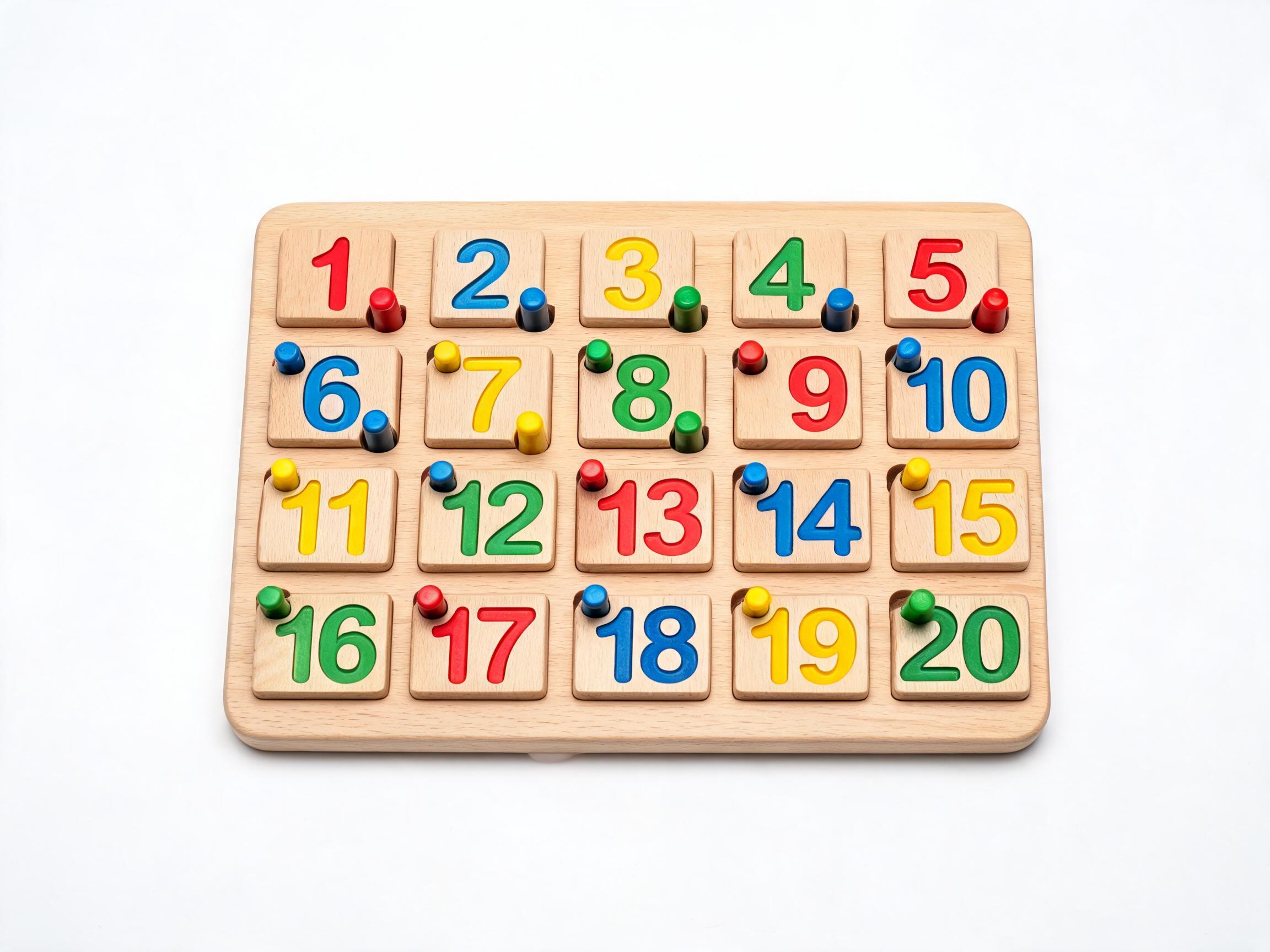
Two examples from our own range show how these categories translate into products: a wooden number puzzle board with counting pegs, where twenty number tiles sit in recessed slots and each slot carries the matching number of counting pegs so the child can self-check the link between numeral and quantity; and a wooden bead threading set with 30 beads and two cotton laces with wooden ends, which supports grasping, hand-eye coordination, and sequencing in preschool threading and counting activities.
Materials and Construction: What Buyers Should Examine
Most Montessori materials sold today are made from wood, but “wooden” is not a single specification. For wholesale purchasing, the construction and finishing details determine both safety and durability in a classroom setting.
Wood species and surface
Common options include beech, birch, rubberwood, and pine. Beech and birch are typically denser and more resistant to dents, which matters in a room used by 20–30 children daily. Pine is lighter and often used for puzzle bases and trays. Ask for the species, the thickness of components, and whether surfaces are sanded smooth with eased edges.
Finish and safety
Finishes vary: water-based lacquer, plant-based oil, or unfinished wood. For preschool use, a finish that is easy to wipe clean without harsh chemicals is practical. Child-safety considerations include:
- Non-toxic, lead-free coatings appropriate for children's products
- Rounded edges and corners, no splinters or rough end grain
- No small parts that detach under normal use for ages under three
- Stable bases so materials do not tip during use
- Paints and dyes that resist saliva and repeated cleaning
Testing requirements vary by destination market. Buyers commonly request compliance documentation such as EN71 for the EU, ASTM F963 and CPSIA for the US, or equivalent standards for other regions. The exact scope and validity of any certificate depends on the specific product, batch, and issuing lab — confirm these against the supplier's original documents for the product you are ordering.
Hardware and joinery
Classroom materials experience more handling than home toys. Check whether knobs are screwed and glued rather than glued only, whether hinges are metal rather than plastic, and whether edges of puzzle pieces are sealed. These details affect how long a set stays in service before components go missing or break.
How Montessori Toys Differ from General Educational Toys
The distinction matters for retail positioning and for preschool procurement, because the two product types are often shelved together but serve different buyers.
| Feature | Montessori material | Conventional educational toy |
|---|---|---|
| Correction | Self-correcting by design | Often requires an adult or app to confirm |
| Concept focus | One attribute isolated per material | Multiple features combined; may distract |
| Material | Usually wood, metal, glass, natural fiber | Often plastic, battery-operated, or electronic |
| Progression | Sequenced across ages and skill levels | Often standalone, age-banded by marketing |
| Audio/light effects | Generally none | Common feature |
| Packaging | Simple, often no display box required | Retail-ready with branding and instructions |
For wholesale buyers, the packaging difference has real cost implications. Montessori materials often ship in plain or minimal packaging, which can reduce unit cost but may require retailers to add their own branding or display solutions.
Buying Considerations for Preschools
Preschool procurement differs from retail buying in volume, replacement cycles, and the need for classroom-ready sets. Key questions when evaluating a supplier:
- Is the set complete and usable as shipped? Some suppliers sell individual pieces; others sell full curriculum-aligned sets. Clarify which components are included and whether replacement parts are available.
- What is the recommended age range? Practical life materials with small parts are usually reserved for ages three and up. Confirm age labeling and choking-hazard warnings.
- How many units per classroom? Montessori classrooms typically hold one of each material. If you are outfitting multiple classrooms, order accordingly.
- Are items available as replacements? Knobs, cylinders, and counting pieces go missing. A supplier who can ship individual components extends the life of a set.
- What documentation is provided? Ask for material safety data, conformity certificates relevant to your market, and care instructions you can share with staff.
- What is the lead time and minimum order? These vary by supplier and product line. Request current terms before planning a semester budget.
Wholesale Sourcing: Questions to Ask Any Supplier
When sourcing Montessori toys wholesale — whether from a wooden Montessori toys supplier or a broader educational-products manufacturer — the evaluation should go beyond price per unit. Here is a practical checklist:
- Material specification: Wood species, board thickness, finish type, and whether any plastic or metal components are used. Ask for samples if possible.
- Dimensions and tolerances: Especially important for interlocking materials such as the pink tower or knobbed cylinders. Ask for actual measured dimensions, not nominal size.
- Safety conformity: Which standard applies to the target market, which lab issued the report, and whether it covers the exact product and finish.
- MOQ and price breaks: Ask how MOQ is calculated (per SKU or per order) and whether mixed containers are accepted.
- Lead time and packaging: Production time, shipping method, and whether packaging can be customized for retail.
- Sample policy: Cost, lead time, and whether sample charges are credited against a future order.
- After-sales support: Replacement for defective or missing pieces, and how those claims are handled.
If a supplier cannot answer these questions with specifics, that is itself useful information. Vague responses at the sampling stage often predict vague responses later.
Quality Checks Before You Commit to a Container
Before scaling an order, verify with physical samples and, if possible, an inspection during production:
- Inspect surface finish: no splinters, cracks, or uneven staining.
- Check moving parts and knobs for secure attachment.
- Verify that pieces fit together as intended — self-correction only works if dimensions are accurate.
- Wipe-test finishes with a damp cloth to see whether color transfers or the surface dulls.
- Drop-test a piece from table height to gauge edge durability.
- Confirm that the shipped packaging protects corners and prevents movement in transit.
For a full production order, a pre-shipment inspection that samples finished goods against the approved sample is standard practice. Discuss inspection arrangements with your supplier before production starts, not after.
Frequently Asked Questions
Are Montessori toys only for preschools?
No. Many parents buy them for home use, and retailers often stock them for both markets. The difference is usually in quantity, packaging, and whether materials are sold individually or in sets.
Do Montessori toys require certification?
Requirements depend on the destination country and the age group. Common standards include EN71 (EU), ASTM F963 and CPSIA (US). Confirm which standard applies and that the certificate covers the specific product you are buying.
What is a typical MOQ for wholesale Montessori toys?
MOQ varies widely by supplier and product complexity. Ask whether it is calculated per SKU or per order, and whether mixed SKUs can be combined to reach the minimum.
Can I get custom branding or packaging?
Many suppliers offer custom packaging or branded labels. Availability depends on the product and order volume. Ask for specifics during sampling.
How do I verify a wooden Montessori toys supplier?
Request material specifications, safety documentation for the exact product, sample pieces for hands-on evaluation, and references or inspection reports where available. Compare response specificity across suppliers — concrete answers are a better signal than broad claims.
Next Steps
If you are evaluating Montessori materials for a preschool or planning a retail assortment, the most useful next step is to request product specifications and a physical sample. Compare actual construction, finish, and dimensions against the criteria in this guide, and confirm safety documentation for your target market before placing a bulk order.
Suppliers who can answer material, safety, MOQ, and lead-time questions with specific numbers make the rest of the evaluation straightforward. Those are the suppliers worth keeping in your sourcing file.