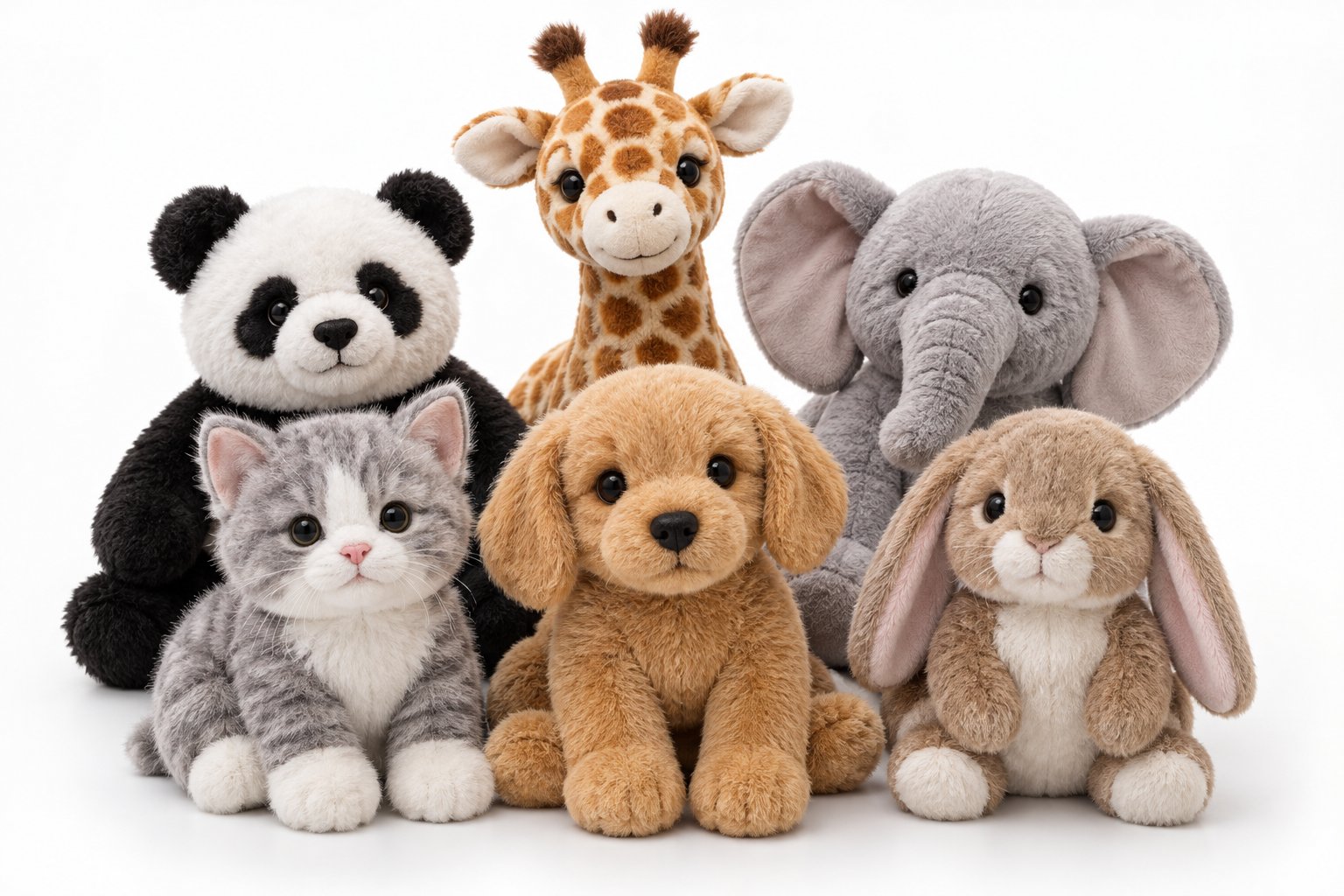

Plush toys are light but bulky, so freight is priced by volumetric weight rather than scale weight. This cost-logic explainer breaks down how compression, poly-bag and export-carton packing, and container utilization affect landed cost — and why a single-piece parcel quote tells you nothing about a 1,000-piece wholesale shipment.
Why Plush Is Priced by Space, Not by Weight

When an importer asks "how much does it cost to ship a stuffed animal," the first mental model to correct is that freight is charged per kilogram of toy. Plush is the textbook example of light-but-bulky cargo. A stuffed animal can weigh very little and still occupy a large volume, and carriers price whichever is greater: actual weight or volumetric weight.
Volumetric weight is a conversion from the space a package takes up. The formula varies slightly by mode and carrier, but the logic is consistent: length × width × height, divided by a dimensional divisor. Because plush compresses, the height of a shipping carton is heavily influenced by how firmly the goods are packed — and that is a supplier-side decision, not a carrier-side one.
Key takeaways
- For bulk plush orders, freight is usually driven by carton volume, not by the weight of the toys.
- Compression and carton height change how many pieces fit per container, which changes your unit freight cost.
- A single-piece parcel quote and a wholesale ocean shipment are two different cost structures — do not compare them directly.
- Before you estimate anything, ask your supplier for carton dimensions, carton weight, and pieces per carton.
Compression: The Variable Buyers Underestimate
A soft plush toy can be compressed, and compression is where packing method turns into money. If cartons are packed loosely, each carton holds fewer pieces for the same outer dimensions, so you pay for air. If goods are packed with controlled compression, more pieces fit into a given carton footprint and height — improving container utilization before the shipment ever reaches a port.
There is a practical limit. Over-compression can distort a toy's shape, crush filling, or affect how the product looks on a retail shelf. The useful question is not "how hard can you squash it," but "what packing method delivers a stable carton while keeping the product in saleable condition." That balance is worth discussing with your supplier during sampling, because it is much harder to renegotiate after production.
Poly Bag + Export Carton: What the Packing Structure Does to Cost
Both standard plush constructions in a typical program use the same basic structure: each piece in a poly bag, then packed into an export carton. The poly bag protects against dust and handling; the export carton provides stacking strength for the container and the warehouse.
Two plush references illustrate the point:
- Plush Teddy Bear Comfort Toy — 30 cm seated height, poly bag + export carton, 60 pieces per carton, MOQ 1,000 pieces.
- Custom Plush Stuffed Animal — customizable 20–60 cm, soft plush fabric with hypoallergenic filling, poly bag + export carton, MOQ 1,000 pcs.
Size range matters here. A program that spans 20 cm to 60 cm will not have a single carton specification; the number of pieces per carton changes with the toy. That means your freight estimate must be built from the actual carton plan for the specific sizes you order, not from an average. Both products are EN71 / ASTM F963 compliant, which is a compliance fact rather than a freight one — but it does affect packing, because compliance labeling and bagging requirements can add to carton contents and handling.
Single-Piece Parcel vs. Bulk Wholesale Shipment
This is where small buyers are most often misled. Searching for the cost to ship "a" stuffed animal usually returns consumer parcel pricing: one box, one address, express network. That model is priced on the dimensional weight of a single parcel, and the per-unit cost is high because you are paying for an individual handling event.
A wholesale import shipment is a different animal entirely. You are not shipping one toy; you are shipping cartons on a pallet or in a container, and the cost is spread across every piece inside. The comparison below separates the two scenarios.
| Scenario | What drives cost | How it is quoted | Who it applies to |
|---|---|---|---|
| Single-piece parcel | Dimensional weight of one parcel | Per-parcel rate, individual handling | Consumer or sample shipment |
| Small wholesale air/express | Chargeable weight of the consolidated cartons | Per-shipment rate on total chargeable weight | Buyers testing a market |
| Bulk ocean / consolidated container | Container volume utilization and carton count | Per-container or per-CBM basis | Importers ordering at MOQ and above |
Notice that no rate appears in that table. That is deliberate. Freight rates move with season, route, fuel, and carrier capacity, and quoting a figure here would be misleading within weeks. What stays stable is the structural logic: for bulk plush, the lever you control is how efficiently volume is used.
How to Build a Realistic Freight Estimate Before You Order
You cannot calculate freight from the product description alone. You need the shipping data that only your supplier can confirm. Ask for:
- Carton dimensions (length × width × height) for each size you plan to order.
- Pieces per carton and carton gross weight.
- Whether the goods will ship in poly bags only or in export cartons, and whether cartons will be palletized.
- Total carton count for your order quantity.
With those numbers, your freight forwarder can calculate chargeable weight and container utilization. Without them, any estimate is a guess. Buyers ordering at the 1,000-piece MOQ should also confirm whether mixed sizes can be consolidated into fewer cartons, since consolidation directly affects how much container space the order consumes.
Where the Cost Actually Sits in a Plush Order
For most wholesale plush programs, freight is a meaningful but not dominant line. The larger cost drivers are usually unit production cost, packing labor, and compliance testing. Freight becomes more visible when products are oversized, under-compressed, or shipped in low volumes where fixed handling costs are spread across fewer pieces.
That is why the same toy can look expensive to ship as a sample and economical to ship by the container. The product did not change; the cost structure did.
Frequently Asked Questions
Is it cheaper to ship stuffed animals by air or by sea?
For bulk orders, ocean freight is typically lower per unit because cost is spread across container volume. Air and express are used when speed matters more than unit cost, such as initial samples or a fast replenishment run.
Does removing the poly bag reduce shipping cost?
The poly bag itself adds negligible weight and volume. The bigger variables are carton dimensions, compression, and pieces per carton. Protective bagging is normally retained for product condition reasons.
Can I get a freight quote from the supplier?
Many suppliers can arrange or coordinate freight, but the rate depends on your destination, Incoterms, and shipment timing. Request carton dimensions and total volume first, then have your forwarder quote against those figures.
Does MOQ affect shipping cost per piece?
Yes. Fixed handling and documentation costs are spread across the order. At 1,000 pieces, the per-piece freight share is lower than for a small trial order, assuming similar carton efficiency.
Next Step: Get the Carton Data Before You Commit
If you are comparing plush suppliers, the fastest way to compare landed cost is to request the same data set from each: carton dimensions, pieces per carton, gross weight, and compliance documentation. Suppliers who can provide that quickly make your freight calculation straightforward; suppliers who cannot leave you guessing.
For programs using the 30 cm teddy bear or custom sizes from 20 cm to 60 cm, both available in poly bag + export carton and compliant with EN71 / ASTM F963, the packing plan can be discussed during sampling. Confirm the carton specification for your exact sizes before you finalize your order quantity.