
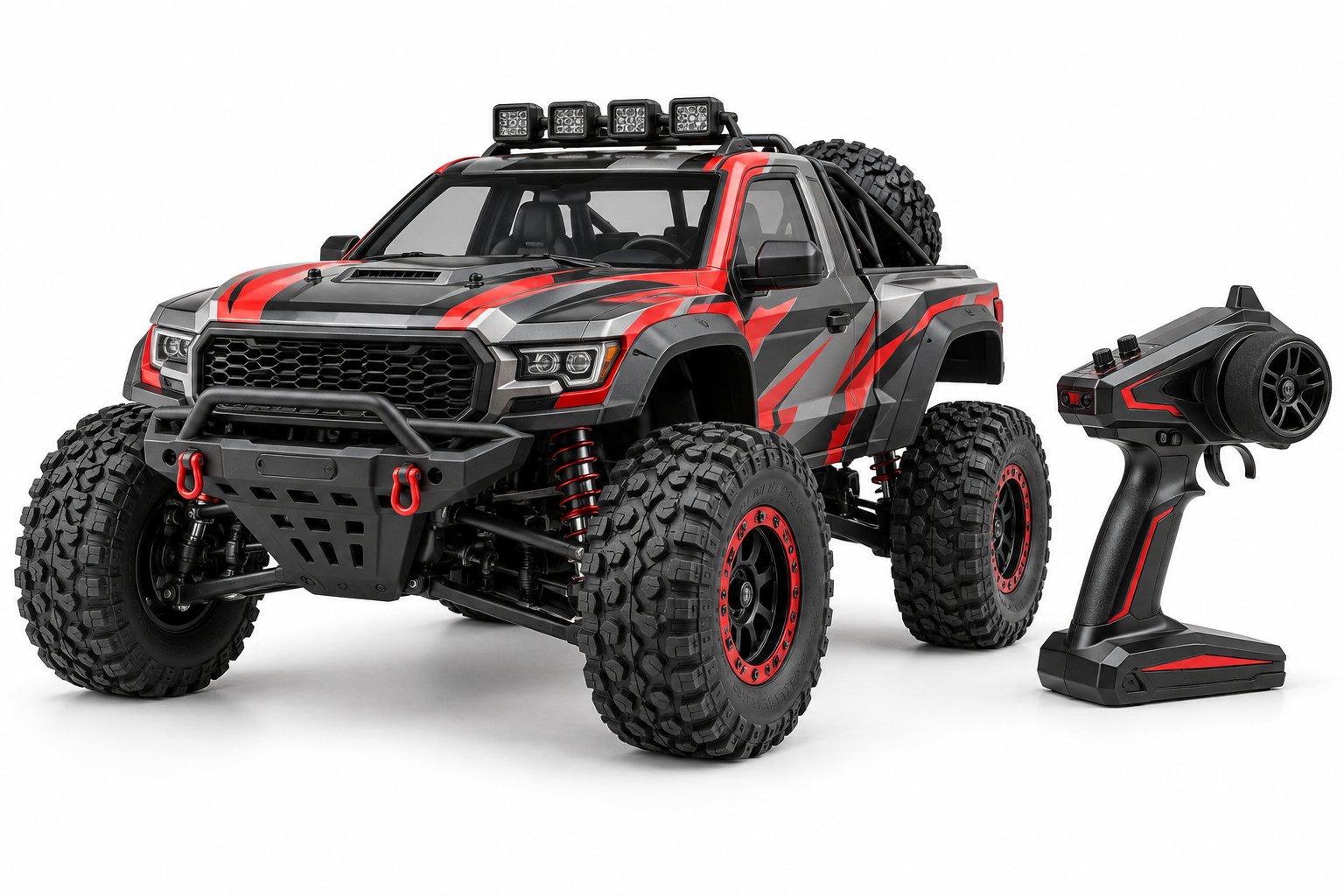
A plain-English guide to what "off-road" actually means on a truck, plus a practical comparison of 4WD RC off-road truck specs and suspension types for buyers who source or resell hobby-grade RC vehicles.
RC Truck Buying Guide
"Off-road" is one of the most loosely used words in both full-size truck marketing and RC toy listings. On a full-size truck, it signals a package of hardware and ratings. On an RC truck, it usually means the vehicle is built to run on dirt, grass, gravel, or uneven ground instead of carpet or pavement. The two are not the same claim, and mixing them up leads to unhappy customers and high return rates.
This article separates the two meanings, then compares the specs that actually matter when you evaluate a 4WD RC off-road truck: drivetrain, suspension, ground clearance, tires, motor, and battery. If you source or resell RC vehicles, these are the fields to check before you commit to a container.
Key Takeaways
- Full-size "off-road" is a capability and durability claim; RC "off-road" is a surface and terrain claim.
- Four-wheel drive (4WD) on an RC truck means torque goes to all four wheels, but the implementation (shaft-driven vs. independent) changes durability and cost.
- Suspension type and travel determine whether the truck absorbs bumps or bounces off them.
- Ground clearance, tire compound, and motor/battery pairing are the specs most often misrepresented in listings.
- Match the spec sheet to the intended terrain before you compare price.
What's inside
What "off-road" means on a full-size truck
On a production truck, an off-road designation is not one feature. It is a bundle of hardware and, in many cases, a set of manufacturer ratings. Typical elements include:
- Drive configuration: four-wheel drive or all-wheel drive with a low-range transfer case.
- Suspension: upgraded dampers, increased travel, and sometimes a lifted ride height.
- Protection: skid plates under the engine, transfer case, and fuel tank.
- Tires: all-terrain or mud-terrain tires with a more aggressive tread and tougher sidewall.
- Angles: published approach, breakover, and departure angles, plus ground clearance measured in millimeters or inches.
- Water fording depth: a specific figure in the owner's manual, not an unlimited capability.
The important point for buyers: a full-size off-road claim is only meaningful when the manufacturer publishes those numbers. "Off-road" without a fording depth, clearance figure, or angle is a styling package, not an engineering claim. The same logic applies when you read an RC product listing.
What "off-road" means on an RC truck
In the RC category, "off-road" describes the surfaces the truck is designed to handle and the chassis features that make those surfaces survivable. A listing that says off-road usually implies the truck can run on:
- Packed dirt and gravel paths
- Short grass and lawn
- Sand and loose soil (with limits)
- Small rocks, roots, and curbs
It does not automatically mean the truck is waterproof, that it can run in deep water, or that it can survive repeated jumps. Those are separate specs. When you evaluate a supplier's RC off-road truck, ask for the specific figures behind the word: ground clearance, suspension travel, tire type, motor size, battery voltage, and whether the electronics are water-resistant or waterproof.
4WD RC off-road truck: how to read the drivetrain spec
"4WD" on an RC truck means the motor drives all four wheels. That is the headline. The engineering difference is in how the power gets there, and this is where price and durability diverge.
Shaft-driven 4WD
A central driveshaft runs front to back, with differentials at each axle. This is the layout used on higher-end hobby-grade trucks. It handles more torque, is easier to service, and is more expensive to produce. If a supplier lists metal differentials and a metal driveshaft, that is a durability signal worth confirming against a sample.
Independent 4WD with a central gearbox
Many mid-range RC trucks use a single central gearbox with drive cups and dog bones to each wheel. It is simpler and lighter, and it is common in 1:10 and 1:16 scale vehicles. It works well for moderate terrain but is less tolerant of binding or high-torque brushless motors.
What to verify
- Differential type: gear differentials, ball differentials, or locked axles. Locked axles give better traction on loose ground but reduce steering on hard surfaces.
- Drive cup and dog bone material: plastic wears faster than metal under repeated load.
- Whether 4WD is selectable: some trucks allow 2WD/4WD switching for longer run time. Confirm this is a real mechanical feature, not a marketing label.
RC truck with suspension: types and what they do
A suspension system on an RC truck does two jobs: keep the tires in contact with uneven ground, and absorb impacts so the chassis and electronics survive. The type of suspension is one of the clearest indicators of how a truck will perform.
Independent suspension
Each wheel moves on its own. This is the most common setup on 1:10 and smaller off-road RC trucks. It gives good handling on mixed surfaces and is easier to package in a smaller chassis. Travel is usually limited compared with a solid-axle design.
Solid axle (live axle) suspension
Both wheels on an axle are connected by a rigid housing. This is typical of scale crawlers and trail trucks. It provides more articulation, which keeps tires planted on rocks and roots, but it limits high-speed stability. If the target market is crawling or trail running, this is the layout to look for.
Oil-filled vs. friction dampers
Oil-filled shock absorbers dissipate heat and resist fading over a long run. Friction dampers are simpler and cheaper, and they are common on entry-level trucks. The spec sheet should state which one is used; if it does not, ask. A truck described as having "adjustable suspension" should also state whether adjustment is preload only or includes damping.
Suspension travel and ground clearance
These are different measurements. Ground clearance is the distance from the lowest point of the chassis to the ground. Suspension travel is how far a wheel can move up and down. A truck can have high clearance but short travel, which means it will scrape on obstacles rather than absorb them. Ask for both numbers, and confirm they are measured, not estimated.
RC off-road truck spec comparison
The table below compares the spec categories you should expect on a supplier datasheet. It is organized by what each spec tells you, not by brand, because the same spec means the same thing across suppliers.
| Spec | What it tells you | What to confirm |
|---|---|---|
| Scale (1:10, 1:16, 1:18) | Overall size and where it can run | Actual length and width in mm, not just the ratio |
| Drive type | Whether all four wheels are powered | Shaft-driven or gearbox-driven; differential material |
| Suspension type | How the truck handles uneven ground | Independent or solid axle; oil-filled or friction dampers |
| Ground clearance | What obstacles the chassis can pass over | Measured value in mm; lowest point identified |
| Suspension travel | How well bumps are absorbed | Front and rear travel figures |
| Tire type | Traction on the intended surface | Compound, tread pattern, foam insert, wheel diameter |
| Motor type | Speed and torque balance | Brushed or brushless; turns or kV rating |
| Battery | Run time and power | Voltage, capacity in mAh, connector type, charge time |
| Water resistance | Whether wet terrain is safe | Which components are rated, and to what level |
Values vary by model. The purpose of this table is to define which fields belong on a datasheet, so you can compare suppliers on the same basis. Where a supplier does not publish a field, request it before quoting.
Buyer checklist before you order
Use this list when you evaluate a 4WD RC off-road truck or a catalog of them. It is written for importers, distributors, and private-label buyers who need to compare offers on the same terms.
- Intended terrain: crawling, trail, short-course, or general backyard use. Ask the supplier which one the model was tuned for.
- Measured clearances: request ground clearance and suspension travel figures. If the supplier cannot provide them, treat the off-road claim as unverified.
- Drivetrain materials: metal versus plastic in differentials, driveshafts, and dog bones. Ask for the material spec, not just "metal parts."
- Electronics rating: waterproof versus water-resistant, and which parts are covered (ESC, receiver, servo).
- Spare parts availability: for resale markets, parts support matters as much as the truck itself. Ask for the parts list and ordering lead time.
- Battery and charger compliance: confirm connector type and whether the charger meets the destination market's requirements.
One more practical point: ask for a sample unit and run it on the terrain your customers will actually use. Spec sheets describe intent; a short test run on dirt and gravel reveals whether the suspension and drivetrain hold up. If a supplier cannot supply a sample or refuses to specify a measurement, that is a decision-relevant gap, not a detail.
FAQ
Is every 4WD RC truck an off-road truck?
No. 4WD describes the drivetrain; off-road describes the terrain and the chassis features that support it. A 4WD truck with low ground clearance and short suspension travel is still limited on rough ground. Check clearance and suspension travel alongside the drive type.
Does a truck with suspension automatically handle jumps?
Not necessarily. Jump capability depends on suspension travel, damper quality, and chassis strength. A truck with basic friction dampers and limited travel may handle small bumps but not repeated landings. Ask about the damper type and travel figures.
What ground clearance should I look for?
There is no single number, because it depends on scale and intended terrain. What matters is that the figure is measured and stated, and that it is matched to the obstacles the truck is meant to clear. A 1:10 crawler and a 1:18 backyard truck will have very different target values.
Are off-road RC trucks waterproof?
Only if the listing specifies which components are waterproof and to what standard. Many are water-resistant, which covers splashes but not submersion. Confirm the rating for the ESC, receiver, and servo separately.
How do I compare two suppliers quoting different specs?
Put both on the same datasheet fields: drive type, suspension type, clearance, travel, tire type, motor type, battery, water resistance, and spare parts support. Compare like for like. If one supplier omits a field, request it before comparing price.
Next step
If you are evaluating RC off-road trucks for a specific market, the fastest way to narrow the field is to define the terrain and scale first, then request a datasheet covering the fields above. For current model specifications, MOQ, and sample availability, contact the supplier directly and confirm the measured figures rather than relying on category descriptions.